Best Medium-Flex Snowboard Boots of 2027
If you want snowboard boots that are comfortable and work well in most conditions, medium-flex boots are a great choice. They are softer than stiff boots but stiffer than soft ones, giving you a good balance of control and comfort. This makes them perfect for all-mountain riding. In this article, we will look at the best medium-flex snowboard boots available. We will help you find the right pair for your feet, your style, and your budget.
1. Vans Aura Pro 2.0

Riding Style: All-mountain
Flex: Medium
Lacing System: Dial Lace
Liner: Thermoformable
The Vans Aura Pro 2.0 blends everyday comfort with a slightly firmer flex that rewards riders who want dependable edge control without sacrificing plush support. The dual-zone Boa Fit System makes dialing in a precise fit effortless, letting you separately tighten the lower and upper zones for a locked-in feel throughout the day. The thermoformable liner molds to your foot over time, reducing pressure points and hot spots on long runs.
This is a strong choice for all-mountain riders progressing toward more aggressive terrain, offering just enough stiffness for stability at speed while still feeling forgiving on mellow groomers. It lacks a walk mode, which some riders may miss during resort transitions, but the overall build quality and fit customization more than make up for it.
Pros:
- Precise dual-zone Boa adjustment
- Comfortable thermoformable liner
- Reliable medium flex for control
Cons:
- No walk mode
2. Vans Encore Pro 2.0 – Women’s

Riding Style: All-mountain
Flex: Medium
Liner Material: V2 UltraCush Smartwool
Lacing System: Dial Lace
Vans updated the Encore Pro line with a refined flex profile that feels responsive without being harsh, making it a great match for women riders who spend long days lapping the whole mountain. The V2 UltraCush Smartwool liner adds warmth and cushioning underfoot, while the dial lace system distributes tension evenly for a secure, wrap-around fit that stays snug from first chair to last.
Riders will appreciate how quickly the thermoformable liner breaks in, minimizing the usual discomfort of new boots. The medium flex strikes a nice balance for carving and freestyle moves alike. The main drawback is the absence of a walk mode, which can make lift lines and parking lots slightly less comfortable.
Pros:
- Plush Smartwool-lined comfort
- Even, adjustable dial lacing
- Versatile medium flex
Cons:
- No walk mode
3. DC Phase Boa

Closure Type: Boa with H4 Coiler
Outsole: Foundation UniLite
Water Resistance: Waterproof
Flex Rating: 4/10
The DC Phase Boa is built for riders who prioritize a soft, playful flex that’s forgiving on jumps, rails, and jib features. The Boa Fit System with an H4 Coiler delivers quick, even tightening across the boot without any pressure points, while the Response Liner I keeps things comfortable through long sessions. The IMPACT ALG insole adds a layer of shock absorption underfoot.
Its waterproof construction and lightweight UniLite outsole make it a reliable option for wet, variable snow conditions. The low 4/10 flex rating means it isn’t suited for high-speed carving or aggressive all-mountain riding, but for park-focused sessions it delivers excellent comfort and easy on-off convenience.
Pros:
- Quick, even Boa tightening
- Waterproof and lightweight
- Great for park and freestyle
Cons:
- Too soft for aggressive riding
View Men’s at Amazon View Women’s at Amazon
4. System APX
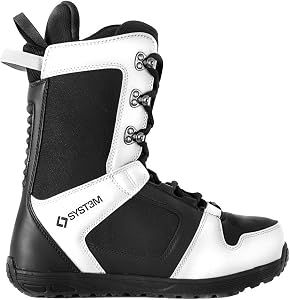
Closure Type: Traditional Lace-Up, Twist
Lining: Thermofit Heat Moldable
Outer Material: Polyurethane
Water Resistance: Water Resistant
The System APX takes a classic approach with traditional lacing, letting riders tighten each zone of the boot independently for a truly custom fit. Smoothed metal lace hooks keep tension locked in through a full day of riding while resisting the fraying that cheaper hardware suffers from. The Thermofit heat moldable liner conforms closely to the foot, eliminating pressure points that plague many stock liners.
Its low-profile design keeps the boot feeling nimble underfoot, appealing to riders who like precise board feel. Traditional laces do take longer to adjust than Boa or quick-pull systems, which may frustrate riders used to faster setups, but the payoff is a genuinely dialed, long-lasting fit.
Pros:
- Highly customizable zonal lacing
- Durable metal lace hooks
- Excellent heat-moldable comfort
Cons:
- Slower to lace up than Boa
5. DC Phase BOA Pro

Closure Type: Dual Boa with H4 Coiler
Outsole: Contact UniLite Rubber
Water Resistance: Waterproof
Flex Rating: 5/10
Building on the standard Phase Boa, the Phase BOA Pro adds an internal ankle harness controlled by a remote dial for added heel-hold and support. This makes it more capable across varied terrain while retaining the quick, precise adjustability of the H4 Coiler tongue dial. The Response Liner III offers upgraded cushioning and warmth compared to the base liner, and the molded IMPACT ALG insole adds noticeable shock absorption.
The slightly firmer 5/10 flex makes this boot more versatile than its sibling, capable of handling moderate all-mountain riding alongside park laps. The Contact UniLite rubber outsole grips well when walking between runs. Riders wanting a stiffer, more aggressive boot may still find it a touch soft for high-speed carving.
Pros:
- Added ankle support via internal harness
- Upgraded, cushioned Response Liner III
- Reliable waterproof protection
Cons:
- Still soft for high-speed carving
View Men’s at Amazon View Women’s at evo
6. Burton Highshot Step On X

Riding Style: All-mountain
Flex: Medium
Liner: Aysm Imprint 3 with DRYRIDE Heat Cycle
Closure System: Dual-Zone Dial Lace
The Burton Highshot Step On X pairs Burton’s Step On binding compatibility with a dual-zone Boa Fit System, giving riders instant board connection alongside a highly tunable fit. The custom moldable liner uses DRYRIDE Heat Cycle lining to actively manage moisture and warmth throughout the day, while the medium flex offers a responsive yet forgiving ride across most terrain types.
Stepping directly onto your bindings without buckling straps saves real time on the mountain, especially for riders who frequently unstrap on flats or lift lines. The dial lace closure keeps everything locked evenly. The main tradeoff is that Step On compatibility requires matching Burton bindings, limiting flexibility if you already own a different setup.
Pros:
- Fast, secure Step On connection
- Even dual-zone Boa fit
- Moisture-managing liner
Cons:
- Requires Step On compatible bindings
7. Burton Highshot Plus

Riding Style: All-mountain
Flex: Medium
Liner Material: 3M Thinsulate
Lacing System: Dial Lace
The Burton Highshot Plus brings the Step On connection system together with 3M Thinsulate insulation for a warm, powerful ride suited to full days on the mountain. The dual-zone Boa Fit System allows independent tightening of the ankle and lower boot, giving precise, wrap-around support, while the custom moldable liner adapts to the shape of your foot for a personalized fit over time.
This boot delivers strong energy transfer for carving and quick direction changes thanks to its medium-stiff feel, making it a favorite among riders who want power without harshness. The quick pull liner closure speeds up the process of getting boots on each morning. As with other Step On boots, you’ll need compatible Burton bindings to unlock the full benefit.
Pros:
- Warm Thinsulate insulation
- Responsive, powerful medium flex
- Fast quick-pull liner closure
Cons:
- Tied to Step On binding ecosystem
View Men’s at REI View Women’s at REI
8. Nidecker Altai

Riding Style: All-mountain
Flex: Medium
Upper: Polyurethane/TPU
Liner Material: PR foam
Designed for riders who love shaping precise turns, the Nidecker Altai offers a mid-stiff flex that responds quickly to input while remaining comfortable enough for all-day wear. The PR foam liner is thermoformable, molding closely to the foot for a snug, personalized fit, and the polyurethane/TPU upper adds durability without excess bulk or weight.
The dial lace system makes fine-tuning tension simple, letting riders lock in support exactly where it’s needed most for aggressive carving or quick edge transitions. This boot performs equally well cutting through groomers or navigating tighter tree runs. It lacks a walk mode, so off-snow comfort takes a slight hit compared to boots built for more casual use.
Pros:
- Precise, responsive mid-stiff flex
- Durable, lightweight upper
- Comfortable PR foam liner
Cons:
- No walk mode
View Men’s at REI View Women’s at REI
9. Burton Tourist

Riding Style: All-mountain
Flex: Medium
Liner Material: DRYRIDE Heat Cycle
Lacing System: Quick Pull
Built with backcountry and splitboard riders in mind, the Burton Tourist offers an extended range of motion that makes trail breaking and skinning noticeably more efficient. The custom moldable liner uses DRYRIDE Heat Cycle lining to regulate warmth and moisture on long approaches, while the quick pull lacing system allows for fast, hassle-free adjustments even with gloves on.
The medium flex balances the flexibility needed for touring with enough support for confident descents once you’ve reached the top. This versatility makes the Tourist a smart pick for riders who split their time between resort laps and backcountry missions. The lack of a dedicated walk mode is a slight oversight given its touring-oriented design.
Pros:
- Extended range of motion for touring
- Fast quick-pull lacing
- Balanced flex for uphill and down
Cons:
- No dedicated walk mode
10. Burton Limelight BOA – Women’s

Riding Style: All-mountain
Flex: Medium
Liner Material: 3M Thinsulate
Closure System: Boa Dial Lace
The Burton Limelight BOA is designed for riders who want comfortable, foot-hugging support right out of the box, making it a great fit for jibbing, buttering, and casual all-mountain days alike. The Boa Fit System evenly tightens the boot across the whole foot, eliminating pressure points, while the 3M Thinsulate insulation keeps toes warm through cold mountain mornings.
Its custom moldable liner breaks in quickly, adding to the boot’s reputation for immediate, all-day comfort without a lengthy adjustment period. The medium flex is playful enough for freestyle tricks yet stable enough for cruising groomers. Riders looking for a stiffer, more performance-driven boot for aggressive carving may find the flex a bit too relaxed.
Pros:
- Comfortable out-of-the-box fit
- Even, easy Boa adjustment
- Warm Thinsulate insulation
Cons:
- Too soft for aggressive carving
How to Choose Medium-Flex Snowboard Boots
Choosing the right snowboard boots can make or break your day on the mountain. Boots that are too stiff can feel unforgiving, while boots that are too soft may not give you enough support. Medium-flex snowboard boots sit right in the middle, offering a balance of comfort, control, and versatility. They work well for most riders and most terrain, which is why they are one of the most popular choices. This guide will walk you through everything you need to know to pick the perfect pair of medium-flex boots for your feet and your riding style.
What Does “Medium Flex” Mean?
Flex refers to how much a boot bends and resists movement. Boots are usually rated on a scale from 1 to 10, where 1 is very soft and 10 is very stiff. Medium-flex boots generally fall between 4 and 7 on this scale. This range gives you enough support for carving and responding quickly, but still allows some playfulness and comfort for freestyle riding and long days on the hill.
Why Medium Flex Works for Most Riders
Medium-flex boots are popular because they do not force you into one style of riding. They are forgiving enough for beginners who are still learning to control their edges, yet supportive enough for intermediate and advanced riders who want performance. If you ride a bit of everything—groomers, powder, park, and bumps—medium-flex boots are a safe and smart choice.
Key Factors to Consider When Choosing Medium-Flex Boots
Before you buy, think about the following factors. Each one affects how the boot feels and performs.
1. Fit and Comfort
Fit is the most important factor. A boot that does not fit well will never perform well, no matter how good the flex rating is. Here is what to check:
- Length: Your toes should lightly touch the front when you stand up straight, but pull back slightly when you bend your knees.
- Width: Your foot should not slide side to side. If you have wide feet, look for boots with a wide-specific fit.
- Heel hold: Your heel should stay locked down when you flex forward. If it lifts, the boot is too big or the wrong shape for your foot.
- Pressure points: Walk around in the boots for at least 10 to 15 minutes. Any sharp pressure means the boot is not right for you.
2. Lacing System
Medium-flex boots come with different lacing systems. Each has pros and cons:
| Lacing System | Pros | Cons |
|---|---|---|
| Traditional Laces | Cheap, easy to repair, reliable | Slower to tighten, no fine-tuning |
| Boa System | Fast, easy, even tightening | More expensive, harder to repair on the hill |
| Speed Lace | Quick, affordable, simple | Less precise fit than Boa |
Pick the system that matches your budget and how much convenience you want.
3. Liner Quality
The liner is the soft inner part of the boot that touches your foot and lower leg. A good liner improves comfort, warmth, and support. Look for liners that are:
- Heat-moldable, so they shape to your foot
- Made with moisture-wicking material
- Equipped with a secure heel hold system
- Removable for washing and drying
Some boots also have a separate tongue stiffener that lets you adjust the flex slightly.
4. Sole and Footbed
The sole affects grip, dampening, and how much feel you get from the board. Medium-flex boots usually have a rubber sole with moderate cushioning. A good footbed supports your arch and reduces fatigue. Many boots come with a basic footbed, but you can upgrade to a custom one for better comfort and support.
5. Boot Flex and Your Riding Style
Your riding style should guide your flex choice. Here is a simple guide:
| Riding Style | Recommended Flex | Why |
|---|---|---|
| Beginner / All-Mountain | 4–5 (Medium-Soft) | Forgiving, easy to learn on, comfortable |
| Intermediate / All-Mountain | 5–6 (Medium) | Balanced control and comfort |
| Advanced / Freestyle | 6–7 (Medium-Stiff) | More support for jumps, rails, and hard charging |
If you are unsure, a flex rating of 5 or 6 is a great starting point for most riders.
6. Size and Brand Differences
Snowboard boot sizes are not the same across all brands. Always try on boots from a few different brands, because each one uses a slightly different shape. If you cannot try them in person, order from a shop with a good return policy. Remember that boots pack out slightly after a few days of riding, so they should feel snug but not painful when new.
7. Budget
Medium-flex boots range from budget-friendly to high-end. Here is a rough idea:
- Budget: $150–$220 — Basic features, traditional laces, decent liner
- Mid-Range: $220–$350 — Better liners, Boa or speed laces, improved sole
- High-End: $350–$500+ — Top materials, heat-moldable liners, advanced lacing, best support
You do not need to spend the most to get a great boot. Focus on fit first, then features.
How to Test Medium-Flex Boots Before You Buy
When you try on boots, do these simple tests:
- Wear the socks you normally ride in.
- Stand and bend your knees forward. Check for heel lift.
- Walk around the shop for several minutes.
- Kick your toe into the ground gently to see if your toes slide forward.
- Flex the boot side to side to feel the stiffness.
If the boots pass these tests and feel comfortable, you are on the right track.
Common Mistakes to Avoid
- Buying too big: Boots should be snug, not roomy. A loose boot causes pain and poor control.
- Ignoring width: Narrow or wide feet need boots that match their shape.
- Choosing flex by looks: A cool-looking boot that is too stiff or too soft will not ride well.
- Skipping the liner check: A cheap liner can ruin an otherwise good boot.
- Not breaking them in: Give new boots a few days to mold to your feet.
Final Thoughts
Choosing medium-flex snowboard boots comes down to fit, flex, and features. Start with a boot that fits your foot shape perfectly. Then pick a flex rating that matches your riding style and ability. Look for a quality liner, a lacing system you like, and a sole that gives good grip and cushioning. Set a budget, but do not sacrifice fit for price. With the right medium-flex boots, you will enjoy better control, more comfort, and longer days on the mountain. Take your time, try on several pairs, and choose the boots that feel best for you.