Best Snowboard Boot Dryers of 2025
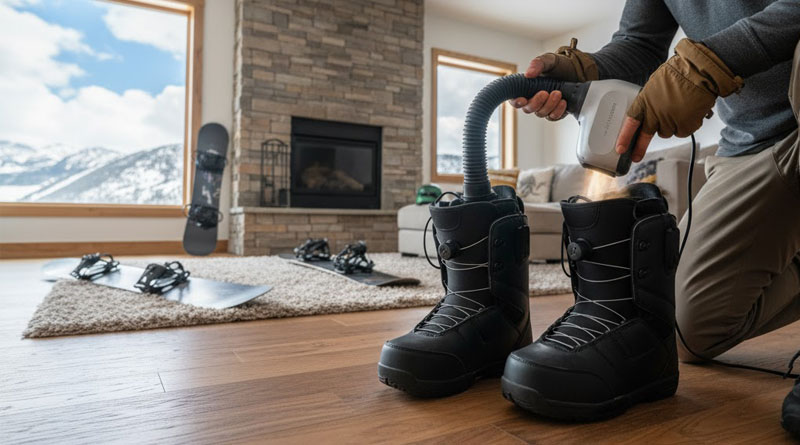
Keeping your snowboard boots dry is just as important as keeping them comfortable. Wet boots can make your feet cold, cause bad smells, and even damage the material over time. That’s where a good snowboard boot dryer comes in. These handy devices remove moisture quickly, helping your boots stay warm, fresh, and ready for your next ride. In this guide, we’ll look at the best snowboard boot dryers available, comparing their features, drying speed, and convenience to help you find the perfect one for your needs.
1. DryGuy Force DX Dry

- Material(s): ABS plastic
- Dimensions: 15 x 12.5 x 7.6 inches
- Weight: 6 pounds
- Heat & timer: Gentle forced air ~105°F, 3-hour timer
The DryGuy Force DX is a dependable workhorse for anyone who needs consistently dry footwear and gloves. It combines gentle forced air with warm heat (around 105°F) so liners and delicate materials aren’t warped or shrunk. In practice it dries most boots, shoes and gloves in about an hour, and the two removable extension tubes help when you’re working with taller ski or snowboard boots. The built quality and ABS plastic shell feel robust without being bulky, and the option to dry up to four garments at once is superb for couples or families.
Odor reduction is an understated advantage: by removing moisture quickly it helps reduce bacteria, fungus and mold that cause smells. Controls are simple — a 3-hour timer and a heat switch give easy customization without fiddly settings. If you own multiple pairs of winter footwear or often return from wet hikes and snow days, the Force DX gets gear ready fast and safely. It’s a pragmatic choice: practical sizing, sensible heat level for liners, and solid drying speed.
Pros: Fast drying, gentle heat, dries multiple items, odor reduction.
Cons: Basic aesthetics, no digital timer, slightly bulky for travel.
2. SOTHING Portable Ski Boot Dryer

- Heat levels: 3 settings (113°F–149°F)
- Timer: LED touch panel, 1–9 hour timer
- Ozone: One-touch ozone function for odor control
- Safety: Heat-resistant housing, PTC control, thermal fuse
The SOTHING Portable Ski Boot Dryer feels modern and thoughtful: an LED touch panel and a wide 1–9 hour timer make scheduling effortless, while three heat levels let you choose gentle care for liners or a more aggressive dry for heavily soaked ski boots. The ozone feature is handy when odor is stubborn — one tap and the unit works to freshen gear. Build quality and safety features stand out: heat-resistant housing plus PTC control and a thermal fuse give confidence during longer cycles.
Performance wise it handles boots, gloves and socks quickly thanks to the upper-range heat (up to 149°F) while still offering lower temps for delicate fabrics. The portability makes it a good travel companion for ski trips, and the digital controls are intuitive even with gloves on. If you want a compact, tech-forward dryer with strong safety layers and effective odor control, SOTHING strikes a good balance between power and convenience without being overcomplicated.
Pros: Powerful heat range, digital timer, ozone odor control, strong safety features.
Cons: Higher heat may be unnecessary for delicate liners, may need careful placement in small gear rooms.
See the SOTHING Portable Ski Boot Dryer
3. Therm-ic Boot and Glove Dryer
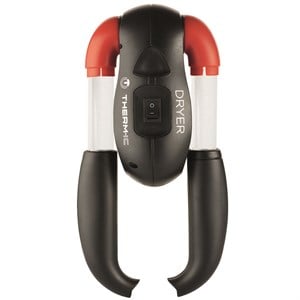
- Portability: Compact for travel
- Power: Dries soaked boots/gloves within a few hours
- Noise: Compact & silent operation
- Fit: Adjustable length to fit all sizes
The Therm-ic Boot and Glove Dryer excels where portability meets real drying performance. It’s compact enough to slip into luggage for overseas ski trips yet effective enough to handle soaked boots or gloves in just a few hours. The silent operation is a standout — no noisy fans or rattles, which makes it ideal for hotel rooms or shared accommodations. Adjustable-length tubes mean it adapts to short trainers or tall liners without awkward angling.
For travellers and weekend warriors who want a no-nonsense, space-saving dryer that still performs, Therm-ic makes sense. It won’t replace larger forced-air systems for drying multiple pairs at once, but its combination of size, silence, and drying power is perfect for one- or two-person trips. Simple, reliable, and built to travel — it’s the dryer you pack when you need gear ready after long days on the mountain.
Pros: Highly portable, silent, effective drying, adjustable fit.
Cons: Not ideal for drying many pairs at once, no advanced controls.
See the Therm-ic Boot and Glove Dryer
4. Everlasting Comfort Boot Dryer

- Capacity: Dries two pairs at once
- Ozone sanitize: Ozone switch for deodorizing
- Timer: Up to 180 minutes adjustable
- Material safety: Gentle warm air safe for many materials
Everlasting Comfort’s Boot Dryer leans into family-friendly practicality: it dries two pairs simultaneously with strong heated airflow while protecting materials from overheating. The ozone sanitizing option is effective for tackling persistent smells left by sweat and dampness, and the generous timer (up to 180 minutes) lets you tailor cycles for light dampness or heavy saturation. Built for heavy everyday use, the unit feels durable and straightforward to operate.
This dryer works well across a wide range of footwear — from neoprene and synthetics to leather — thanks to a gentle warm-air approach that avoids cracking or warping. For households with multiple users or people coming in with wet work or sports shoes, it speeds turnaround and reduces laundry loads. It’s not the smallest travel solution, but for home use it’s reliable, efficient, and thoughtfully designed for regular winter use.
Pros: Dries multiple items fast, ozone deodorizing, long timer, material-safe heat.
Cons: Bulky for travel, ozone function may be unnecessary for light use.
See the Everlasting Comfort Boot Dryer
5. XCMAN Portable Shoe Dryer
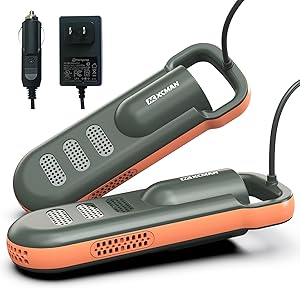
- Temperature range: 105–140°F (up to 145°F peak)
- Dimensions: 9.8 x 4.5 x 2.9 inches
- Power options: 100–240V AC or 12V car adapter
- Noise: Super quiet operation
The XCMAN Portable Shoe Dryer is built for motion: compact, quiet, and versatile enough to run from a standard outlet or a 12V car cigarette lighter. That dual-power capability makes it a smart companion for road trips, camping, and ski travel where you want footwear dried on the go. The convection-style warming rises naturally, drying without aggressive forced air that could overheat liners.
Practical features like a compact footprint and near-silent operation mean you can run it overnight without disturbance. The heating range—up to about 145°F in some conditions—provides enough punch for thicker boots while retaining safety for common materials. If you need a travel-ready dryer that won’t hog space and can be powered from a vehicle, XCMAN strikes a useful balance between performance and portability.
Pros: Travel-friendly dual power, quiet, compact, effective heat range.
Cons: Smaller capacity (best for single pair), may be slower than larger forced-air units.
See the XCMAN Portable Shoe Dryer
6. PEET Original Dryer
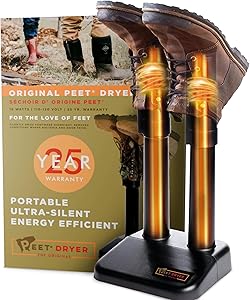
- Design age: Patented 1968 convection design
- Usage: Dries most footwear overnight
- Energy use: Uses less power than a standard light bulb
- Warranty: 25-year warranty with registration
The PEET Original Dryer is a classic for a reason: simple, silent convection heating that gently warms and dries footwear without fans or moving parts. Energy-efficient enough to be left plugged in overnight, PEET is safe on a wide range of materials including leather, neoprene, and synthetics. The long-standing design and UL/CSA safety listings make it a reliable, low-maintenance option for runners, hikers, and winter-sports enthusiasts alike.
It’s not the fastest at blasting out heavy saturation, but for consistent overnight drying and ongoing odor prevention it shines. The low power draw and durable construction mean it’s a set-and-forget solution for boots, cycling shoes, or casual sneakers. If you value longevity, quiet operation, and a tried-and-true approach over flashy features, the PEET Original remains an extremely practical choice.
Pros: Silent convection, energy-efficient, safe for many materials, long warranty.
Cons: Slower for soaking-wet boots, no digital timer or ozone function.
7. JobSite Boot Dryer

- Dry times: Warm-up 30 min; damp 8 hrs; wet 12 hrs
- Operation: Fanless thermal convection, zero noise
- Power: 36 Watts energy-efficient heating
- Warranty: 2-year warranty
JobSite’s Boot Dryer is designed for heavy-duty, everyday practicality. Using fanless thermal convection it warms and dries without moving parts, keeping operation whisper-quiet while avoiding over-drying that can damage materials. The stated warm-up and dry times give clear expectations: light dampness clears in hours while fully soaked boots need overnight or longer. It’s particularly well-suited for work boots, kids’ footwear, and winter liners that return home frequently wet.
The unit’s energy efficiency and simple, silent design make it ideal for garages and mudrooms where you want a reliable overnight dry without distraction. Built by a small Michigan-based business, JobSite emphasizes toughness and real-world durability. If you prefer a simple, dependable dryer that’s quiet and low-maintenance, JobSite offers a steady, no-frills solution.
Pros: Silent fanless operation, energy-efficient, reliable, good warranty.
Cons: Slower on very wet boots, larger items may require longer cycles.
8. DryGuy Two-Pair Boot Dryer

- Drying method: Forced air + convection heat
- Capacity: Up to two pairs (four ports)
- Noise: Whisper-quiet fan operation
- Extras: Citrus scent pods included, 3-hour auto shutoff
The DryGuy Two-Pair Boot Dryer is a compact, efficient solution for households that need a reliable overnight turnaround. Combining forced air with convection heat shortens dry times (often 2–6 hours depending on saturation) while the whisper-quiet fan keeps it suitable for bedrooms and lodges. The citrus-infused scent pods are a small but welcome touch for keeping boots smelling fresh between washes.
With a simple on/off dial and a 3-hour automatic shutoff, it’s easy to use and low-fuss. The compact footprint makes it easy to store in mudrooms or bring to a small ski condo. It won’t match the capacity of larger commercial dryers, but for a couple or small family who need quick, quiet drying, this unit is balanced, effective, and thoughtfully designed.
Pros: Quiet, compact, citrus scent option, efficient drying.
Cons: Limited to two pairs, basic controls only.
See the DryGuy Two-Pair Boot Dryer
9. Snowpea Shoe Dryer

- Temperature: Hot air up to ~149°F
- Timer: 3 / 6 / 9 hour auto shutoff
- Portability: Compact 6.6 x 4.3 x 2.4 inches
- Power: 110–120V, 100W with 5.3 ft cable
Snowpea’s Hot Air Shoe Dryer is a compact, straightforward dryer aimed at travelers and home users who want a simple timer-based solution. Its extendable pipes (up to 7.87 inches) adapt to different shoe sizes and glove depths, while the timer options (3, 6, 9 hours) make it easy to select the right cycle for material and saturation. The unit heats up to around 149°F which gives it solid drying power for thicker winter items.
It’s particularly suited for single-pair use on trips or in smaller homes. Users should note a faint plastic smell on first runs that typically dissipates quickly. Overall, Snowpea provides a compact, effective and affordable way to warm and dry footwear without complicated controls — perfect for ski trips, hiking weekends, or everyday damp conditions.
Pros: Compact, decent heat, useful timer options, extendable tubes.
Cons: Possible initial plastic smell, single-pair capacity.
10. POPCHOSE Heavy-Duty Boot Dryer
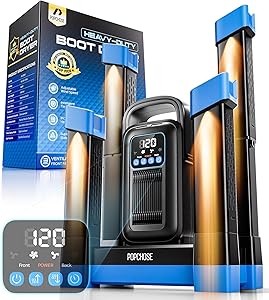
- Power: 800W heating, up to 140°F airflow
- Design: Retractable duct with 4 extendable tubes
- Features: Negative ion generator for odor control
- Controls: Digital display for wind speed & timing (0–180 min)
POPCHOSE’s Heavy-Duty Boot Dryer is built for serious wet-weather use. With an 800W heater and a digital display that controls wind speed and timing up to 180 minutes, it delivers powerful, customizable drying for two pairs at once. The retractable ducts and extendable tubes make it flexible enough for tall ski boots or bulky mountaineering footwear, while whisper-quiet operation keeps it suitable for home use.
The added negative ion generator aims to reduce odors beyond simple moisture removal, which can be useful after long days on snow or mud. Safety features like overheat protection and the option to fine-tune wind speed mean you can match the cycle to delicate liners or heavy leather. If you want a robust, feature-rich dryer that handles tough conditions and larger boots, POPCHOSE offers one of the more powerful home solutions.
Pros: Very powerful, customizable, retractable ducts, odor control.
Cons: Larger and heavier, more complex controls may be overkill for casual users.
See the POPCHOSE Heavy-Duty Boot Dryer
How to Choose Snowboard Boot Dryers
Choosing the right snowboard boot dryer makes winter mornings less miserable and extends the life of your boots and liners. Wet, cold gear not only smells bad but also accelerates material breakdown, reduces insulation performance, and makes for an uncomfortable day on the mountain. This guide walks through the practical factors to consider—capacity, drying method, temperature control, safety features, portability, and maintenance—so you can match a dryer to your riding habits and household needs.
Why a boot dryer matters for snowboarders
Snowboard boots trap moisture from sweat, snow melt, and extended use. Left damp, fibers compress, foam degrades, and bacteria and mold proliferate. A purpose-built boot dryer removes moisture gently and evenly, preventing warping and preserving fit. Beyond preservation, a timely dry means warmer feet and better comfort when you lace in the next day. For frequent riders, a dryer is an investment that saves money by prolonging boot life and reducing the need for extra liners or replacements.
Types of drying systems
Convection (fanless) dryers
Convection dryers warm air and rely on gentle natural airflow to lift moisture out of footwear. They are usually quiet, energy-efficient, and safe for delicate materials since they avoid high, focused heat. Best for overnight drying and regular use. They are slower than forced-air models but are very low-maintenance and suited for leather and sensitive liners.
Forced-air dryers
Forced-air dryers use a fan to push warm air through hoses into the boots. They dry faster and can handle heavier saturation, making them ideal for households with multiple riders or for commercial environments. Because they move more air, they are better at reaching deep into liners and crevices. Look for models with adjustable fan speed so you can dial down intensity for delicate materials.
Ozone and ionizers
Some dryers add ozone or negative-ion generators to reduce odors and kill microbes. These features can be helpful for very smelly or frequently used gear, but ozone units should be used cautiously and in well-ventilated spaces—follow manufacturer instructions. Ionizers are generally safe and add deodorizing benefits without strong chemical smells.
Key specifications to check
- Capacity: How many pairs or items can it dry at once? If you share gear or have family members, choose a two-pair or larger model.
- Temperature range and control: Adjustable heat lets you match dryer settings to liners, leather, and synthetic materials. Look for gentle modes for delicate liners and higher settings for heavy, soaked boots.
- Timer and automation: Automatic shutoff timers and programmable cycles protect gear from overdrying and save energy.
- Noise level: Fan-based units vary. If you run a dryer in a bedroom or condo, look for whisper-quiet fans or fanless convection models.
- Power options: If you travel by car or RV, dual-power or 12V compatibility is useful. For international travel, check voltage compatibility and adapters.
Material compatibility and heat safety
Snowboard boot materials range from leather and thermoformable liners to neoprene and synthetic fabrics. High heat can warp or shrink liners and stiffen adhesives. The safest route is a dryer with multiple heat settings and a maximum temperature that stays below levels known to damage foams and glues (many consumer models sit around 100–149°F / 38–65°C). If you have heat-moldable liners, follow boot manufacturer guidance—some liners should be dried at lower temperatures or air-dried.
Practical features that matter
- Extension tubes or removable probes for tall boots and liners.
- Multiple ports so you can dry boots and gloves or two pairs at once.
- Compactness and storage design—collapsible or retractable tubes save space.
- Controls that are easy to use with gloves or when groggy in the morning: tactile dials, large buttons, or simple touch panels.
- Extras like scent pods or replaceable filters for odor control and freshness.
Portability and travel considerations
If you regularly travel to resorts, consider the dryer’s weight, folded size, and power flexibility. Small tube-style or compact convection units fit in luggage and some offer car-power operation. Larger forced-air units are more effective but bulkier—best left at home or in a shared condo. For frequent flyers, a compact, silent dryer that doubles as a glove/sock warmer is often the most practical choice.
Energy use and environmental concerns
Dryers range from extremely low-wattage fanless models (comparable to a light bulb) to powerful 800W commercial-style machines. If you run the dryer nightly, consider an energy-efficient model or one with a programmable timer to minimize wasted power. Also, frequently laundering liners to remove bacteria consumes water and energy; a dryer that reduces odor and bacterial growth can lower laundry frequency and overall environmental impact.
Maintenance and durability
Choose a dryer built from durable materials and with accessible parts for cleaning. Fan filters should be easy to remove and clean to maintain airflow. Inspect hoses and probes for cracks or clogs, and avoid models with delicate plastic parts if you plan heavy outdoor use. Warranty length and brand reputation are useful proxies for longevity—longer warranties often reflect confidence in build quality.
Budget and value
Price varies widely. Entry-level convection units are inexpensive, quiet, and energy-efficient but slower. Mid-range forced-air units cost more but dry faster and handle multiple users. High-end models add features like precise digital controls, negative-ion generators, and stronger heaters. Match your choice to how often you ride, the number of users, and whether you need portability. For occasional riders, a simple convection system is sufficient. For daily or family use, invest in a larger forced-air or feature-rich dryer.
Common mistakes to avoid
- Using the highest heat setting by default—this can damage liners and adhesives.
- Buying the smallest unit when you need to dry multiple pairs—resulting in wasted time and frustration.
- Ignoring safety certifications—look for UL, CSA, or equivalent safety markings.
- Neglecting ventilation for ozone-equipped units—read instructions carefully.
Final checklist
Before you buy, run through this checklist: how many pairs do you need to dry, are you likely to travel with the dryer, what materials are your boots made from, do you want odor control, and how much drying speed do you need? Also confirm voltage compatibility for travel and inspect warranty terms. A little preparation leads to a dryer that fits your routine and keeps your gear performing season after season.
Short FAQs
How long should I run a boot dryer?
Drying time depends on saturation and dryer type. Fanless convection units often work overnight (6–12 hours), while forced-air units can finish in 1–4 hours. Use timers and lower heat for delicate liners.
Can boot dryers damage heat-moldable liners?
Some heat-moldable liners are sensitive to excessive heat. Always follow boot-maker instructions. Use lower heat settings and shorter cycles if unsure.
Conclusion
Choosing the right snowboard boot dryer is about balancing capacity, drying speed, material safety, and portability. For most riders, a mid-range forced-air dryer with adjustable heat and a timer gives the best mix of speed and safety. For travelers or riders with a single pair, a compact convection or tube-style dryer is often the smartest pick. Match features to your routine, prioritize safety certifications, and you’ll end each day with dry, warm boots ready for the mountain.