Best Downhill Ski Boots of 2026
Finding the best downhill ski boots can make or break your time on the slopes. The right pair gives you comfort, control, and confidence, whether you’re carving fast turns or cruising at a steady pace. With so many options out there, it can feel overwhelming to choose the right fit. That’s why we’ve put together this guide to highlight the top ski boots for different needs and skill levels. From beginners to advanced skiers, these boots will help you enjoy every run.
1. K2 BFC 100 BOA

- Skill Level: Intermediate
- Flex Index: 100 (Medium)
- Last Width: 103 mm
- Sole Type: GripWalk (ISO 23223)
The K2 BFC 100 BOA delivers exceptional comfort right out of the box without compromising performance on the slopes. Engineered specifically for intermediate skiers seeking a wider, roomier fit, these downhill boots feature a generous 103 mm last. The addition of the BOA Fit System provides precise, micro-adjustable wrapping around the foot for superior foothold and custom support all day long.
Beyond fit adjustment, these boots come equipped with a thermoformable foam liner, cuff adjustment, and walk mode for easy trekking off the slopes. With a balanced medium flex index of 100 and two sturdy buckles, they offer ideal control for cruising groomers while keeping feet relaxed and warm from the first chair to the last.
Pros:
- Roomy 103 mm last offers maximum comfort for wider feet
- BOA Fit System enables quick and precise micro-adjustments
Cons:
- Medium 100 flex may feel too soft for aggressive expert skiers
- Fewer traditional buckles might not suit classic fit preferences
See the K2 BFC 100 BOA See the Women’s BFC 95 BOA
2. Tecnica Cochise HV 120

- Skill Level: Advanced
- Flex Index: 120 (Stiff)
- Last Width: 102 mm
- Sole Type: GripWalk with Tech Inserts
Designed for advanced male skiers, the Tecnica Cochise HV 120 unlocks aggressive terrain without sacrificing downhill drive. These boots seamlessly transition from tough uphill climbs to powerful descents thanks to an integrated walk mode and Tech Inserts. The high-volume 102 mm last ensures ample space and comfort for larger feet during intense mountain excursions.
Featuring a stiff 120 flex index, four reliable buckles, and a performance C.A.S. custom moldable liner with a floating tongue, this boot yields direct power transmission and customizable support. GripWalk soles provide confident traction on slick surfaces, making it a complete freeride tool for adventurous skiers.
Pros:
- Tech inserts and walk mode allow versatile hybrid backcountry touring
- Stiff 120 flex offers exceptional responsiveness and downhill power
Cons:
- High-volume fit may feel too loose for skiers with narrow feet
- Stiff flex requires strong technique and aggressive input
See the Tecnica Cochise HV 120
3. Rossignol Alltrack 80 W BOA GW

- Skill Level: Intermediate
- Flex Index: 80 (Medium)
- Last Width: 102 mm
- Sole Type: GripWalk (ISO 23223)
The women’s Rossignol Alltrack 80 W BOA GW is built to bring all-mountain performance and lasting comfort to varied winter terrain. Tailored for intermediate skiers, these boots feature innovative STEP IN technology alongside a micro-adjustable BOA dial, ensuring easy entry and an evenly distributed wrap around the foot for immediate morning readiness.
With a medium 80 flex rating and a forgiving 102 mm last width, they strike a fine balance between control and comfort. Features like an insulated thermoformable liner, walk mode, canting, cuff adjustments, and four buckles make this GripWalk-equipped boot a versatile option for all-day resort adventures.
Pros:
- Easy STEP IN technology and BOA system simplify boot entry and tightening
- Insulated thermoformable liner keeps feet warm and comfortably molded
Cons:
- Soft 80 flex may lack stiffness for advanced or heavy skiers
- 102 mm width might be too wide for narrow foot shapes
See the Rossignol Alltrack 80 W BOA GW
4. K2 Mindbender 120 BOA

- Skill Level: Advanced
- Flex Index: 120 (Stiff)
- Last Width: 100 mm
- Sole Type: GripWalk with Tech Inserts
K2 Mindbender 120 BOA boots combine lightweight touring capabilities with powerful alpine performance for high-level skiing. Built for advanced male skiers who split time between resort boundaries and backcountry lines, these boots feature a sleek 100 mm last and a responsive 120 flex index to tackle challenging downhill snow conditions confidently.
The BOA Fit System provides micro-adjustability to hold your foot firmly without creating unwanted pressure points. Equipped with an Ultralon heat-moldable liner, integrated walk mode, two sturdy buckles, and GripWalk soles with pin tech inserts, this setup guarantees precise energy transfer during climbs and descents alike.
Pros:
- Tech inserts and walk mode deliver smooth touring performance
- BOA system combined with a 100 mm last ensures a secure fit
Cons:
- Stiff flex can be overly demanding for casual intermediate skiers
- Two-buckle design differs from traditional four-buckle preference
5. Salomon S/PRO Supra Dual BOA

- Skill Level: Advanced
- Flex Index: 120 (Stiff)
- Last Width: 100 mm
- Sole Type: GripWalk (ISO 23223)
The Salomon S/PRO Supra Dual BOA redefines precision for advanced male skiers who demand total downhill control. Featuring a dual BOA dial setup, these boots do away with traditional buckles entirely to achieve optimal foothold, eliminating pressure points while wrapping the foot evenly across a performance-oriented 100 mm last width.
Engineered strictly for alpine riding, they feature a stiff 120 flex index paired with an S/Pro CF Expert liner and Custom Tongue 2 for direct edge response. Complete with standard GripWalk soles for walking traction, this boot is built for high-speed charging on technical resort runs.
Pros:
- Dual BOA dials offer unrivaled, uniform foot wrapping and precision
- Stiff 120 flex provides immediate edge control for fast skiing
Cons:
- Lacks a walk mode, limiting touring capabilities off-piste
- Zero-buckle layout takes time for traditional skiers to adapt to
See the Salomon S/PRO Supra Dual BOA
6. Atomic Nexus 110 BOA

- Skill Level: Intermediate
- Flex Index: 110 (Medium)
- Last Width: 101 mm
- Sole Type: GripWalk (ISO 23223)
Blending user-friendly features with dynamic performance, the Atomic Nexus 110 BOA caters directly to intermediate male skiers. These boots stand out due to NexStep Construction, which opens wide to allow hassle-free entry and exit, making boot-fitting frustration a thing of the past before heading onto the snow.
A responsive 110 flex index offers a great balance of comfort and energy transfer for evolving technique. Outfitted with a 101 mm medium-width last, a custom moldable Mimic Silver liner, one primary buckle, a BOA dial, and GripWalk soles, this model provides comfortable, all-day resort performance.
Pros:
- NexStep Construction makes stepping into and out of boots effortless
- Mimic Silver custom liner provides tailored anatomical foot support
Cons:
- Single buckle setup provides fewer traditional adjustment points
- Does not feature a walk mode for hiking or touring support
7. Tecnica Mach1 MV 120

- Skill Level: Advanced
- Flex Index: 120 (Stiff)
- Last Width: 100 mm
- Sole Type: GripWalk (ISO 23223)
Crafted specifically for expert skiers, the Tecnica Mach1 MV 120 offers a modernized medium-volume fit for maximum downhill precision. At its core is the T-Drive 2.0 system, which ensures a smooth, progressive flex while simultaneously making entry and exit vastly easier compared to standard stiff alpine shells.
Featuring a true 120 flex index and a mid-width 100 mm last, this boot transfers energy directly to your edges. Four micro-adjustable buckles, cant adjustment, GripWalk soles, and a premium Performance C.A.S. moldable liner with Celliant work together to deliver custom comfort and elite control on hardpack.
Pros:
- T-Drive 2.0 system enhances flex consistency and power transmission
- Highly customizable C.A.S. liner ensures a anatomical fit
Cons:
- No walk mode included, making long hikes less comfortable
- Demanding 120 flex can feel punishing for lower-level skiers
See the Tecnica Mach1 MV 120 See the Women’s Mach1 MV 105
8. Nordica Sportmachine 3 100

- Skill Level: Intermediate
- Flex Index: 100 (Medium)
- Last Width: 102 mm
- Sole Type: GripWalk (ISO 23223)
The Nordica Sportmachine 3 100 is tailored for intermediate male skiers who prioritize wide-foot comfort and reliable performance. Featuring a spacious 102 mm last, these boots accommodate higher-volume feet, reducing pinch points while maintaining solid ski response across groomed slopes and varied conditions.
A manageable 100 flex rating grants a forgiving feel that encourages skill progression without feeling harsh. Outfitted with a warm Precision Fit PrimaLoft custom moldable liner, canting and cuff adjustments, two sturdy buckles, and GripWalk soles, this boot guarantees all-day comfort across the entire mountain.
Pros:
- Spacious 102 mm last width provides comfort for wider feet
- PrimaLoft insulation keeps toes warm in freezing temperatures
Cons:
- Flex index of 100 lacks stiffness needed for high-speed charging
- Does not feature an integrated hike or walk mode mechanism
See the Nordica Sportmachine 3 100 See the Women’s Sportmachine 3 85
How to Choose Downhill Ski Boots
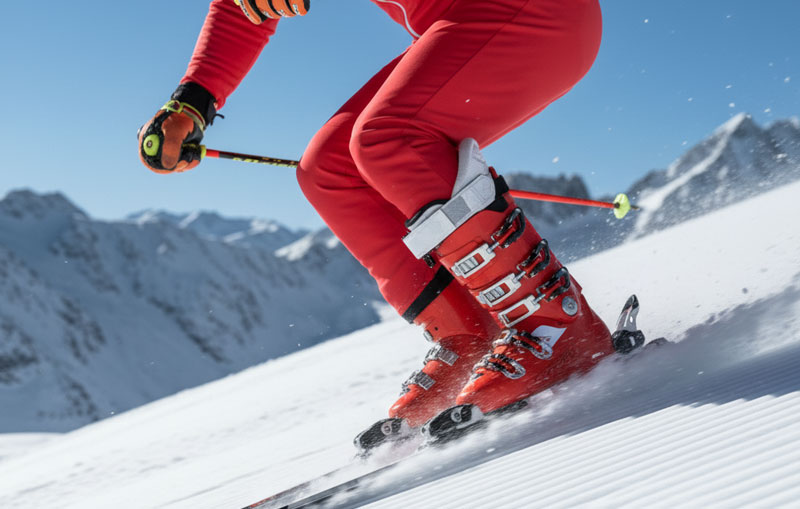
Choosing the right downhill ski boots is one of the most critical decisions a skier can make. Unlike skis, which can be rented or borrowed with relative ease, ski boots are a highly personal piece of equipment. A well-fitting boot provides the necessary control, comfort, and performance for an enjoyable day on the slopes, while a poorly-fitting one can lead to pain, blisters, and a miserable experience. This article will guide you through the process of selecting the perfect pair of downhill ski boots, covering everything from fit and flex to key features and common mistakes to avoid. 🎿
The Importance of a Proper Fit
Fit is everything when it comes to ski boots. It’s the single most important factor that determines your comfort and your ability to control your skis. A good fit ensures a direct connection between your leg and the ski, allowing for precise turns and effortless maneuverability. A boot that is too loose will cause your foot to slide around, leading to a loss of control and potential blisters. A boot that is too tight can cause a range of problems, from numb toes to sharp, localized pain. The goal is a snug, but not constricting, fit that holds your foot and ankle firmly in place without cutting off circulation.
Shell Fit: The First Step
The first step in finding the right fit is to determine your shell size. This is the size of the plastic outer boot before the liner is inserted. To check for shell fit, remove the liner from the boot and slide your foot into the empty shell. Push your toes forward until they touch the front of the boot. You should be able to fit one or two fingers (about 1.5-2 cm) between your heel and the back of the shell. This gap indicates the boot is the correct length. If you can fit more than two fingers, the boot is likely too big. If you can’t fit a finger at all, it’s too small. This initial check is crucial as it ensures the basic length is correct before you get into the finer details of the fit.
Understanding Flex and Stiffness
The flex of a ski boot refers to its forward stiffness. The flex index is a numerical rating that indicates how much resistance the boot offers when you bend your ankle forward. The higher the number, the stiffer the boot. Choosing the right flex is essential for performance and comfort, and it’s primarily determined by your skill level, weight, and skiing style.
Flex Ratings and Skier Type
- Beginner and Intermediate Skiers (Flex 60-90): These skiers generally benefit from a softer flex. A softer boot is more forgiving and easier to flex, which is ideal for learning proper technique and for a less aggressive, more comfortable skiing style.
- Advanced Skiers (Flex 90-120): Advanced skiers need a stiffer boot to transfer power efficiently from their legs to their skis. A stiffer boot provides more responsiveness and control, which is essential for skiing at higher speeds and on challenging terrain.
- Expert and Professional Skiers (Flex 120+): The stiffest boots are reserved for expert skiers, racers, and those who demand the highest level of performance. These boots offer maximum power transmission and control but are less forgiving and can be uncomfortable for prolonged use.
It’s also important to consider your weight. A heavier skier will need a stiffer boot to get the same level of support as a lighter skier. Similarly, a more aggressive skiing style that involves a lot of forward pressure on the shins will require a stiffer boot to prevent over-flexing.
Key Features to Consider
Beyond fit and flex, modern ski boots come with a range of features that can enhance your comfort and performance. Understanding these features will help you narrow down your options.
Liner and Customization
The liner is the soft, inner part of the boot. Most modern boots come with heat-moldable liners. When heated, these liners conform to the shape of your foot, creating a custom fit. This process, often done by a professional boot fitter, can significantly improve comfort and performance. It’s a key feature to look for, as it can solve minor fit issues and provide a truly personalized feel. Some boots even have customizable shells that can be heat-molded or stretched in specific areas to alleviate pressure points.
Last Width
The ‘last’ is the width of the boot at its widest point, usually across the forefoot. Ski boot lasts typically range from narrow (around 97 mm) to wide (over 102 mm). The right last width depends on the shape of your foot. If you have a narrow foot, a narrow last will provide a better fit and more control. If you have a wide foot, a wider last will be more comfortable and prevent cramping. Trying on different boots with varying last widths is the best way to determine what works for you.
Walk Mode and Grip Soles
Many all-mountain and touring boots feature a “walk mode.” This is a lever on the back of the boot that unlocks the cuff, allowing for a greater range of motion and making walking to and from the lifts much easier. If you plan to do any hiking, backcountry skiing, or just want more comfort while walking around the resort, a boot with a walk mode is a great choice. Additionally, many boots now come with grip soles, which provide better traction on slippery surfaces than traditional flat soles.
The Ski Boot Fitting Process: A Practical Guide
To ensure you get the best fit, it’s highly recommended to visit a professional ski boot fitter. Here’s a step-by-step guide to what that process looks like:
- Consultation: The boot fitter will ask you about your skiing ability, style, and any past fit issues. They’ll also measure your feet, checking for length, width, and arch shape.
- Shell Check: As mentioned earlier, the fitter will perform a shell fit to ensure the boot is the correct length for your foot.
- Initial Try-On: You’ll try on the boot with the liner and buckle it up. The fitter will check for pressure points and areas where the fit is not ideal.
- Customization: If needed, the fitter will perform heat molding on the liner or shell to achieve a custom fit. This is often the most important part of the process.
- Stance and Alignment: A good boot fitter will also check your stance and alignment, making sure your boots are set up correctly to match the natural angle of your legs and feet. This can be critical for performance and injury prevention.
Be patient during this process. A proper boot fitting can take a significant amount of time, but the investment is well worth it for the comfort and performance you’ll gain on the mountain. Remember, a boot may feel tight at first, but it should never be painful. The “comfortably snug” feeling is what you’re looking for. By following these guidelines and working with a professional, you’ll be well on your way to finding the perfect pair of downhill ski boots for a season of comfortable and confident skiing. ⛷️