Best Backcountry Ski Poles of 2026
When heading into the backcountry, the right gear makes all the difference, and ski poles are no exception. Backcountry ski poles are built to handle steep climbs, deep snow, and changing conditions, offering more than just balance. They give you stability on tough terrain, help with uphill travel, and support you on tricky descents. With so many options available, choosing the right poles can feel overwhelming. This guide highlights the best backcountry ski poles to keep you confident, comfortable, and ready for every adventure.
1. Black Diamond Traverse Pro

- Basket Type: Powder
- Shaft Construction: 7075 aluminum
- Weight (Pair): 9.8 oz. (90-140 cm); 10.6 oz. (105-155 cm)
- Adjustable: Yes, FlickLock Pro
The Black Diamond Traverse Pro is a completely redesigned touring pole that blends on-the-fly adjustability with a feature-rich build. The FlickLock Pro mechanisms are reliable and easy to operate with gloves, while the extended sticky rubber grips offer multiple hand positions for sidehilling or skinning. The 7075 aluminum shafts keep the poles light enough for long days yet durable enough for rocky descents.
With powder baskets and a unisex fit, these poles suit a wide range of backcountry skiers. The two length options cover most riders, and the collapsed size is reasonable for strapping to a pack. The Traverse Pro is a solid choice for those wanting a modern, adjustable pole without stepping up to carbon.
- Pros: Reliable FlickLock Pro, extended rubber grips, lightweight, durable aluminum
- Cons: Heavier than carbon options, not the most compact when collapsed
2. Leki Helicon Lite

- Basket Type: Powder
- Shaft Construction: Aluminum (HTS 6.5)
- Weight (Pair): 1 lb. 2.2 oz.
- Adjustable: Yes
The Leki Helicon Lite is a dependable, no-nonsense backcountry pole built from high-strength HTS 6.5 aluminum. It adjusts from 110 cm to 145 cm, making it suitable for most adults, and the powder baskets provide flotation in deep snow. The unisex design and simple locking system keep things straightforward for skiers who want reliable performance without extra complexity.
At just over a pound per pair, the Helicon Lite is reasonably light for an aluminum pole. The build quality feels solid, and the grip is comfortable for long tours. However, it lacks the extended foam grips and premium locking mechanisms found on some competitors, so it is best for those seeking a basic, durable touring pole.
- Pros: Durable aluminum, good length range, comfortable grip, affordable
- Cons: No extended grip, basic locking mechanism, heavier than carbon
3. MSR DynaLock

- Shaft Construction: 6061 aluminum
- Grip Material: Rubber
- Locking Mechanism: External Lever Lock
- Adjustable: Yes
The MSR DynaLock Trail Backcountry poles are designed for snowshoers, winter hikers and skiers who value simplicity and comfort. The 2-section 6061 aluminum construction is built for maximum durability, and the external lever locks are easy to use with gloves. They collapse to 31.5 inches and extend up to 55 inches, covering a wide range of heights and uses.
With both powder and trekking baskets included, these poles transition easily between deep snow and packed trails. The rubber grips are comfortable, though they lack the extended foam found on dedicated ski touring poles. For a versatile, rugged pole at a reasonable price, the DynaLock is a strong performer.
- Pros: Very durable, simple lever locks, interchangeable baskets, good value
- Cons: Heavier than ski-specific poles, rubber grip not ideal for skinning, not the most compact
4. Black Diamond Expedition

- Basket Type: Powder
- Shaft Construction: Aluminum
- Weight (Pair): 1 lb. 2.6 oz. (100-140 cm); 1 lb. 2.8 oz. (110-155 cm)
- Adjustable: Yes
The Black Diamond Expedition is a classic backcountry daily driver. These 2-piece adjustable poles are lightweight, durable and built for mountain missions. The aluminum shafts handle abuse well, and the powder baskets provide good flotation. Two length ranges are available, covering most skiers and splitboarders.
The Expedition poles offer reliable performance without unnecessary frills. They collapse reasonably small for strapping to a pack, and the grips are comfortable for long tours. They are not the lightest or most compact option, but they deliver dependable value for anyone wanting a straightforward touring pole.
- Pros: Durable aluminum, good length options, reliable adjustability, solid value
- Cons: Heavier than carbon, not as compact as Z-poles, basic grip design
5. Leki Haute Route 2

- Adjustable: Yes, 110-150 cm
- Shaft Construction: Aluminum (HTS 6.5), 18/16 mm
- Basket Type: Powder
- Weight (Pair): 10.2 oz.
The Leki Haute Route 2 is a lightweight, high-strength aluminum touring pole with essential backcountry features. Speed Lock Plus mechanisms provide infinite adjustability between 110 and 150 cm, and the Aergon grips offer large, ergonomic support surfaces for palming on the push. Foam grip extensions allow control in every hand position, which is great for sidehilling.
At just 10.2 ounces per pair, these poles are impressively light for aluminum. They include Big Mountain Binding Baskets, locking security straps and long carbide flextips. The 18/16 mm shaft diameter balances stiffness and weight well. For touring-focused skiers who want light, functional poles, the Haute Route 2 is an excellent choice.
- Pros: Very light, Speed Lock Plus, ergonomic Aergon grips, foam extensions
- Cons: Not the most compact, premium price, powder basket only
6. Black Diamond Expedition Compactor

- Basket Type: Powder
- Shaft Construction: 7075 Aluminum
- Weight (Pair): 1 lb. 3.68 oz. (100-125 cm); 1 lb. 4 oz. (110-135 cm)
- Adjustable: Yes, FlickLock Pro
The Black Diamond Expedition Compactor uses a stowable Z-pole design that makes it ideal for backcountry use where packability matters. It collapses to just 14.5 inches, easily fitting inside or on a pack. FlickLock Pro locking mechanisms let you fine-tune the length, and the 7075 aluminum shafts are durable for rocky terrain.
Two length ranges are available, covering 100-125 cm and 110-135 cm. The trade-off for the compact design is a slightly higher weight and a more complex setup than standard 2-piece poles. For splitboarders and skiers who need poles that disappear on the descent, the Expedition Compactor is a smart, durable choice.
- Pros: Extremely compact, FlickLock Pro, durable 7075 aluminum, great for pack storage
- Cons: Heavier than non-compact poles, limited length range, Z-pole assembly takes time
7. Black Diamond Traverse

- Basket Type: Powder
- Shaft Construction: Aluminum
- Weight (Pair): 1 lb. 4.2 oz. (90-140 cm); 1 lb. 4.3 oz. (105-155 cm)
- Adjustable: Yes
The Black Diamond Traverse is an all-aluminum touring classic built for the backcountry. Its durable 2-piece construction and ergonomic grips are ready for dawn patrols, deep days and couloirs. Two length ranges cover most skiers, and the powder baskets provide reliable flotation in soft snow.
These poles are not the lightest, but they are built to last. The adjustability is simple and secure, and the grips are comfortable for long tours. For skiers who prioritize durability and value over gram-counting, the Traverse remains a trustworthy daily driver that handles abuse season after season.
- Pros: Very durable, comfortable ergonomic grips, reliable adjustment, good value
- Cons: On the heavier side, not compact, basic feature set
8. Black Diamond Traverse 3

- Basket Type: Powder and Standard
- Shaft Construction: 7075 aluminum
- Probe: Yes
- Weight (Pair): 9.9 oz.
The Black Diamond Traverse 3 is completely redesigned for the splitboarder or skier who demands ultimate adjustability and versatility. It adjusts from 85 to 125 cm, making it equally at home on the skintrack and the descent. The 7075 aluminum shafts keep it light at just 9.9 ounces per pair, and the built-in probe adds a valuable emergency tool.
With both powder and standard baskets included, the Traverse 3 adapts to changing snow conditions. The compact 22.8-inch collapsed length makes it easy to stash. This pole is a standout for splitboarders who want a do-it-all tool, though the short maximum length may not suit taller skiers.
- Pros: Built-in probe, very light, compact, versatile baskets, great for splitboarding
- Cons: Short max length, probe adds complexity, limited height range
9. Black Diamond Expedition Carbon Pro

- Basket Type: Powder
- Shaft Construction: Lower: 16 mm carbon; upper: 18 mm
- Weight (Pair): 1 lb. 0.23 oz. (100-140 cm); 1 lb. 0.6 oz. (105-155 cm)
- Adjustable: Yes
The Black Diamond Expedition Carbon Pro is a lightweight, adjustable pole for daily touring missions. The carbon lower shaft and aluminum upper keep weight low while maintaining durability. Updated Expedition grips are multifunctional for use on the skin track or ski hill, and the powder baskets handle deep snow well.
At just over a pound per pair, these poles are noticeably lighter than aluminum alternatives. They adjust across a wide range and collapse reasonably small for pack carry. The carbon construction saves weight but demands a bit more care on rocky terrain. For weight-conscious tourers, the Carbon Pro is a strong upgrade.
- Pros: Very light, carbon lower shaft, multifunctional grips, good length range
- Cons: Carbon can crack on rocks, premium price, not as compact as Z-poles
10. Black Diamond Expedition 3P

- Basket Type: Powder
- Shaft Construction: Aluminum
- Weight (Pair): 1 lb. 2.5 oz. (90-125 cm); 1 lb. 2.7 oz. (100-140 cm)
- Adjustable: Yes
The Black Diamond Expedition 3P gives backcountry skiers a full range of adjustability and hand positions. Its compact, packable design comes in handy when you are ready to stash the poles on a descent or attach them to a pack. The aluminum shafts are durable, and the powder baskets provide flotation in soft snow.
Two length ranges cover most users, and the collapsed size is impressively small for an adjustable pole. The 3-piece design adds a bit of weight and setup time compared to 2-piece poles, but the packability is a worthy trade-off. For skiers who prioritize stowability without going full Z-pole, the Expedition 3P is a practical choice.
- Pros: Compact and packable, durable aluminum, good adjustability, powder baskets
- Cons: Heavier than carbon, 3-piece setup slower, not the lightest option
How to Choose Backcountry Ski Poles
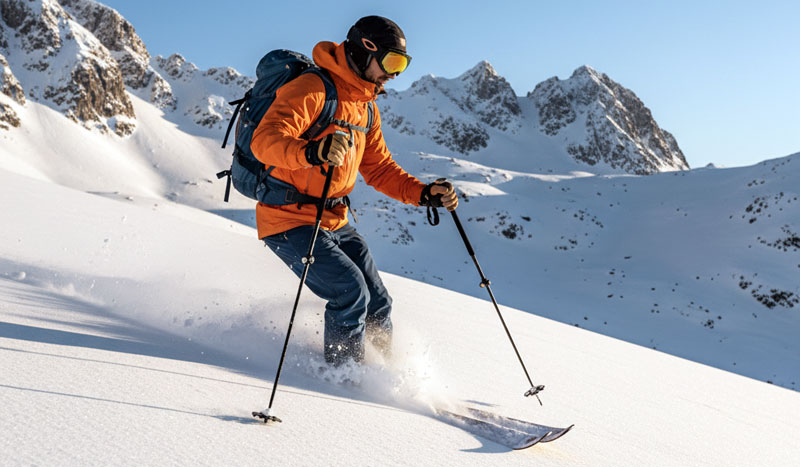
Backcountry ski poles are one of the most overlooked pieces of touring gear, yet they play a critical role in your comfort, efficiency, and safety on the skin track and the descent. Unlike resort poles, backcountry poles must handle changing terrain, deep snow, steep skin tracks, and the need to be stowed on a pack during technical descents. Choosing the right pair involves understanding materials, adjustability, grips, baskets, locking mechanisms, and how those features match your style of touring. This guide walks through everything you need to know to make an informed decision.
Why Backcountry Poles Are Different
Resort skiing generally involves fixed-length poles used on groomed runs. Backcountry skiing and splitboarding demand more versatility. You may need a longer pole for pushing across flat approaches, a shorter pole for steep sidehills, and a pole that collapses small enough to strap to your pack when you switch to bootpacking or riding. Backcountry poles are built to be adjustable, durable, and adaptable to deep snow and variable conditions.
The key differences come down to a few core features:
- Adjustable length for climbing, descending, and sidehilling
- Powder baskets for flotation in deep snow
- Extended grips for choking up on steep skin tracks
- Reliable locking mechanisms that work with gloves
- Collapsibility for pack storage during descents or bootpacks
Key Factors to Consider
1. Shaft Material
The shaft material affects weight, durability, and price. The most common options are aluminum, carbon, and hybrid constructions.
| Material | Pros | Cons | Best For |
|---|---|---|---|
| Aluminum (6061, 7075, HTS 6.5) | Durable, affordable, bends rather than shatters | Heavier than carbon | Daily drivers, rocky terrain, budget-conscious skiers |
| Carbon | Lightweight, stiff, low swing weight | Can crack or shatter on impact, expensive | Weight-conscious tourers, long missions |
| Hybrid (carbon lower, aluminum upper) | Balances weight and durability | Still pricier than full aluminum | Skiers wanting light poles with some durability |
Aluminum poles like the Black Diamond Traverse or Leki Helicon Lite are excellent all-around choices. They may bend on hard impacts, but they rarely fail catastrophically. Carbon poles such as the Black Diamond Expedition Carbon Pro save noticeable weight but require more careful handling around rocks and trees.
2. Adjustability and Length Range
Adjustable poles are essential for backcountry use. Fixed-length poles are lighter and simpler, but they cannot adapt to changing terrain or be shortened for steep skin tracks. Most backcountry skiers choose two or three-section adjustable poles.
When selecting a length range, consider your height and intended use. A common starting point is to stand with the pole tip on the ground and the grip under your armpit for flat terrain. For touring, you may want a pole that extends longer for flat approaches and shortens for steep climbs.
- Two-section poles are lighter and stiffer but collapse less compactly.
- Three-section poles collapse smaller for pack storage but add weight and flex.
- Z-poles collapse into three or four segments for maximum packability, ideal for splitboarders and ski mountaineers.
Examples include the Black Diamond Expedition Compactor, which collapses to 14.5 inches, and the Black Diamond Traverse 3, which collapses to 22.8 inches and includes a built-in probe.
3. Locking Mechanisms
The locking mechanism is what keeps your pole at the length you set. It must be reliable, easy to use with gloves, and resistant to icing. Common types include:
- External lever locks: FlickLock, Speed Lock, and DynaLock are popular. They are fast, secure, and easy to adjust with gloves.
- Internal twist locks: Lighter and sleeker but can slip or freeze, and are harder to operate with gloves.
- Push-button locks: Used on Z-poles for fixed length settings. Simple and secure but not infinitely adjustable.
For backcountry use, external lever locks are generally the best choice. Black Diamond’s FlickLock Pro and Leki’s Speed Lock Plus are two of the most trusted systems on the market.
4. Grips and Hand Positions
The grip affects comfort, control, and how well you can handle varying terrain. Most backcountry poles use rubber, foam, or cork grips.
| Grip Material | Pros | Cons |
|---|---|---|
| Rubber | Durable, good grip when wet | Can feel cold, less breathable |
| Foam | Lightweight, comfortable, good for extended grips | Can wear down over time |
| Cork | Comfortable, moisture-wicking, classic feel | Heavier, more expensive |
Extended grips are a major advantage in the backcountry. They let you choke up on the pole when traversing a steep sidehill or skinning uphill, without adjusting the pole length. Look for poles with foam or rubber extensions below the main grip, such as the Leki Haute Route 2 or Black Diamond Traverse Pro.
Ergonomic grips with support surfaces, like Leki’s Aergon grips, allow you to palm the top of the pole for extra push. This reduces hand fatigue on long tours.
5. Baskets
Baskets keep your poles from sinking too deep into snow. The two main types are powder baskets and trekking baskets.
- Powder baskets: Large diameter for flotation in deep snow. Standard for backcountry skiing.
- Trekking baskets: Smaller diameter for packed trails and summer hiking.
- Interchangeable baskets: Some poles, like the MSR DynaLock, include both powder and trekking baskets.
For dedicated backcountry skiing, powder baskets are essential. If you also use your poles for winter hiking or snowshoeing, consider a model with interchangeable baskets.
6. Weight
Weight matters most when you are carrying poles on your pack or swinging them repeatedly on a long descent. Lighter poles reduce fatigue, but they often cost more and may be less durable.
Weights range from around 9.8 ounces per pair for lightweight aluminum or carbon models to over 1 pound 4 ounces for durable aluminum poles. For most skiers, a pair weighing between 10 and 18 ounces is a good balance. Splitboarders and ski mountaineers often prioritize lighter poles, while resort-adjacent tourers may prefer durability over grams.
7. Collapsed Length and Packability
How small your poles collapse matters if you frequently stow them on your pack. This is especially true for splitboarders, who often ride with poles on their back, and for ski mountaineers tackling technical descents.
- Standard two-section poles collapse to around 31 to 41 inches.
- Three-section poles collapse to around 22 to 25 inches.
- Z-poles collapse to as little as 14 to 15 inches.
If packability is a priority, look at the Black Diamond Expedition Compactor or Black Diamond Expedition 3P. If you rarely stow your poles, a standard two-section pole will be lighter and stiffer.
8. Straps and Safety
Most backcountry poles include adjustable straps. Straps can improve comfort and power transfer, but they also pose a risk in avalanches or on steep terrain. Some skiers prefer to remove straps entirely to reduce entanglement risk.
Look for straps that are easy to adjust and release. Leki’s locking security straps are a good example. If you ski in avalanche terrain, consider whether you want straps at all, or choose poles with breakaway straps.
9. Special Features
Some backcountry poles include extra features that may be worth considering:
- Built-in probe: The Black Diamond Traverse 3 includes a probe in the shaft, useful for emergencies.
- Carbide tips: Durable tips that grip on ice and rock. Most backcountry poles include them.
- Interchangeable baskets: Useful for year-round use.
- Extended foam grips: Great for sidehilling and steep skin tracks.
Matching Poles to Your Skiing Style
For Resort and Sidecountry Touring
If you mostly ski lift-accessed terrain with occasional sidecountry laps, a durable aluminum two-section pole is ideal. Look for reliable lever locks, powder baskets, and comfortable grips. The Black Diamond Traverse or Leki Helicon Lite are solid choices.
For Backcountry Touring
For dedicated touring, prioritize adjustable length, extended grips, and moderate weight. A pole like the Black Diamond Traverse Pro or Leki Haute Route 2 offers a good balance of features, weight, and durability.
For Splitboarding
Splitboarders need poles that collapse small and adjust easily. The Black Diamond Traverse 3, with its built-in probe and compact collapsed length, is designed with splitboarders in mind. The Black Diamond Expedition Compactor is another excellent option.
For Ski Mountaineering
Ski mountaineers prioritize low weight and packability. Carbon poles like the Black Diamond Expedition Carbon Pro save weight, while Z-poles like the Expedition Compactor offer maximum stowability. Durability is a trade-off, so choose based on your terrain and risk tolerance.
Common Mistakes to Avoid
- Buying fixed-length poles for backcountry use
- Choosing poles that are too short or too long for your height
- Ignoring grip extensions, which are invaluable on steep skin tracks
- Overlooking basket type and compatibility
- Prioritizing weight savings over durability when skiing rocky terrain
- Not testing locking mechanisms with gloves before buying
Final Thoughts
Choosing backcountry ski poles comes down to matching features to your terrain, style, and priorities. Aluminum poles offer durability and value, while carbon saves weight at a higher cost. Adjustability, reliable locking mechanisms, extended grips, and powder baskets are the core features to look for. Collapsibility matters if you frequently stow your poles, and special features like built-in probes can add safety and versatility.
Take the time to handle poles in person if possible. Test the locks with gloves, check the grip comfort, and consider how the poles feel at your preferred length. A well-chosen pair of backcountry poles will serve you for many seasons, making every tour more efficient and enjoyable.