Best Ski Touring Backpacks of 2026
Ski touring is all about freedom, adventure, and exploring the mountains at your own pace, but the right gear makes all the difference. A reliable backpack is one of the most important pieces of equipment you’ll need, carrying everything from safety gear and extra layers to snacks and water. The best ski touring backpacks are designed to be lightweight, comfortable, and practical, with features that make long days in the backcountry easier. In this guide, we’ll look at the top choices available today.
1. Black Diamond Cirque 35

- Frame Type: Frameless
- Capacity: 35 L (2,136 cu in)
- Materials: 210D nylon with Dynex grid
- Carry Options: Diagonal / A-frame / Vertical snowboard
The Black Diamond Cirque 35 is a purpose-built, mid-capacity alpine pack made for fast approaches and technical lines. The roll-top design expands or compresses as needed, and the lightweight 210-denier nylon with Dynex grid keeps the weight down while resisting abrasion. Its multiple carry options (diagonal, A-frame, vertical) and quick-deploy PickPocket™ piolet system make transitions smooth when terrain gets steep. An external avalanche-tool pocket with drain holes plus a quick side zipper to the main compartment makes retrieving skins, crampons, or tools simple on the move.
Comfort-wise, the Cirque balances low weight with usable padding: stretch-woven shoulder straps and a padded hipbelt help during long shuttles. Interior organization is minimal but sensible — an interior sleeve, exterior zip pocket, and radio/hydration routing cover essentials without adding bulk. If you want a no-nonsense, durable pack for serious backcountry days where weight and function matter, the Cirque 35 is a strong choice.
- Pros: Lightweight, durable build; excellent carry options; quick tool access; good volume range.
- Cons: Minimal internal organization; no raincover; less padding for long load-haul days.
See the BD Cirque 35 See the BD Cirque 50
2. Black Diamond Dawn Patrol 32

- Frame Type: Frameless
- Capacity: 32 L (≈1,953 cu in)
- Fabric: 100% postconsumer recycled polyester
- Access: Panel / back-panel zip access
The Dawn Patrol 32 is a versatile all-day backcountry pack designed to handle long tours and mixed objectives. Its 32-liter capacity is roomy enough for extra layers, food, water, and an avy kit while keeping a slim, contoured profile. The separate, easy-access avalanche-safety pocket and oversized insulated shoulder pocket make organizing emergency gear and hydration intuitive. Built from recycled materials, the Dawn Patrol balances eco-conscious construction with snow-shedding performance.
The suspension is form-fitting and body-hugging, which reduces bounce on steep climbs and helps when you’re cutting fresh skin tracks. Zippered back-panel access speeds mid-trip retrievals, and multiple external attachment points let you carry skis, splitboard, helmet, or piolets without fuss. If you want a dependable, well-featured pack for varied backcountry days that prioritizes organization and comfort over ultralight minimalism, the Dawn Patrol 32 delivers.
- Pros: Great organization; insulated shoulder pocket; sustainable materials; comfortable fit.
- Cons: Slightly heavier than ultralight rivals; no included raincover.
See the BD Dawn Patrol 32 See the BD Dawn Patrol 25 See the BD Dawn Patrol 15
3. Black Diamond Cirque Ultra 35

- Frame Type: Frameless
- Gear Capacity: 35 liters
- Weight: 2 lbs. 5 oz.
- Material: Ultra 200 polyethylene; 100-denier nylon ripstop
The Black Diamond Cirque Ultra 35 is a purpose-built ski touring pack for backcountry athletes who count every ounce. Its frameless, ultralight construction keeps weight to a minimum while a tough Ultra 200 polyethylene body resists abrasion from ski edges, branches and rock. The roll-top closure trims the profile and lets you compress the pack as your load shrinks, which is ideal when you shed layers on the skin track.
A dedicated avalanche tool pocket provides quick access to your shovel and probe, a critical feature when seconds matter. The hipbelt includes pockets for snacks or a compass, and the S/M and M/L sizing options help dial in the fit. With 35 liters of capacity, it works for long day tours or minimalist overnight missions. The waterproof fabric adds weather protection, though the lack of a raincover and limited exterior organization may not suit everyone.
- Pros: Ultralight, waterproof fabric, quick-access avy pocket, roll-top compression
- Cons: Frameless suspension, no raincover, minimal exterior pockets
See the BD Cirque Ultra 35 See the BD Cirque Ultra 25
4. Gregory Targhee 30 – Women’s

- Frame Type: Internal Frame
- Gear Capacity: XS/S: 28 liters; S/M: 30 liters
- Weight: XS/S: 2 lbs. 14.1 oz.; S/M: 3 lbs. 2.9 oz.
- Material: 210-denier recycled nylon with C0 DWR; 1,000-denier CORDURA nylon
The Gregory Targhee 30 for women is a well-rounded snow pack that balances comfort, durability and backcountry function. The internal frame uses alloy steel stays and an HDPE framesheet to support moderate loads, while the padded hipbelt and women’s-specific torso fit keep the pack stable on descents. Snow-shedding fabric on the body helps prevent snow buildup, and the avalanche safety pocket keeps essential tools organized and reachable.
Ski and board carry capabilities make it versatile for both splitboarders and skiers, and six exterior pockets provide ample organization for goggles, gloves, skins and snacks. The 210-denier recycled nylon with C0 DWR avoids PFAS, and the 1,000-denier CORDURA base stands up to rough use. At just over 3 pounds in the larger size, it is not the lightest option, but the added structure and comfort are worth it for long tours and demanding terrain.
- Pros: Supportive internal frame, women’s-specific fit, snow-shedding fabric, avalanche pocket
- Cons: Heavier than frameless options, top-only access, bulky for fast missions
See the Gregory Targhee 30 – Women’s
5. Mammut Haldigrat 30 E2

- Frame Type: Internal Frame
- Gear Capacity: 30 liters
- Weight: 5 lbs. 13.48 oz.
- Avalanche Airbag: Yes
The Mammut Haldigrat 30 E2 is a serious avalanche airbag pack built for big alpine climbs and consequential descents. Its internal frame carries weight efficiently, and the airbag system is designed to deploy quickly even in freezing conditions. Orange details throughout the pack help you locate avalanche tools fast, which is a thoughtful touch when visibility is poor or stress is high. The 420-denier recycled nylon oxford shell is durable and weather-resistant.
With 30 liters of capacity, top and back access, and two exterior pockets plus main compartments, the Haldigrat balances storage and quick access. It is reservoir compatible, so you can stay hydrated on long ascents, and the hipbelt includes pockets for small essentials. At nearly 6 pounds, much of the weight comes from the airbag system, making it heavier than non-airbag packs. For riders who prioritize safety in avalanche terrain, that trade-off is often worthwhile.
- Pros: Integrated avalanche airbag, fast deployment, durable recycled shell, reservoir compatible
- Cons: Heavy, expensive, limited exterior pocket count
See the Mammut Haldigrat 30 E2
6. Ortovox Free Rider 22

- Frame Type: Frameless
- Gear Capacity: 22 liters
- Weight: 2 lbs. 8.6 oz.
- Material: Polyamide 420-denier 100% recycled
The Ortovox Free Rider 22 is designed for freeride terrain where maneuverability matters most. Its frameless design and snug fit against the back allow the pack to move with you rather than against you, which is ideal for tight tree runs and technical descents. Two stays provide a modest amount of structure without adding much weight. The 420-denier recycled polyamide fabric is durable and environmentally conscious, and the top and back access make it easy to reach gear.
With 22 liters of capacity, this pack suits day trips into backcountry terrain where you carry the essentials and not much more. It has four exterior pockets plus a main compartment, and the hipbelt includes pockets for quick-access items. The lack of a raincover means you will need to provide your own weather protection in wet conditions. For freeriders who value a close, stable carry and minimalist organization, the Free Rider 22 is a strong choice.
- Pros: Snug frameless fit, recycled durable fabric, multiple exterior pockets, stable carry
- Cons: No raincover, modest capacity, limited suspension for heavy loads
7. Dynafit Ridge 24 – Women’s

- Frame Type: Frameless
- Gear Capacity: 24 liters
- Weight: 2 lbs. 0.63 oz.
- Material: CORDURA ripstop
The Dynafit Ridge 24 for women is a lightweight, compact pack built for ambitious day tours in alpine terrain. Its frameless construction keeps the weight low, and the CORDURA ripstop fabric provides excellent durability against rock and ice. The women’s-specific fit includes a hipbelt with pockets and a waist range of 28 to 48 inches, helping the pack stay stable during technical movement. Top and panel access make it easy to retrieve gear without fully unloading the pack.
With 24 liters of capacity and three exterior pockets plus a main compartment, the Ridge 24 offers enough space for skins, layers, water and avalanche tools on fast, minimalist missions. At just over 2 pounds, it is one of the lighter options in this group, which pays off on long climbs and high-output tours. There is no raincover included, so you will need to pack accordingly in wet weather. For ski mountaineers who value low weight and a clean design, this pack delivers.
- Pros: Very lightweight, durable CORDURA ripstop, women’s-specific fit, panel access
- Cons: Frameless, no raincover, limited capacity for overnight trips
See the Dynafit Ridge 24 – Women’s
8. Dynafit Blacklight 24

- Frame Type: Frameless
- Gear Capacity: 24 liters
- Weight: 1 lb. 8.69 oz.
- Material: Recycled nylon UHMWPE Gridstop; Robic nylon ripstop
The Dynafit Blacklight 24 is an ultralight ski touring pack for ambitious tours where speed and efficiency are the priority. At just over 1.5 pounds, it is the lightest pack in this selection, thanks to a frameless design and advanced fabrics like recycled nylon UHMWPE Gridstop and Robic nylon ripstop. These materials offer impressive strength-to-weight ratios, resisting abrasion while keeping the pack minimal. Top and panel access let you reach gear quickly whether you are transitioning on the skin track or preparing for a descent.
With 24 liters of capacity and three exterior pockets plus a main compartment, the Blacklight 24 keeps gear organized and within easy reach. The hipbelt includes pockets for small items, and the waist fit ranges from 28 to 48 inches. There is no raincover, so you will need to manage moisture with internal protection or dry bags. For weight-conscious ski mountaineers who want a stripped-down pack that still carries comfortably, the Blacklight 24 is an excellent option.
- Pros: Extremely lightweight, durable Gridstop and Robic fabrics, panel access, hipbelt pockets
- Cons: Frameless, no raincover, minimal padding for heavy loads
How to Choose Ski Touring Backpacks
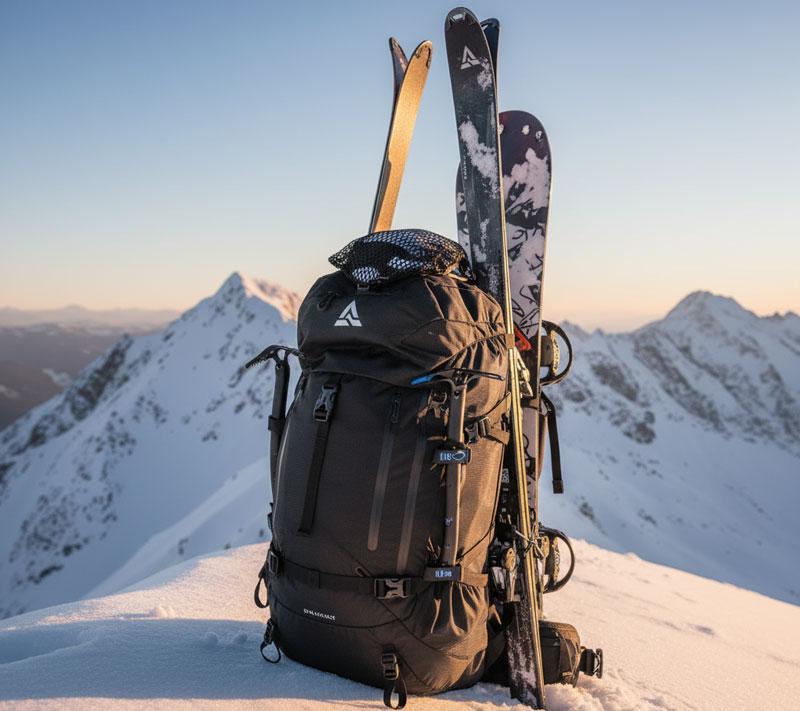
Ski touring combines the uphill climb of mountaineering with the downhill thrill of alpine skiing. Unlike resort skiing, where a small hydration pack or no pack at all will do, ski touring demands a backpack that carries safety gear, layers, food, water, and sometimes even a rope and harness. Choosing the wrong pack can ruin your day with discomfort, poor weight distribution, or inaccessible equipment. This guide walks you through every critical factor, from volume and fit to safety features and materials, so you can select a ski touring backpack that works for your objectives, body, and budget.
Understand the Different Types of Ski Touring Backpacks
Not all ski touring packs are created equal. They generally fall into three categories based on duration and terrain.
Day Tour Packs (15–30 Liters)
These are ideal for single-day tours lasting two to six hours. They carry a shovel, probe, skins, a spare layer, lunch, and one to two liters of water. They are lightweight, low-profile, and often have a diagonal or A-frame ski carry. If you mostly do lift-assisted sidecountry or short dawn patrols, this is your category.
Extended Day or Light Overnight Packs (30–45 Liters)
For long spring tours, hut trips, or winter ascents where you carry more layers, a stove, or a sleeping bag liner, this size offers extra room without becoming unwieldy. Many models in this range can compress down for day use but expand for an overnight.
Multi-Day Expedition Packs (45–60+ Liters)
These are for multi-day traverses, winter camping, or guiding. They carry a full sleeping bag, tent, stove, food for several days, and technical gear. They are heavier and bulkier but offer superior load transfer and sometimes removable frames or lids.
Volume and Load Carrying Capacity
Volume is measured in liters. The right volume depends on trip length, season, and whether you carry technical gear. Use the table below as a starting point.
| Trip Type | Recommended Volume | Typical Contents |
|---|---|---|
| Short dawn patrol (1–2 hours) | 15–20 L | Shovel, probe, skins, water, snack, extra gloves |
| Full day tour (4–6 hours) | 22–30 L | Above plus spare layer, lunch, first aid, headlamp |
| Long day or spring mountaineering | 30–40 L | Above plus rope, harness, crampons, ice axe |
| Hut trip or overnight | 40–50 L | Sleeping bag, stove, food, extra layers |
| Multi-day expedition | 50–65+ L | Tent, full sleeping system, multiple days of food |
Remember that volume ratings are not standardized. A 30 L pack from one brand may feel smaller than another. Always try the pack loaded if possible.
Fit and Suspension: The Most Important Factor
A ski touring backpack must move with your body while skinning and skiing. A poor fit causes shoulder pain, hip bruising, and fatigue. Follow these guidelines.
Torso Length
Measure your torso from the C7 vertebra (the bony bump at the base of your neck) to the top of your iliac crest (hip bone). Most packs come in sizes S, M, L, or adjustable. The hip belt should wrap around your hip bones, not your waist. The shoulder straps should curve over your shoulders without digging into your neck.
Hip Belt and Load Transfer
For packs over 25 liters, a padded, contoured hip belt is essential. It should carry 70–80% of the weight. Look for a hip belt with forward pull adjustment so you can tighten it easily with gloves. Some packs have removable hip belt pockets for snacks or a phone.
Back Panel and Ventilation
Ski touring is sweaty work. Back panels with channels, mesh, or foam patterns improve airflow. However, ventilation often trades off with stability. For aggressive descents, a close-fitting back panel is better. For long, mellow approaches, ventilation matters more.
Women-Specific vs. Unisex
Women often have shorter torsos, narrower shoulders, and different hip curvature. Women-specific packs adjust these dimensions. If a unisex pack fits you well, that is fine, but do not assume one size fits all.
Carry Systems for Skis and Gear
How you carry your skis affects both comfort and speed. Most ski touring packs offer two or three options.
Diagonal Carry
One ski is attached diagonally across the back, the other parallel. This is fast, secure, and keeps the pack narrow. It works well for short carries and boot packs. Look for a dedicated diagonal strap and a reinforced loop at the bottom corner.
A-Frame Carry
Skis are placed in an A-shape with tails together at the bottom and tips apart at the top. This is stable for long carries and keeps the skis away from your legs. It requires two side compression straps and a top strap. A-frame is slower to set up but more comfortable on uneven terrain.
Snowboard Carry
If you splitboard or carry a snowboard, look for vertical carry with a dedicated snowboard strap and a reinforced back panel. Many ski packs also accept a snowboard diagonally, but vertical is more secure.
Additional Gear Attachments
- Ice axe loop: A reinforced loop and a Velcro or elastic shaft holder.
- Crampon pouch: A separate pocket or external straps to keep sharp points away from fabric.
- Helmet carry: A mesh net or straps to hold a helmet on the outside.
- Rope carry: A removable top strap or a dedicated rope holder under the lid.
- Hydration sleeve: An insulated sleeve for a bladder hose to prevent freezing.
Safety and Avalanche Gear Compatibility
This is non-negotiable. Your ski touring backpack must carry avalanche safety gear in a way that is fast and reliable.
Shovel and Probe Pockets
Look for a dedicated avalanche safety pocket that is separate from the main compartment. It should be large enough for a shovel blade, handle, and a 240–320 cm probe. The pocket should be accessible without opening the main pack. Some packs have a dedicated shovel handle sleeve and a probe slot.
Quick Access
In an avalanche burial, seconds matter. The shovel and probe must be reachable with one hand, ideally without removing the pack. Practice deploying your gear with gloves on. Avoid packs where the shovel is buried under layers or requires two hands to unzip.
Radio and Rescue Gear
If you carry a two-way radio or a rescue sled, ensure there is a secure pocket or attachment point. Some packs have a dedicated radio pocket on the shoulder strap.
Materials, Durability, and Weight
Ski touring packs face abrasion from ski edges, rocks, and ice. They also need to be light enough for uphill travel.
Fabric Denier
Denier measures fiber thickness. Common ski pack fabrics range from 100D to 420D. A 210D ripstop nylon with a polyurethane coating is a good balance of weight and durability. High-wear areas like the bottom and ski carry points often use 420D or Cordura.
Water Resistance
Most packs are water-resistant, not waterproof. A DWR (durable water repellent) finish sheds snow and light rain. For wet climates, look for a pack with a waterproof zipper or a included rain cover. You can also use a pack liner.
Weight
Ultralight packs (under 1 kg) often sacrifice durability and suspension. Heavier packs (1.5–2 kg) carry loads better. For day tours, aim for 800 g to 1.3 kg. For expeditions, 1.5–2.2 kg is reasonable.
Zippers, Straps, and Accessibility
You will open your pack with gloves on, often in cold and windy conditions. Design details matter.
Main Compartment Access
- Top lid: Classic, secure, but can be slow.
- Front panel zip: Fast access to the main body without unloading.
- Rear panel zip: Good for accessing gear while the pack is on your back, but can be vulnerable to snow ingress.
- Combination: Many packs offer a top lid plus a front or side zip.
Zipper Quality
Look for YKK zippers or equivalent. Glove-friendly zipper pulls are large loops or cords. Avoid tiny metal pulls that are hard to grip.
Compression Straps
Side compression straps stabilize the load and can be used for A-frame ski carry. They should be easy to adjust with gloves and not dangle. Some packs have removable compression straps to save weight.
Additional Features to Consider
- Helmet compatibility: Does the pack interfere with your helmet when looking up?
- Hydration compatibility: Insulated hose sleeve and a clip on the shoulder strap.
- Back panel access: Useful for dig-outs or accessing a camera.
- Removable lid: Turns a 35 L pack into a 28 L pack for short tours.
- Key clip and internal pockets: For keys, wallet, phone, and small tools.
- Reflective accents: For visibility in low light.
- Women’s specific fit: Shorter torso, narrower shoulder straps, contoured hip belt.
How to Test a Ski Touring Backpack Before You Buy
Online reviews help, but nothing beats trying a pack in person. Follow this checklist.
- Load it up: Ask the shop to add 5–10 kg of weight. Walk around, bend over, and simulate skiing.
- Adjust all straps: Hip belt first, then shoulder straps, then load lifters, then sternum strap.
- Check for hot spots: Any pressure on your hips, shoulders, or lower back will only get worse on a tour.
- Test ski carry: If possible, attach skis in both diagonal and A-frame. Does the pack sag? Does the load shift?
- Access the avalanche pocket: Put on gloves. Can you open the shovel pocket and pull out the shovel in under 10 seconds?
- Wear a helmet: Look up, down, and side to side. The pack should not push your helmet forward or block your view.
Common Mistakes to Avoid
- Buying too much volume: A 50 L pack for day tours encourages overpacking and adds weight.
- Ignoring hip belt fit: A pack that sits on your shoulders will cause pain and fatigue.
- Choosing style over function: A pack that looks cool but lacks a dedicated avalanche pocket is a safety risk.
- Forgetting hydration: Without an insulated hose, your water will freeze. Plan for a thermos or insulated bladder.
- Not testing with gloves: Zippers, buckles, and straps feel different with gloves on.
- Assuming all brands size the same: A medium in one brand may be a large in another. Always measure your torso.
Final Recommendations by Use Case
| Use Case | Recommended Volume | Key Features |
|---|---|---|
| Resort sidecountry / short tours | 15–22 L | Diagonal ski carry, avalanche pocket, lightweight |
| Full-day backcountry tours | 25–35 L | A-frame and diagonal carry, hip belt, hydration sleeve |
| Spring mountaineering | 30–40 L | Rope carry, crampon pouch, ice axe loop, durable fabric |
| Hut trips | 35–45 L | Removable lid, compression straps, comfortable suspension |
| Multi-day expeditions | 50–65 L | Heavy load transfer, expandable, waterproof zippers |
Choosing a ski touring backpack is a balance of fit, function, and weight. Prioritize a proper torso fit and a comfortable hip belt. Then ensure the pack carries your avalanche gear securely and accessibly. Finally, match the volume to your typical tour length. A well-chosen pack disappears on your back, letting you focus on the skin track and the descent. Take your time, try before you buy, and remember that the best pack is the one you forget you are wearing.