Best Resort Ski Backpacks of 2026
When you head out for a day on the slopes, the right ski backpack can make all the difference. A good resort ski backpack keeps your gear safe, organized, and easy to reach, whether you’re carrying snacks, extra layers, or water. It should be comfortable to wear on lifts and light enough not to slow you down. In this guide, we’ll look at the best resort ski backpacks that combine comfort, durability, and smart design to help you enjoy every run.
1. Gregory Verte 18

- Frame Type: Frameless
- Gear Capacity: S/M: 16 liters; M/L: 18 liters
- Fits Torso Length: S/M: 15-19 inches; M/L: 16-21 inches
- Weight: S/M: 1 lb. 12.5 oz.; M/L: 2 lbs. 2.2 oz.
The Gregory Verte 18 is a compact snow pack built for resort laps and quick sidecountry missions. Its Freeride hipbelt moves with your body, helping the pack stay stable when you are hiking a ridge or riding chopped-up snow. The simple panel access makes it easy to grab gloves, goggles, or a snack without wrestling with the whole pack. A single stay adds a bit of structure without making the pack feel bulky, and the blended recycled nylon shell holds up to regular snow contact.
With 16 to 18 liters of capacity depending on size, this pack is best for short days when you only need the essentials. The hipbelt and four exterior pockets keep small items organized, while the main compartment swallows a spare layer, water, and a small avalanche kit. It is not designed for long tours or heavy loads, but for lift-served skiing and snowboarding it strikes a good balance between comfort and simplicity.
Pros: Freeride hipbelt moves naturally; lightweight and compact; easy panel access.
Cons: Frameless design limits heavier loads; small capacity for full backcountry days.
2. Osprey Glade 20L

- Frame Type: Frameless
- Gear Capacity: 20 liters
- Fits Torso Length: 17-22 inches
- Weight: 2 lbs. 1.6 oz.
The Osprey Glade 20L is a versatile snow pack for skiers and snowshoers who want a simple, reliable carry system. The top-loading design keeps gear secure, and the 20-liter capacity is enough for a shell, lunch, water, and a small safety kit. The recycled ocean-sourced nylon fabric is a standout feature, offering durability with an environmentally conscious build. A hipbelt and torso range of 17 to 22 inches help the pack sit comfortably on a wide range of body types.
With only one exterior pocket plus the main compartment, the Glade keeps organization minimal. That makes it a good choice for riders who prefer to pack light and move fast. It is frameless, so heavy loads will sag, but for lift laps and short snowshoe trips it carries well. The hydration sleeve and coated fabric add practical value for cold, wet days.
Pros: Eco-friendly recycled ocean-sourced nylon; comfortable hipbelt.
Cons: Limited exterior organization; frameless design not ideal for heavy loads.
3. SEMSTY 12L Ski Backpack

- Capacity: 12 liters
- Dimensions: 12.2 x 3.15 x 20.9 inches
- Carry Options: Vertical snowboard, diagonal ski, horizontal snowboard
- Hydration: Compatible, bladder not included
The SEMSTY 12L Ski Backpack is a budget-friendly option for short ski and snowboard sessions. It includes purpose-built snow tool sleeves, an external shovel blade carry, and a fleece-lined goggle pocket that helps prevent scratches. The exterior quick-stash pocket is handy for a phone or pass, and the internal compartment fits a 14-inch laptop, which makes the pack useful beyond the slopes. Water-resistant nylon helps it stand up to snow and sharp ski edges.
The S-shaped shoulder belts and air-permeable PE foam back panel are designed to keep movement free and your back drier. A hipbelt, sternum strap, and integrated whistle add security and safety. At 12 liters, it is best for minimalist carry, but the multiple carry options make it surprisingly versatile for skiing, snowboarding, or snowshoeing. It is a good entry-level pack for riders who do not need a large backcountry setup.
Pros: Affordable; multiple ski and snowboard carry options; fleece-lined goggle pocket.
Cons: Small 12L capacity; bladder not included; not ideal for long tours or large avalanche gear.
4. Unigear 22L Ski Backpack

- Capacity: 22 liters
- Dimensions: 21.26 x 10.24 x 6.3 inches
- Material: 900D polyester with PU coating, 500D PVC bottom
- Hydration: Fits 3L bladder
The Unigear 22L Ski Backpack is built for day touring, skiing, hiking, and mountaineering. Its 22-liter capacity and individual compartments make it easy to organize a shovel, ice axes, gloves, clothing, and a phone. The velvet-lined goggle pocket protects lenses from scratches, and the internal sleeve fits a 14-inch laptop. The hydration system accommodates a 3L bladder, so you can stay hydrated on long days without stopping.
The S-shaped shoulder belts and inverted Y-shaped PE foam back panel are designed for comfort and airflow. A hipbelt, sternum strap, and whistle add security, while reflective strips improve visibility. The 900D polyester shell with PU coating and scratch-resistant 500D PVC bottom offer strong durability for harsh winter use. Adjustable ski carry straps with HYPALON webbing and dual ice axe loops add serious function for the price.
Pros: Durable 900D polyester and PVC bottom; fits 3L hydration bladder.
Cons: Heavier than minimalist packs; 22L may be small for overnight tours.
5. Black Diamond Dawn Patrol 32

- Frame Type: Frameless
- Gear Capacity: 32 liters
- Fits Torso Length: S/M: 16-19 inches; M/L: 18.5-21.5 inches
- Weight: 2 lbs. 9.27 oz.
The Black Diamond Dawn Patrol 32 is made for big, all-day off-piste adventures. The front pocket stores an avalanche kit, and the insulated shoulder pocket holds a hydration tube, soft flask, or radio. With 32 liters of capacity, it can carry layers, food, water, and safety gear for long tours. The panel access makes it easy to reach the main compartment, and the hipbelt with pockets keeps small items close at hand.
The pack uses recycled polyester throughout, including the liner, and the fit range accommodates a variety of torso lengths. It is frameless, so it relies on careful packing for structure, but it carries well when loaded thoughtfully. The Dawn Patrol 32 is a strong choice for skiers and riders who need a dedicated backcountry pack with room for avalanche gear and a full day of supplies.
Pros: Large 32L capacity for full-day tours; dedicated avalanche tool pocket.
Cons: Frameless design needs careful packing; no raincover included.
6. DAKINE Poacher 14L

- Frame Type: Frameless
- Gear Capacity: 14 liters
- Fits Torso Length: 20 inches
- Weight: 1 lb. 12.2 oz.
The DAKINE Poacher 14L is the most minimalist pack in the Poacher collection. It is designed to hold essential avalanche safety gear for short backcountry laps and general lift riding. The panel access makes it easy to get to the main compartment, and the hipbelt helps keep the pack stable when you are moving quickly. At 14 liters, it is small enough to stay out of the way but large enough for a shovel, probe, and a few extras.
The pack is made from 100% recycled polyester and weighs just 1 lb. 12.2 oz., making it a light option for quick missions. It has two exterior pockets plus the main compartment, so organization is simple. The fixed 20-inch torso length and 48-inch waist fit are less adjustable than some competitors, but for riders who match those dimensions it is a clean, no-frills snow pack.
Pros: Very lightweight; minimalist design; recycled polyester fabric; good for short backcountry laps.
Cons: Limited fit adjustment; small 14L capacity; only two exterior pockets; no raincover.
7. DAKINE Heli 2.0 18L

- Frame Type: Frameless
- Gear Capacity: 18 liters
- Fits Torso Length: 16-19 inches
- Weight: 2 lbs. 9.59 oz.
The DAKINE Heli 2.0 18L is built to get out in harsh conditions. It has refined storage for must-have gear and versatile ski and snowboard carry options for going deeper into the backcountry. The top and panel access gives you multiple ways to reach your gear, and the 18-liter capacity is a good middle ground for day tours. The recycled 600-denier polyester diamond ripstop and coated polyester fabrics add durability.
The hipbelt and 16 to 19-inch torso range help the pack fit securely, while the 28 to 44-inch waist range accommodates a variety of riders. With two exterior pockets plus the main compartment, it keeps organization simple but functional. It is not the lightest pack in this size, but the rugged materials and carry options make it a solid choice for skiers and snowboarders who want a durable backcountry companion.
Pros: Durable recycled 600-denier fabrics; versatile ski and snowboard carry.
Cons: Relatively heavy for its size; no raincover; limited exterior pocket count.
8. Osprey Firn 18L

- Capacity: 18 liters
- Dimensions: 19.3 x 11.4 x 9.4 inches
- Weight: 2.2 lbs.
- Carry System: Ski Lasso Carry System
The Osprey Firn 18L is a vest-style snow pack with a close-to-body harness and organizational pockets for food, soft flasks, a headlamp, or tech. The Ski Lasso Carry System is ambidextrous and lets you stow skis without taking the pack off, and it can be removed or tucked away when not in use. The flexible yet stable snow-shedding backpanel helps the pack sit well during dynamic movement.
Alpine-specific features include a one-handed direct-access crampon pocket, space for avalanche equipment, and lightweight carbonate-coated fabric. A top compression strap doubles as an axe stabilizer, and the front panel avalanche tool pocket keeps safety gear accessible. At 18 liters and 2.2 lbs., it is a focused pack for technical ski mountaineering and fast day tours where fit and quick access matter most.
Pros: Vest-style close-to-body fit; Ski Lasso carry system; crampon pocket; snow-shedding backpanel.
Cons: Expensive; 18L may be tight for full-day tours; specialized design less ideal for resort-only use.
How to Choose Resort Ski Backpacks
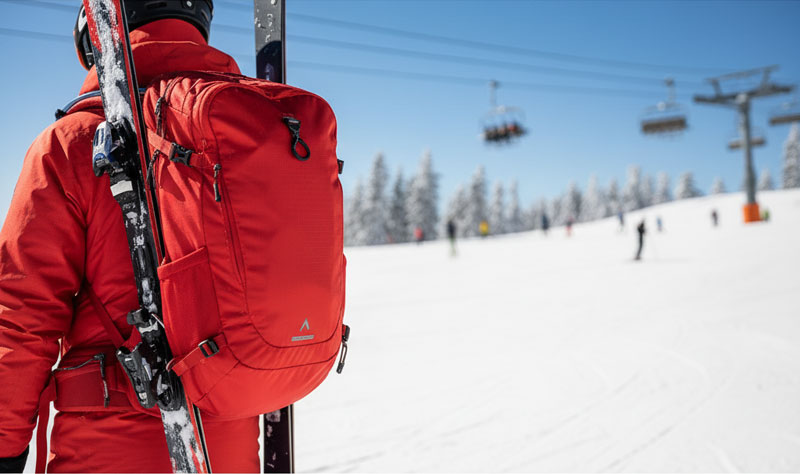
Choosing the right backpack for resort skiing is a balancing act between carrying what you need and staying light and mobile on the lifts and slopes. Unlike backcountry touring packs, a resort ski backpack is designed for short laps, lift queues, and quick access to essentials. This guide walks you through every major decision—size, fit, features, and materials—so you can pick a pack that enhances your day instead of hindering it.
Why a Dedicated Resort Ski Backpack Matters
Many skiers simply grab an old school backpack or a technical daypack. That often leads to discomfort, poor weight distribution, and annoying dangling straps on the chairlift. A resort-specific ski backpack solves these problems with features like:
- Low-profile designs that won’t push you forward when sitting on a lift.
- Diagonal or vertical ski carry for short hikes or when you need both hands free.
- Fleece-lined goggle pockets to protect lenses from scratches.
- Insulated hydration sleeves to keep water from freezing.
- Quick-access avalanche tool pockets (even if you stay in bounds, a shovel and probe are wise in deep snow).
Without these, you risk cold water, scratched goggles, and a sore back by noon. The good news: resort packs are generally smaller (10–30 liters) and less expensive than touring packs, but they still require careful selection.
Step 1: Determine the Right Volume
Volume is measured in liters. For resort skiing, you rarely need more than 30 liters. Here is a simple breakdown:
| Volume Range | Best For | Typical Contents |
|---|---|---|
| 10–15 L | Minimalist skiers, spring days, short outings | Water bottle, snack, phone, sunscreen, thin layer |
| 16–22 L | Most resort skiers, all-day sessions | Hydration bladder, lunch, extra goggles, mid-layer, tool pocket |
| 23–30 L | Skiers carrying camera gear, kids’ supplies, or avalanche gear | Shovel, probe, extra layers, thermos, first-aid kit |
| 30+ L | Not recommended for resort—too bulky on lifts | Overkill for lift-served skiing |
Rule of thumb: If you can’t fit everything in 25 liters, reconsider what you’re bringing. Resort skiing means you’re never far from your car or a lodge.
Step 2: Focus on Fit and Harness System
A pack that shifts around on the chairlift is miserable. Fit is more important than brand or color. Look for these harness features:
- Padded shoulder straps that are contoured and not too wide.
- A thin, removable waist belt — you don’t need a heavy load-bearing belt for resort days, but a simple strap keeps the pack from swinging.
- Sternum strap with elastic or adjustable slider to fine-tune across your chest.
- Back panel with light padding and a snow-shedding material (e.g., coated nylon).
- Torso length adjustment — some packs come in sizes (S/M, M/L). Try before you buy.
To test fit: Load the pack with about 5 kg (11 lbs) of gear, loosen all straps, put it on, then tighten the waist belt first, then shoulder straps, then sternum strap. The pack should hug your back without restricting arm movement. Jump up and down—if it bounces more than an inch, it’s wrong.
Step 3: Essential Features for Resort Skiing
Hydration Compatibility
Most resort packs have a dedicated hydration sleeve and a port for the hose. Look for an insulated hose cover or a pack that routes the hose over the shoulder and close to your body. Without insulation, water freezes in minutes on cold days. Alternatively, carry a wide-mouth insulated bottle in an external pocket.
Ski Carry Options
Even at resorts, you might hike a short bootpack or carry skis across a parking lot. Two main systems:
- Diagonal carry: One strap over the shoulder, one across the back. Quick and stable for short distances.
- Vertical carry: Skis attach to the back of the pack, A-frame or parallel. Better for longer hikes but bulkier on lifts.
For resort use, diagonal is usually enough. Look for reinforced loops or buckles that won’t scratch your ski topsheet.
Goggle and Helmet Carry
A fleece-lined goggle pocket is non-negotiable. It prevents scratches and keeps goggles warm to reduce fogging. Some packs also have a helmet carry net or strap—useful for lunch breaks, but not essential if you rarely take your helmet off.
Avalanche Tool Pocket
Even in-bounds, avalanches can happen. A dedicated, externally accessible pocket for a shovel handle and probe is a smart safety feature. It should be separate from your main compartment so you don’t have to dig through layers. Many resort packs now include this.
Snow Safety and Weather Resistance
Your pack will get snow on it. Look for:
- Coated nylon or polyester (e.g., 210D or 420D) with a DWR finish.
- Water-resistant zippers (not just standard zippers).
- TPU or laminated fabric on the bottom for abrasion resistance.
- No open mesh — mesh pockets collect snow and ice.
Avoid cotton or untreated canvas. They soak up water and freeze.
Step 4: Organization and Access
How you access your gear matters when you’re wearing gloves. Key design elements:
- Panel-loading or top-loading? Panel loaders (like a suitcase) give full access to everything. Top loaders are lighter but require digging.
- External pockets: At least one small pocket for phone, sunscreen, and lip balm. A dedicated snack pocket is nice.
- Key clip or leash inside a pocket — prevents losing your car key in snow.
- Compression straps to cinch the pack down when half-empty.
- Glove-friendly zippers — large pulls, not tiny cords.
Avoid packs with too many tiny compartments. They add weight and confusion. Two to four well-placed pockets are ideal.
Step 5: Weight and Suspension Trade-offs
Resort packs are typically 0.5–1.2 kg (1–2.6 lbs) empty. Lighter is better, but not at the cost of durability. A thin framesheet or plastic stay helps transfer weight to your hips. However, for loads under 8 kg (18 lbs), a simple padded back panel is enough. Skip heavy internal frames unless you plan to carry skis for long distances.
Consider these weight-saving measures:
- Remove the waist belt if it’s detachable and you don’t need it.
- Choose a pack without a helmet carry net if you never use it.
- Opt for a 15L pack instead of 25L if you pack light.
But do not sacrifice a comfortable harness or a hydration sleeve just to save 100 grams.
Step 6: Materials and Durability
Ski resorts are hard on gear: metal edges, chairlift bars, abrasive snow. Look for:
| Material | Pros | Cons |
|---|---|---|
| 210D nylon | Light, cheap, decent abrasion resistance | Not as durable as higher denier |
| 420D nylon | Very durable, good for heavy use | Slightly heavier |
| Cordura nylon | Excellent abrasion resistance | Expensive, heavier |
| Polyester | UV resistant, cheap | Less abrasion resistance than nylon |
| X-Pac or laminated fabric | Waterproof, very durable | High cost, stiff |
For most resort skiers, a 420D nylon or a 210D with reinforced bottom is a good balance. Check stitching—double-stitched seams at stress points (shoulder straps, ski carry loops) are a must.
Step 7: Trying Before You Buy
If possible, visit a shop and load the pack with 5–7 kg of weight. Wear a ski jacket or a similar bulky layer. Simulate sitting on a chairlift—does the pack push your head forward? Simulate reaching for a snack—can you access a pocket with gloves on? Simulate carrying skis—do the straps dig into your shoulders?
Online shopping is fine, but check the return policy. A pack that feels great in the store may annoy you after three hours on the hill.
Common Mistakes to Avoid
- Buying a backcountry pack for resort use. They’re too large, too heavy, and have unnecessary features.
- Overlooking hydration insulation. Frozen water is useless.
- Choosing style over fit. A cool color won’t help if the pack gives you a backache.
- Ignoring the waist belt. Even a thin strap stabilizes the load.
- Packing for every contingency. You’re at a resort—you can go to the car or lodge.
- Skipping the avalanche pocket. Even in-bounds, a shovel and probe can save a life.
Top Recommendations by Use Case
While specific models change yearly, here are archetypes to look for:
- Minimalist (10–15L): A simple panel-loader with a hydration sleeve, one fleece goggle pocket, and a diagonal ski carry. Examples: Dakine Heli Pack 12L, Ortovox Free Rider 16.
- All-rounder (16–22L): Adds an avalanche tool pocket, a helmet carry, and a waist belt. Examples: Black Diamond Dawn Patrol 15, Mammut Nirvana 18.
- Gear-heavy (23–30L): For photographers or families. Includes multiple pockets, a larger shovel pocket, and sometimes a back panel access. Examples: Evoc Line 30, Deuter Freerider 28 SL.
Read reviews from skiers who actually ride resorts, not just backcountry. Look for comments on lift comfort and durability.
Final Checklist Before You Buy
- Volume between 10 and 30 liters (ideally 15–22 for most).
- Hydration sleeve with insulated hose routing.
- Fleece-lined goggle pocket.
- Diagonal ski carry (or vertical if you hike a lot).
- External avalanche tool pocket (shovel + probe).
- Padded, adjustable shoulder straps and a simple waist belt.
- Water-resistant fabric and zippers.
- Glove-friendly zipper pulls.
- Key clip inside a pocket.
- Compression straps to reduce bulk.
Take your time. A good resort ski backpack will last five to ten seasons and make every ski day smoother. Borrow or rent a few packs if you’re unsure, and prioritize fit and function over brand name or color. Once you find the right one, you’ll barely notice it’s there—which is exactly the point.