Best All-Temp Ski Waxes of 2026
Choosing the right ski wax can make or break your day on the slopes. If you want to glide smoothly without worrying about changing weather, all-temp waxes are your best friend. These versatile waxes work well in cold, warm, and mixed snow conditions, saving you time and money. In this article, we’ll show you the best all-temp ski waxes available. We’ll explain what makes each one great, so you can find the perfect fit for your skis and enjoy a faster, smoother ride.
1. Hertel Super HotSauce

- Temperature Range: 6F to 52F
- Size: 340 grams
- Application: Rub on or iron on
- Type: All-temperature ski and snowboard wax
Hertel Super HotSauce is an all-temperature wax built for riders who want to spend less time tuning and more time on the mountain. With a single ounce lasting up to three full days, it delivers smooth glide and consistent control across snowboards and skis, adapting to changing snow conditions without constant reapplication. The formula interacts with the snow’s structure to maintain speed and stability from cold mornings to warmer afternoons.
Beyond performance, this wax is made without harmful additives, offering a more sustainable option that does not compromise on ride quality. Riders get reduced fatigue and improved stability thanks to its control-focused design. The 340 gram size provides excellent value for a full season, and the choice of rubbing or ironing on makes it flexible for quick touch-ups or a complete hot wax routine.
Pros:
- Long-lasting formula with up to three days per ounce
- Works across a wide temperature range
- Fluoro-free and made without harmful additives
- Large 340g size offers great value
Cons:
- Not as specialized as temperature-specific racing waxes
- Rub-on application may not penetrate as deeply as hot waxing
2. Swix Universal

- Temperature Range: All temperatures
- Size: 60g or 180g bar
- Fluoro Content: Non-Fluoro
- Use: All skis and snowboards
Swix Universal is a straightforward everyday training wax that delivers reliable gliding properties and solid base protection. Designed for all temperatures, it takes the guesswork out of wax selection, making it a smart choice for recreational skiers and snowboarders who want consistent performance without needing a quiver of different waxes. It works well as a base prep or daily training wax across a variety of snow conditions.
The non-fluoro formula keeps things simple and environmentally friendlier, while still offering the glide and durability riders expect from a reputable brand like Swix. Available in 60g or 180g bars, it suits both occasional users and those who wax regularly. It is an excellent all-around option for anyone who wants dependable performance and base protection without overthinking temperature-specific tuning.
Pros:
- Simple all-temperature formula
- Good base protection and glide for training
- Non-fluoro and environmentally conscious
- Available in two convenient sizes
Cons:
- Not designed for high-level racing performance
- May not excel in extreme cold or wet snow compared to specialized waxes
3. IGOSKI Ski Wax

- Temperature Range: Most snow conditions and temperature ranges
- Fluoro Content: Non-Fluoro
- Application: Wax iron
- Use: All skis and snowboards
IGOSKI Ski Wax is a high-quality universal wax that takes the stress out of choosing the right product for the day. If you are unsure which wax to use, this bar glides well in most snow conditions and temperature ranges, making it a dependable go-to for skis and snowboards alike. It is particularly useful for riders who want one wax that covers the majority of their days on the mountain without needing a detailed snow temperature analysis.
The non-fluoro formula is applied with a wax iron and works across all templates, meaning it suits a wide range of boards and skis. It provides consistent glide and is easy to work with during a standard hot wax routine. While it may not match the top-end speed of specialized racing waxes, it offers excellent versatility and value for recreational and intermediate riders who prioritize simplicity and reliable performance.
Pros:
- Versatile universal formula for most conditions
- Non-fluoro and easy to apply with an iron
- Works on all skis and snowboards
- Good choice for riders unsure about wax selection
Cons:
- Not a high-performance racing wax
- Limited information on exact temperature range
4. Dakine Nitrous

- Base Material: 100% petroleum-based paraffin wax
- Size: 5.6 oz (160g)
- Temperature Options: Cold below 20F, Warm above 26F, All Temp
- Fluoro Content: PFC FREE
Dakine Nitrous is a petroleum-based paraffin wax that delivers long-lasting speed across a variety of conditions. Hot waxing is recommended for best results, but it can also be rubbed on for quick applications. The blended formula is designed to maintain speed and durability, making it a solid choice for riders who want dependable performance without frequent reapplication. With Cold, Warm, and All Temp options, it covers a broad range of winter conditions.
The PFC-free formula is a welcome choice for those looking to reduce perfluorocarbon exposure while still getting reliable glide. The 160g bar is a practical size for regular tuners, offering enough product for multiple wax sessions. Whether you are riding deep winter powder or warmer spring slush, Dakine Nitrous provides a consistent and durable base layer that helps protect your skis or snowboard while keeping you moving fast.
Pros:
- Durable paraffin formula for long-lasting speed
- PFC-free and available in temperature-specific options
- Can be hot waxed or rubbed on
- Practical 160g size for regular use
Cons:
- Petroleum-based rather than plant-based
- Rub-on application may not last as long as hot waxing
5. Hertel Wax Rub N Go

- Item Form: Solid
- Recommended Uses: Exterior
- Item Weight: 70 g
- Number of Items: 1
Hertel Wax Rub N Go is designed for riders who want a fast, mess-free way to refresh their base without a full hot wax setup. It applies quickly with no corking or buffing required, making it ideal for on-the-go touch-ups between runs or when you are short on time. The solid formula delivers a lasting coat that holds through extended use, so you can spend more time riding and less time maintaining your gear.
Its compact 70g size fits easily in a pocket or pack, making it a practical companion for ski trips and snowboard sessions. While it may not replace a thorough hot wax for deep base penetration and maximum speed, it is an excellent option for convenience and quick glide restoration. Riders who value simplicity and durability will appreciate how easy it is to keep their skis or snowboard running smoothly.
Pros:
- Extremely quick and easy to apply
- No corking or buffing needed
- Durable coat that holds through extended use
- Compact 70g size for travel
Cons:
- Less deep base penetration than hot waxing
- Smaller size means more frequent reapplication
6. mountainFLOW Ski Wax

- Base Material: 100% plant-based ingredients
- Petroleum Content: 0%
- Size: 130g/bar
- Properties: Biodegradable and non-toxic
mountainFLOW Ski Wax is a plant-based alternative to conventional petroleum waxes, made from 100% plant-based ingredients. It is biodegradable, non-toxic, and safe for both the user and the environment, which matters because anything applied to skis or snowboards eventually enters the surrounding ecosystem. Despite its eco-friendly formula, it performs as well as conventional petroleum-based waxes, backed by controlled performance testing.
The 130g bar offers a generous amount of wax for multiple applications throughout the season. It is a strong choice for environmentally conscious riders who do not want to sacrifice speed or durability. While it may not have the same widespread availability as traditional wax brands, it delivers on its promise of wicked-fast performance. For skiers and snowboarders looking to reduce their environmental footprint without giving up glide, mountainFLOW is a compelling option.
Pros:
- 100% plant-based and biodegradable
- Non-toxic and safe for the environment
- Performs as well as petroleum-based waxes
- Generous 130g bar size
Cons:
- May be harder to find in some local shops
- Plant-based formula may require slightly different application care
7. Purl – Ski & Snowboard Wax

- Temperature Range: All-temperature universal
- Base Material: Biodegradable microcrystalline petroleum products
- Application Temp: 265°F (130°C)
- Origin: Made in the USA
Purl Purple Universal Wax is formulated to perform across a broad range of snow temperatures and conditions, making it ideal for alpine skis, snowboards, touring skis, and cross country skis. It delivers smooth glide from early-season cold snow to warm spring conditions. Made from biodegradable microcrystalline petroleum products, it penetrates ski and snowboard bases for excellent durability and resists premature wear caused by friction, heat, and static.
Application is fast and easy using a ski wax iron at the recommended 265°F, and it is compatible with any standard waxing kit, scraper, or brush. Proudly made in the USA, Purl Purple offers dependable performance with a biodegradable formula that is better for the environment. It can be used alone for everyday riding or paired with PURL warm or cold waxes to fine-tune your setup for changing snow conditions.
Pros:
- All-temperature versatility for many snow conditions
- Biodegradable and made in the USA
- Long-lasting base protection
- Easy to apply with a standard wax iron
Cons:
- Still petroleum-based despite being biodegradable
- Requires a wax iron for best results
See the Purl – Ski & Snowboard Wax
8. Hertel Racing FC739

- Temperature Range: 6°F to 52°F
- Fluoro Content: Fluoro-free
- Durability: Up to seven days per ounce
- Origin: Made in the USA
Hertel Racing FC739 is an all-temperature ski and snowboard wax built for riders who demand long-lasting performance. With just one ounce lasting up to seven full days on the slopes, it dramatically reduces the need for frequent waxing. It delivers smooth glide and control by interacting with the snow’s structure, adapting to changing conditions across a wide temperature range from 6°F to 52°F. The formula prioritizes control, helping reduce rider fatigue and improve stability for safer, more confident runs.
This fluoro-free and sustainable wax is made in the USA, offering top-tier performance without compromising on environmental responsibility. Backed by Hertel’s legacy of innovation since 1972, including inventing the first all-temperature wax and earning Olympic golds, it delivers trusted, authentic results. For riders who want maximum durability and consistent glide in all weather conditions, Racing FC739 is an outstanding choice that combines speed, safety, and sustainability.
Pros:
- Exceptional durability with up to seven days per ounce
- Wide temperature range from 6°F to 52°F
- Fluoro-free and made in the USA
- Control-focused design reduces fatigue
Cons:
- Higher price point than recreational waxes
- May be overkill for casual riders
The Comprehensive Guide to Choosing All-Temp Ski Waxes
Skiing and snowboarding are fundamentally dynamic sports. Throughout a single day on the mountain, you might encounter crisp, frozen corduroy at dawn, wind-swept packed powder on top of the ridge by mid-morning, and slushy, high-moisture snow at the base by afternoon. For recreationists and season pass holders alike, continually stripping, matching, and ironing temperature-specific waxes to keep up with shifting weather can quickly turn a passion into a tedious chore. This is where universal or all-temperature (all-temp) ski wax steps in.
Designed to deliver consistent glide across a wide envelope of weather conditions, all-temp wax is the workhorse of ski tuning. However, selecting the right all-temp wax requires understanding how ski bases interact with snow crystals, how different wax formulations function, and how application methods impact overall durability. This guide covers everything you need to know to choose, apply, and maximize the performance of all-temperature ski waxes.
What Is All-Temp Ski Wax and How Does It Work?
All-temp ski wax is a hybrid hydrocarbon or polymer blend formulated to provide reliable glide across a broad temperature spectrum—typically ranging from 10°F to 32°F (-12°C to 0°C). Unlike temperature-specific waxes, which are tightly optimized for narrow thermal bands and specific snow crystal hardness levels, all-temp wax strikes a balance between oiliness, surface hardness, and water repellency.
The Physics of Ski Glide
To understand why wax is necessary, one must look at the micro-physics of ski-to-snow friction. When a ski glides across snow, friction generates kinetic heat. This heat melts the tips of microscopic snow crystals, creating a razor-thin film of water beneath the ultra-high-molecular-weight polyethylene (UHMWPE) base of your ski. Your glide depends entirely on managing this water film:
- Dry Friction (Extreme Cold): In temperatures well below freezing, the snow crystals are hard, sharp, and abrasive. The friction generated is insufficient to form a liquid film, causing the sharp crystal points to drag directly against the base. Soft waxes are quickly abraded away under these conditions.
- Optimum Moisture (Moderate Cold): Between 15°F and 28°F (-9°C to -2°C), a balanced microscopic water film forms. Friction is low, and glide is effortlessly smooth.
- Capillary Friction (Warm/Wet Snow): As temperatures approach or exceed 32°F (0°C), excess water builds up beneath the base. This excess liquid creates surface tension and suction—similar to two wet pieces of glass sticking together. Soft, hydrophobic waxes with aggressive hydrophobic additives are needed to push water away and break suction.
All-temp wax achieves its versatility by blending medium-density hydrocarbon waxes. It is formulated to be hard enough to resist moderate crystal abrasion in colder snow, yet sufficiently hydrophobic to repel moisture when the snow turns soft and wet.
Types of All-Temp Ski Wax Formulations
Not all universal waxes are constructed equally. Depending on your performance expectations, environmental concerns, and available tuning tools, you will need to choose between different chemical compositions and delivery methods.
1. Chemical Composition
Historically, fluorinated compounds (PFAS) were added to waxes to enhance water repellency in warm, wet snow. However, due to environmental persistence and health risks, toxic fluoros have been globally banned in commercial ski wax manufacturing. Modern all-temp waxes rely on cleaner, highly effective alternatives:
- Pure Hydrocarbon Waxes: Made from refined petroleum paraffin and microcrystalline waxes, these are the standard choice for non-racing skiers. They offer smooth glide, good base protection, and affordable pricing across standard conditions.
- Ceramic and Siloxane-Enhanced Waxes: Formulated with eco-friendly additives, these high-performance universal waxes enhance water dispersion in high humidity without relying on fluorocarbons.
- Graphite and Molybdenum Additives: Universal graphite waxes feature fine carbon particles that neutralize static electricity buildup caused by friction in dry, cold, or dirty artificial snow. They are an excellent sub-variant of all-temp wax for late-season or heavily transformed snow.
- Plant-Based and Plant-Synthetic Hybrids: Modern bio-waxes utilize soybean, seed oils, and natural waxes. They reduce environmental impact when shed into watershed runoff during the spring melt while matching traditional hydrocarbon performance under moderate conditions.
2. Delivery and Application Formats
All-temp waxes come in three primary application forms, each offering trade-offs between durability and ease of application.
| Format | Application Method | Durability (Days on Snow) | Best Used For |
|---|---|---|---|
| Hot Wax (Solid Bar) | Melted with wax iron, scraped, brushed | 3 to 7 Days | Deep base saturation, maximum protection, long-term performance. |
| Rub-On / Paste | Direct application, buffed with cork/pad | 0.5 to 1 Day | Quick mid-day touch-ups or short day trips when short on time. |
| Liquid Spray / Wipe-On | Sprayed/spread, air-dried, brushed | 1 to 2 Days | Fast preparation at home or hotel room without iron or scraper mess. |
All-Temp vs. Temperature-Specific Waxes: When to Choose Which?
While all-temp wax is convenient, it represents a performance compromise. Understanding when it excels—and when it falls short—helps you decide if a universal blend is right for your outing.
When All-Temp Wax Is Ideal
- Transitional Weather: When temperatures fluctuate between morning frosts (20°F) and afternoon thaws (36°F).
- Multi-Day Ski Trips: When traveling to a resort where weather forecasts are uncertain or varied.
- Daily Recreational Skiing: For skiers looking for effortless glide without needing dedicated tuning work benches.
- Base Storage and Travel: Hot waxing with a rich hydrocarbon all-temp wax seals the porous polyethylene base during off-season storage or air travel, preventing base oxidation.
When to Switch to Temperature-Specific Waxes
- Extreme Cold (< 10°F / -12°C): Universal wax is too soft for jagged, super-frozen snow crystals, leading to rapid wear and drag. A dedicated cold synthetic wax with high paraffin hardness is required.
- Extreme Heat (> 35°F / +2°C Slush): When skiing through standing surface water, universal wax lacks sufficient hydrophobic kick. A dedicated warm-weather, high-structure wax combined with coarse base structuring is far superior.
- Competitive Racing: Race conditions demand exact matching of snow humidity, temperature, and crystal structure to optimize hundredths of a second.
Key Features to Consider When Buying All-Temp Wax
When selecting a universal wax, review the following key characteristics on the product label:
- Stated Thermal Range: Check the temperature window listed by the manufacturer. Some “universal” waxes target 14°F to 32°F, while others extend from 0°F to 38°F. Choose a range that matches your home region’s typical winter climate.
- Ironing Temperature Rating: For hot wax bars, check the required iron temperature (typically between 110°C and 130°C / 230°F to 266°F). Waxes that melt easily without smoking protect both your lungs and your ski bases from thermal damage.
- Base Compatibility: Ensure the wax is suitable for your ski base type (extruded vs. sintered bases). Sintered bases absorb hot wax deeply due to their high porosity, whereas extruded bases benefit more from regular rub-on or soft universal coats.
- Environmental Safety: Look for labels confirming biodegradable, fluoro-free, or non-toxic formulations to minimize chemical runoff into mountain ecosystems.
Step-by-Step Guide to Applying All-Temp Ski Wax
To get the longest life and fastest performance out of your chosen all-temp wax, follow these proper application workflows.
Method A: Hot Wax Application (Maximum Longevity)
- Clean the Base: Use a brass brush or base cleaner liquid to remove dirt, grit, and old oxidized wax from the base structure. Wipe clean with a lint-free cloth.
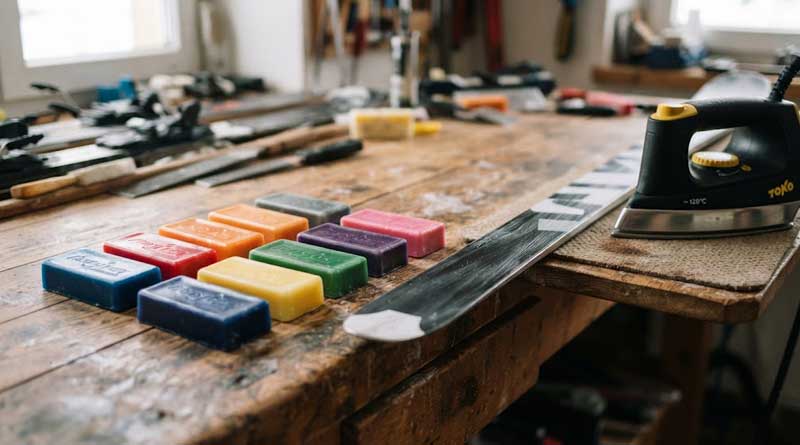
- Drip the Wax: Hold the universal wax bar against a dedicated ski tuning iron set to the manufacturer’s recommended temperature. Drip a steady line of molten wax along the length of the base.
- Spread and Iron: Smoothly move the iron from tip to tail without stopping in one spot to avoid delaminating the base. Maintain a liquid layer of wax directly behind the iron.
- Cooling Period: Allow the skis to cool at room temperature for at least 20 to 30 minutes so the wax fully crystallizes within the base pores.
- Scrape: Use a sharp plastic scraper held at a 45-degree angle to scrape off all excess surface wax, working from tip to tail until the base looks smooth and clear.
- Brush: Use a stiff nylon brush followed by a horsehair brush from tip to tail to clear wax out of the micro-structure channels, exposing the texture of the base for water drainage.
Method B: Liquid / Rub-On Application (Fast Touch-Up)
- Clean the base of moisture and debris using a towel.
- Apply liquid or paste wax evenly across the entire base surface.
- Allow the solvent to dry completely (typically 2 to 5 minutes).
- Buff the base vigorously using a hand felt pad or cork block to create friction and press the wax into the base surface.
- Finish with a light brushing using a nylon brush to clear the structure.
Maintenance Tips to Maximize Base Longevity
Regular maintenance ensures that your all-temp wax performs at its absolute peak every time you drop into a run. Keep these best practices in mind:
- Watch for “Dry Base” White Patches: Polyethylene base material oxidizes when unprotected, turning chalky gray or white near the steel edges. Apply hot all-temp wax immediately when you spot dry patches.
- Wax Every 3–5 Days on Snow: Even if your skis still feel moderately fast, applying a fresh coat of hot wax regularly prevents friction burn and maintains base elasticity.
- Keep Your Tools Clean: Keep plastic scrapers sharp using a scraper sharpener, and brush out old wax dust from your tuning brushes periodically using base cleaner.
- Store Correctly Off-Season: Apply a thick layer of all-temp hot wax at the end of the winter season, but do not scrape it off. Leave the un-scraped layer intact over the summer to block air, dust, and moisture from damaging the base, scraping it clean right before your first autumn trip.
Frequently Asked Questions (FAQ)
Can I mix all-temp wax with temperature-specific wax?
Yes. You can layer or melt an all-temp wax together with a cold or warm wax bar to slightly broaden or adjust its thermal range. For example, adding a small amount of cold hard wax to an all-temp bar boosts durability on abrasive, machine-made snow.
Is liquid rub-on wax as good as hot wax?
Liquid rub-on wax offers excellent short-term glide but lacks the durability of hot wax. Because liquid wax stays on the surface rather than penetrating deep into sintered base pores, it typically wears off after half a day to a full day of active skiing. It is best used as a quick booster over an existing hot wax base.
Will all-temp wax work on snowboards too?
Absolutely. Ski wax and snowboard wax are identical in chemical composition. The only difference is that snowboards require significantly more wax volume and wider scrapers due to their larger surface area.
Why does my all-temp wax feel slow on spring slush?
Spring slush creates extreme suction due to standing surface water. While all-temp wax repels water reasonably well, overcoming wet suction often requires adding a coarser mechanical structure (rilling) to the ski base alongside a warm-weather hydrophobic wax.