Best Ski Helmet Cameras of 2026
Capturing every exciting moment on the slopes is easier than ever with a ski helmet camera. Whether you’re skiing through powder, racing down steep trails, or enjoying a day with friends, the right camera helps you relive the action in amazing detail. These compact, durable devices are built to handle cold, snow, and high speeds while delivering clear, steady footage. In this guide, we’ll look at the best ski helmet cameras that combine performance, reliability, and ease of use for every type of skier.
1. MTCA Helmet Action Camera

- Video: 4K Ultra HD
- Photo: 16MP stills
- Lens & Stabilization: 145° wide + 6-axis gyro EIS
- Battery & Housing: ~3.5 hr; IP68 waterproof
Light, rugged, and image-focused, the MTCA Helmet Action Camera is an excellent choice for skiers who want crisp footage without fuss. The 4K capture and 16MP photos deliver detailed clips for descents and scenic climbs, while the 145° wide lens frames a natural POV that avoids the fisheye distortion some action cams produce. The 180° rotatable screen is useful for quick framing and vlogging on the mountain, and the WiFi connectivity makes it simple to transfer clips to a phone between runs.
The standout feature is the 6-axis gyro stabilization — footage stays remarkably smooth even at high speed or over choppy terrain, which reduces time spent stabilizing in post. The IP68 housing gives confidence in wet, snowy, or slushy conditions, and continuous recording while charging removes battery anxiety on longer days when you can top up from a power bank. Smart features like pre/post-record, time-lapse, and loop recording add versatility for helmet mounting, dash-cam use, or campsite timelapses. Overall, it’s a balanced, adventure-ready camera for skiers who want reliable, high-resolution POV footage without a steep price tag.
- Pros: Excellent stabilization; true 4K; durable waterproof housing; rotatable screen.
- Cons: Battery life good but not class-leading; accessory ecosystem smaller than GoPro.
See the MTCA Helmet Action Camera
2. Sixmou i3

- Size & Weight: Thumb-size; 1.25 oz (35.7 g)
- Mounting: Magnetic pad + 360° rotating clip; multiple mounts
- Waterproof: 40 m (131 ft) with housing
- Battery: 800 mAh; up to 150 min (1080p)
The Sixmou i3 is built around stealth and convenience — it’s tiny enough to forget you’re wearing it, which makes it perfect for helmet-mounted POV footage where low profile matters. For skiers who prefer unobtrusive setups, the magnetic mounting accessories and spring clip let you place the camera on a helmet peak, jacket zip, or chest harness in seconds. Image quality at 4K is impressive for such a small unit, and hands-free recording frees you up to focus on technique and terrain rather than gear.
Practical strengths are clear: long-ish battery life for a micro camera, waterproof housing for winter storms and plunge-worthy conditions, and multiple mounts so you can switch angles quickly between runs. The small size means fewer wind-noise surfaces and a more natural silhouette on the helmet, but tiny cameras can be fiddly when changing batteries or SD cards in gloves. Overall, the Sixmou i3 is ideal for skiers who want a minimalist, go-anywhere POV cam that’s unobtrusive on the slope and simple to mount and remove between lifts.
- Pros: Extremely compact and light; versatile magnetic mounting; decent 4K for size; solid waterproof housing.
- Cons: Small controls tricky with gloves; camera not waterproof without case; lower battery at 4K.
3. bayehngs WiFi Helmet Camera

- Video: HD 1080P recording
- Connectivity: WiFi app preview/playback
- Durability: IP66 splash-resistant
- Battery: 1600 mAh; ~6 hours runtime
The bayehngs WiFi Helmet Camera is a sensible, no-nonsense option for skiers who want long runtime and simple operation rather than headline specs. At 1080P it won’t produce the ultra-high-resolution clips of 4K rigs, but it captures clean, usable footage that’s easy to store and edit. The 1600 mAh battery is impressive for this class and will usually last a full day of laps without swapping — great for backcountry outings or long resort days. The lightweight build and multiple mounting options make it straightforward to fit to helmets or handlebars.
Connectivity to a phone via WiFi simplifies previewing and downloading runs between lifts, and the IP66 rating means light snow and sleet won’t cut a session short. The camera’s strength is endurance and convenience rather than cutting-edge image quality — if you want a dependable recorder with simple controls and robust battery life, this fills that niche. For skiers focused on documenting long sessions or using the camera as a training aid, it’s a practical, cost-effective choice that keeps shooting without fuss.
- Pros: Long battery life; easy WiFi transfers; light and mount-friendly; weather-resistant.
- Cons: 1080P only; not fully submersible; image stabilization not highlighted.
See the bayehngs WiFi Helmet Camera
4. AKASO Brave 4

- Video & Photo: 4K30fps video; 20MP photos
- View Angle & Stabilization: up to 170°; gyro stabilization
- Waterproof: 40 m (131 ft) with case
- Battery & Screens: 2×1050mAh; dual screens
The AKASO Brave 4 is a well-rounded action camera that’s popular for good reason: strong feature set, dual batteries, and a usable accessory kit that plays nicely for ski helmet mounting. The 4K30 video and 20MP photos offer solid detail for slope footage, while selectable viewing angles (including 170°) let you dial in a natural field of view for different helmet positions. The included waterproof case and dual batteries make it easy to shoot long days or take the camera off piste without worrying about sudden weather changes.
Gyro-based stabilization keeps footage watchable even during aggressive turns, and the WiFi/HDMI options simplify sharing and reviewing clips on the chairlift. The remote wristband (note: not waterproof) is handy for starting and stopping recordings without unzipping layers. For skiers who want a reliable, affordable all-rounder with good battery redundancy and a broad accessory kit, the Brave 4 strikes an attractive balance between capability and value.
- Pros: Dual batteries and accessories included; waterproof case; flexible viewing angles; good stabilization.
- Cons: Remote not waterproof; 4K limited to 30fps; image quality not top-tier vs premium brands.
5. Hiicam 4K Action Camera

- Video & Photo: 4K60FPS video; 20MP stills
- Screens & Power: Rear 2″ touch IPS + 1.4″ front; 2×1350mAh
- Stabilization: EIS (up to 4K30fps)
- Waterproof: 40 m (131 ft) with housing; supports 256GB SD
The Hiicam 4K Action Camera aims at enthusiasts who want high-frame 4K capture and convenient handling on the mountain. The 4K60 capability provides smoother motion for fast runs, while dual screens — including a rear touch display — make framing and mode changes straightforward when you’re grabbing footage between runs. EIS stabilization is effective up to 4K30, delivering steady results for POV helmet mounts when you’re cruising groomers or tackling choppy icy descents.
Battery life is improved by two 1350mAh packs included in the kit, and large-SD support keeps you shooting all day. The waterproof housing lets you brave wet weather and spring-ski slush without worry, though the case is required for full submersion. WiFi and the remote control add convenience for starting/stopping without exposing gloves to cold. For skiers who value frame-rate flexibility, touchscreen convenience, and long-term recording with generous storage options, the Hiicam is a compelling mid-range helmet camera choice.
- Pros: High frame-rate 4K60; dual batteries; touch screen; big SD support.
- Cons: EIS limited to 4K30; housing required for waterproofing; slightly bulkier with case.
See the Hiicam 4K Action Camera
6. Apexcam Action Camera

- Video & Photo: 4K60FPS video; up to 64MP photo
- Screen: 2.0″ high-sensitivity touch display
- Zoom & Accessories: 8× digital zoom; 64GB card included
- Wide Angle & Modes: 170° field; time-lapse, loop, pre-record
The Apexcam M80 delivers a feature-rich package tailored to adventurous skiers who want a robust set of shooting modes and on-device control. Native 4K60 capture matches fast ski maneuvers nicely, and the claimed 64MP photo mode plus 8× zoom give more framing flexibility than many action cams. The responsive 2.0″ touchscreen simplifies menu navigation and playback, which is handy when adjusting settings mid-day on the hill.
Built-in modes like pre-record and driving (power-on) recording are useful for auto-triggered capture scenarios or when using the camera as a helmet dash during travel. The accessory kit and included batteries support varied mounting setups, and WiFi + 2.4G remote extend usability while keeping hands warm. While digital zoom and very high megapixel claims are performant within limits, the M80 is a solid cost-effective option for skiers wanting a versatile, customizable helmet camera with plenty of shooting features.
- Pros: 4K60 capture; touchscreen ease; comprehensive modes; useful accessory pack.
- Cons: Digital zoom (not optical); remote not waterproof; image quality may vary at max resolution.
7. DRIFT Ghost XL
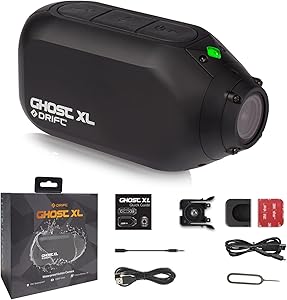
- Waterproof: IPX7 rated (out-of-box waterproof)
- Video: 1080P HD recording; 140° wide-angle
- Battery: 3000mAh; up to 9 hours continuous
- Modes: Dash cam mode; event detection; loop recording
The DRIFT Ghost XL is designed for endurance and simplicity, making it a standout for long ski days and multi-day trips where charging opportunities are limited. The giant 3000mAh battery easily supports an entire day — often several — of continuous recording, and the IPX7 waterproofing removes worry about wet-snow exposure. While it records at 1080P rather than 4K, the Ghost XL prioritizes reliability, long runtime, and straightforward operation over the highest possible resolution.
Its dash-cam style features like event detection and loop recording are useful for backcountry travel and logging long transfers to and from resorts, and the broad 140° lens captures sweeping runs with a cinematic feel. The Ghost XL is ideal for skiers who value battery life, ruggedness, and an always-on camera approach rather than maximal megapixels. If you need day-long recording, durable waterproofing straight from the box, and easy setup on a helmet or chest rig, the Ghost XL is a dependable companion.
- Pros: Massive battery life; out-of-box waterproof; simple, dependable operation; great wide-angle coverage.
- Cons: 1080P only (no 4K); larger physical size; fewer advanced shooting modes than smaller rivals.
How to Choose Ski Helmet Cameras
Capturing your ski adventures on camera is one of the best ways to relive the thrill of carving down snowy slopes or exploring off-piste trails. A ski helmet camera lets you record from your own point of view, giving you immersive, hands-free footage that’s perfect for sharing or improving your technique. But with so many action cameras on the market, choosing the right one can be tricky. From video resolution to stabilization and mounting options, every feature affects how your footage turns out. Here’s a complete guide to help you choose the best ski helmet camera for your next trip to the mountains.
Video Quality and Resolution
The first factor to consider is video quality. A camera’s resolution determines how sharp and detailed your footage looks. Most modern action cameras offer at least 1080p Full HD recording, but higher-end models now reach 4K or even 5K quality. If you want crisp, cinematic footage that can be displayed on large screens, go for a 4K camera with at least 30 frames per second (fps). For smoother motion, especially in fast skiing or snowboarding sequences, look for 60fps or higher frame rates. Cameras with 4K60 capability capture rapid turns and jumps without blurring or stutter, giving you fluid playback even in challenging lighting conditions.
Image Stabilization
When skiing, even the steadiest helmet mount won’t eliminate vibrations or bumps. That’s where image stabilization comes in. Electronic Image Stabilization (EIS) and Gyro Stabilization systems correct for sudden movements, keeping your footage smooth and watchable. Some advanced cameras use six-axis stabilization for even better performance in fast-paced downhill runs. If you ski on rough terrain or enjoy moguls and off-piste routes, strong stabilization is essential to avoid shaky, unusable clips. It’s worth noting that not all stabilization works at full 4K resolution, so check the camera’s specs before buying.
Durability and Weather Resistance
Cold, snow, and moisture are constant on the slopes, so your ski helmet camera needs to handle harsh conditions. Look for models with waterproof or at least weather-sealed designs. Cameras with IP68 or IPX7 ratings are ideal, meaning they can survive snow, rain, and submersion without damage. If your camera isn’t waterproof by itself, make sure it comes with a rugged waterproof housing. This not only keeps out snow and water but also protects against impacts during falls or collisions. In addition, choose a camera that remains functional at low temperatures, as some batteries and screens can struggle below freezing.
Mounting Options and Compatibility
A ski helmet camera is only as good as its mount. The mount should keep the camera secure without affecting comfort or visibility. Many cameras come with adhesive mounts that attach to the front, side, or top of a helmet, while others use strap or clip systems. Side mounting tends to give a more natural point of view, similar to what your eyes see, while top mounting provides a higher, more cinematic angle. Some newer models feature magnetic mounts that allow quick attachment and removal, which is great for switching between helmets or adjusting angles mid-day. Always check that the camera’s mount is compatible with your helmet design and that it stays stable even on rough terrain.
Battery Life and Power Options
Battery performance is another crucial factor, especially in cold weather where batteries tend to drain faster. Most action cameras offer between 90 minutes to 3 hours of continuous recording, though high-capacity models can last even longer. If you plan long ski days or multi-day trips, consider a camera with swappable batteries or the ability to record while charging via a power bank. Keep spare batteries warm in an inner pocket to extend their life. Some cameras include dual battery kits, which are ideal for longer sessions or travel without easy charging access.
Field of View and Lens Options
The field of view (FOV) determines how wide your footage appears. A wide-angle lens captures more of the landscape and your surroundings, creating immersive footage that shows both the slope and your movement. Typical action cameras offer FOVs between 140° and 170°. While wider angles give a dynamic, “first-person” effect, they can also introduce fisheye distortion. Look for cameras that allow adjustable FOV settings so you can switch between wide, medium, and narrow views depending on the shot. Some advanced models even let you tilt or rotate the lens, giving you more control over framing.
Connectivity and Sharing Features
In today’s digital world, instant sharing is a must. Many ski helmet cameras now come with built-in WiFi and Bluetooth for quick file transfers and remote control. You can connect the camera to your smartphone through a dedicated app to preview footage, change settings, or post clips directly to social media. Some even feature live streaming capabilities, so you can broadcast your runs in real time. If you enjoy editing or sharing content online, prioritize cameras with fast wireless connections and intuitive mobile apps. HDMI output is also handy if you want to view your videos on a larger screen without transferring files.
Size, Weight, and Ease of Use
A ski helmet camera should be lightweight and compact so it doesn’t affect your balance or comfort. Bulky cameras can cause drag or feel awkward during fast descents. Ultra-light models, some weighing under 40 grams, are barely noticeable and perfect for long sessions. Controls should be easy to access with gloves on, ideally with large buttons or touchscreen interfaces. Dual-screen cameras are especially useful, allowing you to check framing or settings quickly without removing the helmet. Simplicity is key—choose a model that lets you start recording instantly with one button or voice command.
Audio Performance
While most people focus on video, good audio makes a huge difference in immersion. Wind noise is a big challenge when skiing, so look for cameras with noise reduction microphones or external mic compatibility. Some waterproof housings can muffle sound, so consider using them only when necessary. A few premium models allow connecting Bluetooth microphones or offer advanced noise filtering that maintains clarity even at high speeds. If commentary or vlogs are part of your plan, audio quality should be a serious consideration.
Extra Features Worth Considering
Loop Recording and Dash Cam Mode
Some cameras include loop recording or dash cam functionality, automatically overwriting old footage to save space. This is great for those who like to record continuously without managing files manually.
Time-Lapse and Slow Motion
Time-lapse and slow-motion modes let you get creative with your ski footage. Capture a sunrise over the mountains or a jump in cinematic slow motion for a professional-looking edit later.
Voice Control and Remote Operation
Voice control allows hands-free operation, ideal when you’re wearing thick gloves or moving fast. Similarly, remote wristbands or smartphone apps make it easy to control the camera from a distance without removing gear.
Storage Capacity
Always check memory card compatibility. For 4K recording, you’ll need at least a Class 10 or UHS-I microSD card with large capacity. Some models support up to 256GB, allowing hours of high-quality footage before needing to offload files.
Budget and Brand Considerations
Your budget will largely determine what features you can get. Premium models from brands like GoPro, Insta360, or DJI offer excellent image quality, superior stabilization, and advanced connectivity—but at a higher price. Mid-range options from brands such as AKASO, Apexcam, or Hiicam provide great value, offering 4K recording and waterproof cases at a fraction of the cost. Cheaper cameras can be fine for casual users, but they often compromise on stabilization, battery life, and app quality. Choose based on your priorities—serious skiers may prefer investing in a high-end camera that will last several seasons.
Conclusion
Choosing the right ski helmet camera comes down to balancing image quality, durability, and usability. Look for 4K recording, solid stabilization, and reliable waterproof protection as must-haves for ski use. Pay attention to mounting options, battery life, and ease of control with gloves. Features like dual screens, WiFi sharing, and adjustable fields of view add convenience and creativity to your footage. Whether you’re carving groomers, hitting backcountry lines, or just enjoying family ski trips, the right helmet camera will let you capture every thrilling moment with clarity and style.