Best Ski Goggles for All Conditions of 2026
Finding the best ski goggles for all conditions can make every day on the mountain more comfortable and enjoyable. Good ski goggles help protect your eyes from bright sunlight, wind, snow, and harmful UV rays while keeping your vision clear. Whether you ski on sunny slopes, cloudy days, or changing weather, the right pair can improve visibility and confidence. In this guide, we’ll look at some of the best ski goggles for different conditions, styles, and skiing needs.
1. OutdoorMaster OTG Ski Goggles

- Design: OTG over-the-glasses fit for adults and youth
- Lens: Dual-layer anti-fog coated inner lens
- Protection: 100% UV400 protection with soft TPU frame
- Compatibility: Extra-long elastic strap fits all helmets
The OutdoorMaster OTG Ski Goggles are a practical choice for skiers and snowboarders who wear prescription glasses on the slopes. The over-the-glasses design means you do not have to struggle with contacts or ski without clear vision. The dual-layer lens technology with an anti-fog coated inner lens keeps your view clear even when you are working up a sweat on a long run. The soft TPU frame adds durability while staying comfortable against your face.
These goggles also deliver excellent optical clarity and reliable UV400 protection, which is essential for long days in bright snow conditions. The extra-long elastic strap ensures universal helmet compatibility, making them suitable for both adults and teens. Whether you are a beginner or a seasoned rider, these goggles offer a solid balance of performance and value. The included carrying pouch is a nice touch for storage and travel.
- Pros: Fits over glasses, strong anti-fog performance, universal helmet fit, good value
- Cons: Lens not interchangeable, limited color options, may feel bulky for some users
See the OutdoorMaster OTG Ski Goggles
2. goodr Peak G

- UV Protection: 100 percent
- Lens Shape: Cylindrical
- Frame Size: Medium
- Interchangeable Lenses: Yes, 1 additional included
The goodr Peak G snow goggles are built for riders who want adaptability without overcomplicating things. The S1 yellow lens is designed for low-light conditions, helping you see terrain details when the clouds roll in. The swappable strap and interchangeable lens system mean you can adjust on the fly, whether you are ripping groomers or carving fresh powder. The cylindrical lens shape offers a classic look with a medium frame size that fits a wide range of faces.
With 100 percent UV protection and helmet compatibility, these goggles check the essential boxes for a day on the mountain. They are not polarized or photochromic, so you will need to swap lenses when conditions change, but the included additional lens helps cover different light situations. The standard bridge fit keeps things comfortable, and the medium frame size works well for adults and older teens. Overall, the Peak G is a versatile option for riders who value flexibility.
- Pros: Interchangeable lenses, swappable strap, good for low light, helmet compatible
- Cons: Not polarized, light transmission not specified, medium frame may not fit all
3. Smith I/O MAG ChromaPop

- UV Protection: 100 percent
- Lens Shape: Spherical
- Frame Size: Medium
- Interchangeable Lenses: Yes, 1 additional included
The Smith I/O MAG ChromaPop snow goggles are designed for skiers and riders who demand sharp optics and quick lens changes. ChromaPop technology boosts color and contrast so every wind lip, landing, and tree glade stands out clearly. The MAG lens system lets you swap lenses in seconds, which is a huge advantage when light conditions shift throughout the day. The spherical lens shape provides a wide field of view and reduces distortion, helping you stay focused on your line.
With 100 percent UV protection and a medium frame size, these goggles work well for a wide range of adults. The standard bridge fit and helmet compatibility make them easy to integrate with your existing gear. Multiple lens options are available with varying light transmission rates, so you can fine-tune your setup for sunny or stormy days. The included additional lens adds value right out of the box. For riders who want premium clarity and convenience, the I/O MAG ChromaPop is a strong contender.
- Pros: Excellent contrast and clarity, fast MAG lens swapping, spherical lens, helmet compatible
- Cons: Not polarized, premium price, medium frame may not suit larger faces
See the Smith I/O MAG See the Smith I/O MAG S See the Smith I/O MAG XL
4. Smith 4D MAG ChromaPop

- UV Protection: 100 percent
- Lens Shape: Spherical
- Frame Size: Medium
- Interchangeable Lenses: Yes, 1 additional included
The Smith 4D MAG ChromaPop snow goggles take visibility to the next level with a wide field of view and sharp optics. The 4D MAG design extends the lens downward to improve your downward vision, which is a game-changer when you are checking zippers, buckling boots, or navigating steep terrain. ChromaPop technology enhances definition and contrast, so you can spot subtle changes in snow texture before they catch you off guard. The spherical lens shape keeps distortion low and clarity high.
With 100 percent UV protection and a medium frame size, these goggles are built for adults who want premium performance. The MAG lens system makes swapping lenses fast and intuitive, and the included additional lens gives you flexibility for changing light. The standard bridge fit and helmet compatibility ensure a secure, comfortable fit with most snowsports helmets. Multiple lens tint options are available with varying light transmission rates. If you want top-tier optics and a wider field of view, the 4D MAG ChromaPop is worth the investment.
- Pros: Expanded downward vision, excellent ChromaPop clarity, fast lens swapping, helmet compatible
- Cons: Not polarized, high price, medium frame may not fit everyone
See the Smith 4D MAG See the Smith 4D MAG S See the Smith 4D MAG XL
5. OutdoorMaster PRO

- Design: Frameless spherical lens with OTG fit
- Lens System: Interchangeable, 20+ options sold separately
- Protection: 100% UV400 and anti-fog coating
- Compatibility: Extra-long elastic strap fits all helmets
The OutdoorMaster PRO ski goggles combine a frameless design with a large spherical lens to deliver a truly unobstructed view of the slopes. The OTG design lets you wear your prescription glasses underneath, making them a great choice for riders who do not want to switch to contacts. The interchangeable lens system supports a wide range of extra lenses for day, night, and different weather conditions, though those additional lenses are sold separately. All lenses are anti-fog coated and offer 100% UV400 protection.
The extra-long elastic strap ensures universal helmet compatibility, and the goggles are suitable for both adults and teens. The frameless design not only looks sleek but also reduces visual interference, giving you a super wide HD vision experience. The protective case and carrying pouch add convenience for transport and storage. If you want a versatile goggle with a huge lens selection and a clean, modern look, the OutdoorMaster PRO is a solid pick.
- Pros: Frameless wide view, OTG compatible, huge lens selection, UV400 protection
- Cons: Extra lenses cost more, may be too large for smaller faces, not polarized
6. findway Ski Goggles OTG
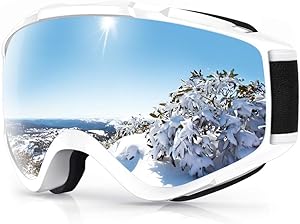
- Ventilation: Smooth air-flow system reduces fogging
- Lens: Italian-made anti-fog inner lens, spherical frameless design
- Protection: 100% UV protection with revo mirror coating
- Compatibility: OTG fit, helmet compatible, not for kids under 12
The findway Ski Goggles OTG are built for performance and comfort across a range of winter activities. The professional ventilation system is designed to reduce fogging by optimizing airflow over the inside of the lens, bringing in fresh air and exhausting moisture quickly. The performance double lens is anti-scratch, anti-fog, and impact resistant, with a full-face revo mirror coating that reflects light and adds style. The inner lens is made in Italy with long-lasting anti-fog materials, and the spherical frameless design creates a super wide HD vision.
The oversized OTG design allows you to wear your glasses under the goggles, making them suitable for skiers and snowboarders who wear prescription eyewear. The silicone-backed non-slip strap is extra long and widening, with high-density 3D jacquard construction for a secure fit over helmets. The premium TPU frame and triple-layer foam provide warmth, breathability, and comfort. These goggles are designed for men, women, and youth, but they are not suitable for kids under 12. A one-year guarantee and 24/7 customer service add peace of mind.
- Pros: Excellent ventilation, Italian anti-fog lens, OTG fit, wide HD vision
- Cons: Not for kids under 12, not polarized, strap may be too long for some
See the findway Ski Goggles OTG
7. SMITH Squad

- Lens: ChromaPop technology with anti-fog and smudge-resistant coatings
- Design: Semi-rimless, oversized cylindrical lens
- Fit: Responsive fit frame with dual-slide strap
- Integration: Seamless pairing with Smith snowsports helmets
The SMITH Squad goggles are designed to give you a crystal clear view no matter how the weather and light change. The semi-rimless design and oversized cylindrical lens yield a wide field of view, backed by sharp optics and Smith’s best anti-fog tech. ChromaPop lens technology enhances definition, contrast, and natural color so you never miss a detail, while smudge- and moisture-resistant coatings make cleaning easy and keep your optics clear while skiing or snowboarding.
These goggles are built for ultimate integration with Smith snowsports helmets, maximizing comfort, venting, and fog-free performance. The dual-slide strap lets you easily size the goggles correctly, and the responsive fit frame adjusts to your face for a precise fit. The ultra-wide, silicone-backed strap stays put even during aggressive riding. Whether you are cruising groomers or exploring the trees, the Squad offers a comfortable, secure fit with excellent optical performance.
- Pros: ChromaPop clarity, wide field of view, helmet integration, secure dual-slide strap
- Cons: Not polarized, cylindrical lens may not suit everyone, premium price
8. EXP VISION Over-Glasses Ski Goggles

- Design: Panoramic cylindrical lens with detachable sponge frame
- Anti-Fog: Anti-fog coated lens with top and bottom vents
- Protection: 100% UV400 protection against UVA and UVB rays
- Compatibility: OTG friendly with adjustable helmet-compatible strap
The EXP VISION Over-Glasses Ski Goggles stand out for their detachable sponge frame, which makes it easy and fast to clean the sponge without scratching the lens. This feature also helps refresh the smell of sweat on the goggles after repeated use. The panoramic cylindrical lens design delivers super clear vision with less visual interference, making it easier to spot terrain details whether you are exploring backcountry trails or cruising resort slopes. Strategic top and bottom vents promote consistent airflow, minimizing fogging even during intense runs.
The anti-fog coated lens resists moisture buildup, and the wide-view design delivers crisp optics across your peripheral vision. Complete UV400 protection blocks harmful UVA and UVB rays, reducing eye fatigue on sun-reflective snow. The ultra-lightweight frame reduces pressure on your face and minimizes neck strain, so you can wear them from first chair to last run. The spacious OTG-friendly frame fits comfortably over most prescription glasses, and the adjustable strap system accommodates any helmet for a secure fit.
- Pros: Detachable sponge for easy cleaning, OTG friendly, lightweight, UV400 protection
- Cons: Not polarized, cylindrical lens may not suit all, sponge may need frequent cleaning
See the EXP VISION Over-Glasses Ski Goggles
How to Choose Ski Goggles for All Conditions
Skiing and snowboarding are sports of light. The quality of your vision directly affects your safety, confidence, and enjoyment on the mountain. A single pair of goggles that works perfectly under bright sun will often fail you in flat light or a snowstorm. Conversely, a lens optimized for low light becomes dangerously dark when the sun breaks through. Choosing the right ski goggles for all conditions is not about finding one magic lens; it is about understanding the technology, lens categories, and modular systems that allow you to adapt. This guide breaks down the essential factors—from lens shape and VLT to interchangeable systems and ventilation—so you can build a quiver of lenses or choose a versatile all-rounder.
1. Understand the Core Purpose of Ski Goggles
Ski goggles do far more than block wind. They protect your eyes from UV radiation (which increases with altitude), flying ice, and tree branches. More importantly, they enhance contrast. Snow is highly reflective, and without a goggle, the terrain in front of you can appear as a featureless white carpet. A good goggle uses lens tint, coatings, and polarization to reveal the texture of the snow—the difference between an icy patch and powder, or a rock and a shadow.
2. The Most Critical Factor: Lens Tint and VLT
Visible Light Transmission (VLT) is the percentage of light that passes through the lens to your eye. This is the single most important specification for choosing goggles for different conditions.
VLT Ranges Explained
- 0–10% VLT (Category 4): Extremely dark. For high-altitude glaciers and intense sun. Not suitable for driving or low light.
- 10–20% VLT (Category 3): Dark tint. Ideal for bright, sunny days on the mountain.
- 20–40% VLT (Category 2): Medium tint. A versatile range for partly cloudy to overcast conditions.
- 40–60% VLT (Category 1): Light tint. Best for overcast days, shadows, and moderate snowfall.
- 60–90% VLT (Category 0): Nearly clear. Essential for night skiing, deep storms, and extremely flat light.
For “all conditions,” you will either need a goggle with a photochromic lens (which auto-adjusts VLT) or a system with interchangeable lenses covering at least two categories: one for sun (10–20% VLT) and one for low light (50–70% VLT).
3. Lens Shape: Cylindrical vs. Toroidal vs. Spherical
Lens shape affects peripheral vision, optical distortion, and style. Each has trade-offs.
Cylindrical Lenses
These curve only horizontally. They are the most affordable, offer a classic look, and are easy to change. However, they can produce slight distortion at the edges and have less internal volume, making them more prone to fogging in some cases.
Toroidal (or Spherical) Lenses
These curve both horizontally and vertically, mimicking the shape of the human eye. They offer superior peripheral vision, reduced distortion, and better air circulation (which helps prevent fogging). They are generally more expensive but are the top choice for serious all-condition skiers.
Why Shape Matters for All Conditions
A spherical lens keeps the lens surface at a more consistent distance from your eye, which reduces optical distortion when you look sideways. In flat light, where every subtle shadow counts, this clarity is invaluable. Cylindrical lenses can be fine for budget-conscious skiers, but if you frequently ski in variable light, spherical is worth the investment.
4. Interchangeable Lens Systems: The Key to All-Condition Versatility
No single lens excels in both bright sun and heavy snow. The practical solution is a goggle with a quick-change lens system. Modern systems use magnets, clips, or a combination of both.
Magnetic Systems
Magnets hold the lens in place and allow for lightning-fast swaps—often in under 10 seconds. High-quality magnetic goggles (like those from Anon or Smith) use strong neodymium magnets and a mechanical lock for security. They are excellent for changing conditions on the fly.
Clip & Lever Systems
These use physical latches or levers at the frame’s edges. They are extremely secure and less likely to shift on impact, but swapping lenses can take a bit longer. Brands like Oakley and Giro offer robust clip systems.
Photochromic Lenses: The “Set and Forget” Option
Photochromic lenses automatically darken when UV light increases and lighten when clouds roll in. They are a fantastic choice if you hate carrying extra lenses. However, they have limitations: they can be slow to adapt (especially in cold temperatures), and they typically have a narrower VLT range (e.g., 20–40%) compared to dedicated lenses. They are great for partly cloudy days but may not be dark enough for full sun or light enough for night skiing.
5. Frame Size and Fit
Fit is not just about comfort; it affects fogging and field of view. A poorly fitting goggle will let in cold air, create gaps, or press uncomfortably against your nose.
Helmet Compatibility
Most modern skiers wear helmets. Your goggles should sit flush against the helmet’s brim without a gap. A gap creates a “wind tunnel” that can freeze your forehead and cause fogging. Look for goggles with a “helmet-compatible” design—often a slightly larger frame and a strap with silicone grippers.
Face Shape and Nose Bridge
If you have a narrow face, a large goggle may overlap your nose or leave gaps at the cheeks. If you have a wide face, a small goggle may pinch. Many brands offer low-bridge fit versions for people with flatter nose bridges. Always try goggles on with your helmet if possible.
OTG (Over-the-Glasses) Goggles
If you wear prescription glasses, you need OTG goggles. These have deeper frames and cutouts in the foam to accommodate glasses. Without OTG, your glasses will press against your face, causing pain and fogging.
6. Ventilation and Anti-Fog Technology
Fogging is the enemy of all-condition skiing. It happens when warm, moist air from your face meets the cold lens. To combat this, look for:
- Dual-pane lenses: Two lenses with a sealed air gap act as insulation, reducing temperature difference.
- Anti-fog coating: A hydrophilic coating on the inner lens absorbs moisture. Never wipe the inside of your lens—you will destroy this coating.
- Ventilation: Frame vents (top and bottom) allow airflow. Some goggles use active ventilation with foam filters.
- Proper fit: A tight seal around your face keeps moist breath from entering the goggle.
For all conditions, a dual-pane, spherical goggle with good ventilation is your best bet. In humid or rainy conditions (common in spring), you may need to be extra diligent about not sealing your face covering over your goggle’s bottom vent.
7. Polarization: Pros and Cons
Polarized lenses reduce glare from reflective surfaces like snow and ice. They can be excellent for bright, sunny days on groomed runs. However, they can also make it harder to see icy patches because they cut out some of the light that reveals texture. Many ski goggle manufacturers avoid full polarization for this reason, or they use it sparingly. For all-condition skiing, a non-polarized lens with high contrast (like Oakley’s Prizm or Smith’s ChromaPop) is often a better choice than a polarized lens.
8. Contrast-Enhancing Lens Technologies
Brands have developed proprietary tints that filter specific wavelengths of light to boost contrast in flat light. These are game-changers for all-condition skiing.
- Oakley Prizm: Enhances contrast by separating colors. Different Prizm tints are available for snow (e.g., Prizm Snow Sapphire for sun, Prizm Snow Torch for low light).
- Smith ChromaPop: Filters crossovers between blue and green light, making details pop. Available in various tints.
- Anon Perceive: A similar contrast-enhancing technology with a wide range of tints.
- Giro Vivid: Enhances contrast and reduces eye fatigue.
When choosing for all conditions, prioritize a contrast-enhancing lens for your low-light lens. A standard rose or yellow tint works, but proprietary tech is noticeably better.
9. A Practical All-Condition Lens Quiver
If you want to be prepared for everything, here is a suggested lens selection for a single goggle frame with interchangeable lenses:
| Condition | Recommended VLT | Lens Tint Example | Notes |
|---|---|---|---|
| Bright sun, bluebird | 10–15% | Dark grey, dark brown, mirrored | Maximum glare reduction |
| Partly cloudy / variable | 20–35% | Rose, copper, amber | Versatile; good contrast |
| Overcast / flat light | 50–65% | Yellow, rose, high-contrast pink | Boosts shadow definition |
| Snowstorm / night | 70–90% | Clear, yellow, clear with contrast | Maximum light transmission |
With a magnetic or clip system, you can carry two lenses (e.g., a 15% and a 60%) and swap as needed. Many skiers find that a single photochromic lens (e.g., 20–40% VLT) plus a clear lens for storms covers 90% of days.
10. Additional Features to Consider
Strap and Silicone Grippers
A wide strap with silicone beads on the inside prevents the goggle from sliding up your helmet. This is essential for all-day comfort.
Foam Density
Multi-density foam (often two or three layers) provides a better seal and more comfort. Fleece-backed foam wicks moisture.
Field of View (FOV)
Frameless or semi-frameless designs offer a wider FOV. For all-condition skiing, a wide FOV helps you spot obstacles and other skiers in flat light.
Prescription Inserts
If you don’t want OTG, you can get prescription inserts that snap into the goggle’s nose bridge. These are custom-made and can be swapped between lenses.
11. Putting It All Together: A Step-by-Step Buying Strategy
- Determine your budget. Expect to spend $80–$150 for a basic interchangeable goggle, $150–$250 for a premium system with two lenses, and $250+ for top-tier brands with advanced contrast tech.
- Choose a lens shape. Spherical or toroidal for best all-around performance; cylindrical for budget.
- Decide on lens swapping. Magnetic or clip system if you want multiple lenses; photochromic if you prefer one lens.
- Select your primary lens. A 20–40% VLT contrast-enhancing lens is the best single-lens compromise. If you buy a two-lens kit, choose a 10–20% and a 50–70%.
- Try on with your helmet. Check for gaps, pressure points, and nose bridge fit. Look up, down, and sideways to test FOV.
- Verify anti-fog and ventilation. Read reviews for fogging issues. Dual-pane and good vents are non-negotiable.
- Consider OTG or inserts if you wear glasses.
12. Common Mistakes to Avoid
- Buying a dark lens for all conditions. You will be blind in storms and shadows.
- Wiping the inner lens. This destroys the anti-fog coating. Shake or air-dry instead.
- Ignoring helmet compatibility. A gap causes fog and a cold forehead.
- Assuming all photochromic lenses are fast. Some take minutes to change, which is too slow for rapidly shifting light.
- Overlooking contrast technology. A cheap yellow lens works, but a Prizm or ChromaPop lens in the same VLT will reveal more terrain detail.
13. Maintenance for Longevity and Performance
To keep your goggles performing in all conditions, care for them properly:
- Store in a soft microfiber bag or hard case.
- Never rest goggles on your forehead or helmet—this stretches the strap and presses the foam.
- Clean the outer lens with a microfiber cloth and lukewarm water. Avoid harsh chemicals.
- Do not leave goggles in a hot car; heat can delaminate the lens and degrade coatings.
- Replace lenses when they become scratched or the anti-fog coating wears off.
14. Final Recommendations by Skier Type
Budget-Conscious Occasional Skier
Look for a cylindrical goggle with a 20–40% VLT rose lens and a secondary clear lens if the system allows. Brands like OutdoorMaster or Wildhorn offer decent entry-level interchangeable goggles.
All-Mountain Enthusiast (10–20 days/year)
Invest in a spherical goggle with a magnetic interchangeable system. Get a 15% VLT mirrored lens for sun and a 55% VLT contrast lens for storms. Smith I/O Mag or Anon M4 are excellent.
Dedicated Powderhound or Professional
Go for a premium goggle with three lenses: 10% for sun, 30% for variable, and 65% for low light. Oakley Flight Deck with Prizm Snow lenses or Smith 4D Mag with ChromaPop lenses are top-tier.
Conclusion
Choosing ski goggles for all conditions is a process of matching lens technology to the light you actually ski in. There is no single perfect lens, but with an interchangeable system and two well-chosen lenses—one dark, one light—you can handle anything from a bluebird groomer to a whiteout storm. Prioritize VLT, contrast enhancement, and fit. Your eyes will thank you, and your skiing will improve when you can see the terrain clearly. Remember: the best goggle is the one you forget you are wearing, because your vision is perfectly adapted to the mountain’s ever-changing light.