Best Ski Boot Bags of 2026
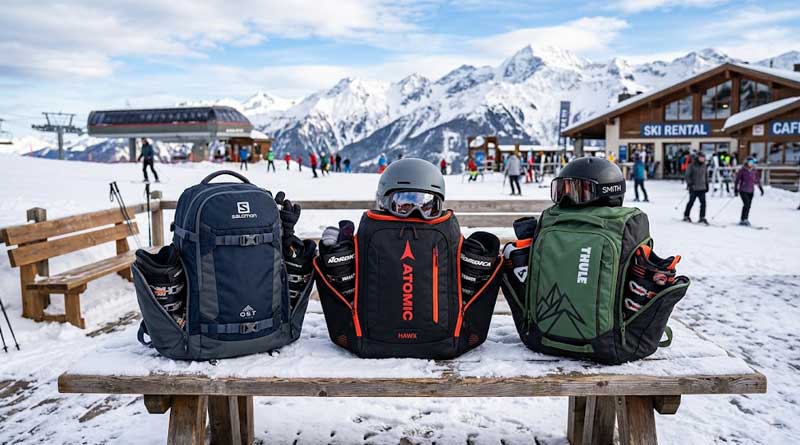
If you love skiing, you know how important it is to protect your gear. A good ski boot bag keeps your boots safe and makes carrying them easy. It also helps keep your car or home clean. With so many options, finding the right bag can be hard. This article reviews the best ski boot bags to help you choose the perfect one for your needs.
1. REI Co-op Powderbound

- Capacity: 55 L / 3,356 cu in
- Material: 600D recycled polyester shell, tarpaulin-lined boot bay
- Dimensions: 20 x 13 x 12 in
- Weight: 1 lb. 13 oz.
Think of the Powderbound as the bag that quietly does its homework while flashier packs are still showing off. REI didn’t chase gimmicks here — they built a boot bay with actual drainage, lined it in tarpaulin so slush doesn’t become a science experiment, and hinged the back panel so it unfolds into a stand-on mat when you’re wrestling a size-13 boot into place. Helmet and goggles slide in alongside without a fight, and the top-wrap zipper means you’re not excavating for your gloves while everyone else is already on the lift.
What earns this bag its keep is how little it complains about being carried. The padded back panel and shoulder straps turn a parking-lot slog into a non-event, and the 600D recycled polyester — borrowed from REI’s own duffel lineup — shrugs off the abuse that comes with airport carousels and gear-room floors. A PFAS-free DWR finish keeps moisture from settling in. It’s not trying to be everything; it’s trying to be reliable, season after season, and that restraint is the whole appeal.
- Pros: Durable recycled materials, smart boot access, drainable boot bay, comfortable carry.
- Cons: Single-boot-pair capacity, pockets are functional but not highly modular.
2. Unigear Ski Boot Bag

- Capacity: 50 L
- Material: Tarpaulin + 1050D nylon, tarpaulin-lined bottom
- Dimensions: 11.8 x 12.6 x 19.7 in
- Boot fit: Fits up to US men’s 12.5
Unigear seems to have asked “what if a budget bag actually tried?” — and the answer is this three-compartment hauler that keeps boots, helmet, and soggy accessories from ever touching each other. The flip-down back panel becomes an impromptu changing mat, so you’re not standing sock-footed in a puddle, and webbing on the exterior lets you strap on skis or a board when your hands are already full of coffee and car keys.
The fabric choice does a lot of quiet lifting: heavyweight 1050D nylon paired with tarpaulin gives the whole bag a tougher-than-its-price-tag feel, and the fully lined bottom laughs off cold and wet without missing a beat. An EVA-padded back and adjustable straps keep the load from becoming a chore across long walks to the lodge. It’s not chasing a premium badge — it’s chasing usefulness, and for the price, it delivers more of that than expected.
- Pros: Great value, multiple compartments, waterproof-lined bottom, standing mat feature.
- Cons: Less premium finish than top brands; lighter warranty/support.
3. evo 50L Boot Pack
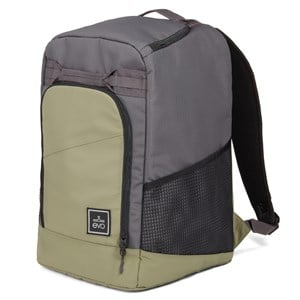
- Capacity: 50 L
- Material: 600D recycled PET ripstop with PU face out
- Dimensions: 19 x 13 x 13 in
- Pockets: Top helmet, front accessories, back boot pocket
There’s a certain confidence in a bag that’s bluesign® approved and PFC-free before it even gets to the fun stuff. evo built this pack for people who want their gear conscience-clean and their organization dialed in — a tarpaulin-lined boot compartment and coated mesh pockets keep the wet stuff quarantined, while YKK zippers and beefy haul handles suggest this thing isn’t planning on falling apart mid-season.
Wearing it is refreshingly uncomplicated: helmet goes up top, goggles get their own padded corner, and there’s enough room left over for an extra layer or two you didn’t think you’d need. The recycled fabric doesn’t feel like a compromise — it feels like the standard finish, not an upsell. evo also kicks 2% of proceeds to youth programs, a small detail that costs you nothing but says something about the company behind the zipper pulls. All told, it’s a dependable, values-forward option for regular resort runs.
- Pros: Thoughtful organization, sustainable materials, durable zippers and trims.
- Cons: Not the largest capacity for extended trips; Proposition 65 note for CA buyers.
4. Dakine 50L Boot Pack
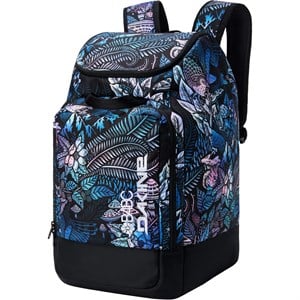
- Capacity: 50 L / 3,051 cu in
- Material: Nylon/Polyester (color dependent)
- Dimensions: 19 x 14 x 13 in
- Access: Rear-entry zipper for boot access
If getting out of the parking lot faster than everyone else sounds appealing, Dakine built this bag around exactly that fantasy. The rear-entry panel unzips wide open, so you’re clicking into boots while your buddies are still digging through a duffel. Helmet and goggles get their own dedicated homes, and a front cargo pocket swallows the small stuff — phone, keys, chapstick — without making you hunt for it later.
Nothing here feels experimental, and that’s sort of the point: Dakine leans on a track record of sturdy stitching and dependable materials instead of reinventing the boot bag. There’s enough room for a helmet and a spare layer alongside your boots, plus exterior stash spots for wet gloves or a water bottle. It carries at a reasonable weight for its size, and the straightforward layout rewards people who’d rather grab-and-go than fuss with a dozen compartments. Simple, sturdy, and fast — that’s the whole pitch.
- Pros: Easy rear-entry boot access, dedicated helmet/goggle pockets, solid materials.
- Cons: Simpler feature set than premium expedition packs; color-dependent fabric choices.
5. Osprey Mountain Bound

- Gear Capacity: 45 liters (2,746 cu. in.)
- Material: 420D recycled ocean-sourced nylon
- Dimensions: 22 x 13.8 x 8.7 inches
- Weight: 2 lbs. 14.24 oz.
Osprey approached this one less like a boot bag and more like a backpack that happens to carry boots — and the difference shows the moment it’s on your shoulders. AirScape suspension keeps the panel off your spine, turning what’s usually a shuffling, uncomfortable trek from car to lift into something closer to a normal walk. It’s built for people who treat “gear capacity” as seriously as fit.
The details reinforce that mindset: a built-in padded mat unfolds for changing on slush-covered pavement, so wet socks stay off the agenda. Ocean-sourced recycled nylon gives the shell real toughness without leaning on virgin plastic, which matters if you’re the type who cares where materials come from as much as how they perform. It trades some exterior organization for that comfort-first design, but for skiers who log long walks or airport transfers regularly, that’s a fair swap.
- Pros: Comfortable back panel suspension, convenient built-in changing mat.
- Cons: Limited exterior organizational pockets, slightly heavy when fully empty.
6. Thule RoundTrip

- Capacity: 60 L / 3,661 cu in
- Material: 600D polyester (bluesign approved)
- Dimensions: 22.8 x 14.8 x 14.4 in
- Extras: Standing mat, ventilation zippers, luggage pass-through
The RoundTrip reads like it was designed by someone who’s missed one too many flights fumbling with gear. Thule crammed in nearly every travel convenience imaginable: a boot bay roomy enough for a men’s 13, a fold-out standing mat for dry changes, ventilation zippers that let damp gloves actually dry out, and — the real sleeper feature — a luggage pass-through that clips onto a rolling suitcase handle so you’re not juggling bags through security.
Underneath the convenience is genuinely solid construction, with bluesign® approved fabric signaling Thule’s not ignoring the manufacturing side of things either. The front compartment eats extra layers without complaint, and side pockets keep gloves and base layers from turning into a tangled mess. It costs more and weighs a bit more than the minimalist competition, but if your ski days regularly involve an airport, that tradeoff pays for itself fast.
- Pros: Travel-friendly features, robust materials, good ventilation, organized pockets.
- Cons: Slightly heavier than minimalist packs; premium price bracket.
7. SEMSTY Ski Boot Bag

- Capacity: 55 L
- Material: 840D nylon exterior, tarpaulin-lined bottom
- Dimensions: 12.5 x 13.3 x 20.8 in
- Comfort: EVA-padded mesh back panel and adjustable straps
SEMSTY doesn’t reinvent the boot bag so much as sand down its rough edges. The 840D nylon shell shrugs off scrapes, and a padded, tarpaulin-lined bottom keeps snowmelt from soaking through to whatever’s packed on top. A flip-down panel turns into a stand-on mat for boot changes, and small non-slip feet on the base keep the bag from sliding around on ice — a detail easy to overlook until you’re grateful for it.
Inside, it stays sensible: a dedicated boot compartment, a generous main area for helmet and layers, and enough pockets to keep small items from disappearing into the abyss. The padded straps and ergonomic back panel make longer carries genuinely bearable rather than merely tolerable. It’s not chasing a brand name — it’s chasing solid performance at a price that doesn’t sting, and on that front it delivers.
- Pros: Good value, comfortable carry, solid waterproof lining, stable base.
- Cons: Brand support and long-term warranty may be limited compared with legacy brands.
8. Maelstrom 55L Bag

- Capacity: 55 L
- Material: 1680D twisted nylon, water-resistant
- Dimensions: 21.66 x 13 x 11.4 in
- Travel: Airline-friendly size, TSA-friendly features
Maelstrom clearly built this one with the terminal in mind as much as the trailhead. High-denier 1680D nylon means the shell can take a beating from baggage handlers without flinching, and a reinforced, non-slip base means you can set it down on ice without watching it slide off toward the lift line. TSA-conscious sizing and airline-friendly dimensions round out a bag that seems to assume you’ll be flying to your snow, not just driving there.
Multiple compartments keep boots, layers, and accessories from becoming one chaotic pile, while an EVA-padded mesh back and a chest strap make the whole thing manageable even when it’s fully loaded. It’s not a lightweight — the tougher fabric adds some heft — and the brand name won’t ring familiar the way legacy makers do. But if your season includes more airports than parking lots, that durability starts to feel like the point rather than a tradeoff.
- Pros: Very durable fabric, comfortable ergonomics, airline-minded sizing, good compartmentation.
- Cons: Heavier fabric adds weight; brand recognition is lower than long-established makers.
9. Geestock 50L Backpack

- Capacity: 50 L
- Material: 1200D Oxford with ripstop + tarpaulin-lined bottom
- Comfort: EVA-padded mesh back and thick shoulder straps
- Extras: Air vents, external straps, USB port, ID slot
Geestock’s approach seems to be: why stop at “boot bag” when you could build a small travel hub instead? The heavyweight 1200D Oxford cloth and tarpaulin lining handle waterproofing without complaint, while a scattering of vents and external straps let you tune airflow or lash on a board depending on the day. A flip-down panel doubles as a changing mat, and the padded back keeps hard boot edges from turning your spine into a complaint department.
Then come the extras that push it past “just a boot bag” territory: an ID slot in case it goes missing in transit, ski/board straps for hands-free carrying, and even a USB port for anyone charging a power bank on the go. It’s a lot of bag for skiers who double as commuters or frequent travelers — though minimalists may find some of the add-ons more novelty than necessity. Either way, it’s built tough enough to earn its keep season after season.
- Pros: Extremely durable construction, travel extras, comfortable carry system.
- Cons: Added features may be unnecessary for minimalists; USB port requires external power bank.
10. Athletico Ski Boot Bag
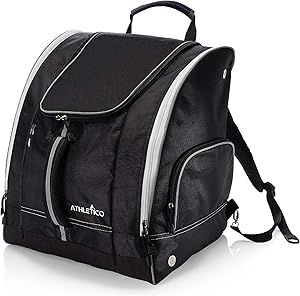
- Material: Water-resistant polyester
- Access: Side-entry zippered boot openings
- Carry: Hidden straps, padded lumbar support, top/front handles
- Safety: Reflective piping for low-light visibility
Athletico isn’t interested in reinventing anything — it just wants to be the bag that works, every time, without asking much of you in return. Side-entry zippers keep boots away from your dry layers, and the oversized main compartment happily swallows a helmet, jacket, and whatever else you’re hauling for the day. Reflective piping is a small touch, but it earns its place on those dusk drives home when visibility matters more than style points.
Carrying it is where the design quietly shines: hidden backpack straps and padded lumbar support mean you’re not white-knuckling a duffel handle across a half-mile of parking lot. It won’t turn heads with premium materials or a long list of extras, but for anyone who wants a dependable, wallet-friendly workhorse that shows up ready every weekend, Athletico earns its spot without needing to shout about it.
- Pros: Affordable and durable, comfortable carry options, reflective detail for safety.
- Cons: Fewer premium materials and extras than higher-end models; limited sizing detail.
See the Athletico Ski Boot Bag
The Ultimate Guide to Choosing the Perfect Ski Boot Bag
Skiing is an exhilarating winter sport, but hauling your equipment to and from the mountain can quickly become a hassle. Among all your gear, ski boots are arguably the most crucial—and expensive—investment you will make. Protecting them during travel is essential for keeping them performing well and lasting for seasons to come. A high-quality ski boot bag does far more than just carry your boots; it organizes your apparel, protects your helmet and goggles, and makes navigating airports and parking lots significantly easier.
With dozens of brands, sizes, and styles on the market, selecting the right bag can feel overwhelming. This guide breaks down everything you need to know to choose the best ski boot bag for your specific travel habits, gear load, and budget.
Why You Need a Dedicated Ski Boot Bag
It can be tempting to throw your boots into a standard duffel bag or carry them by their power straps, but dedicated ski boot bags offer several specialized advantages:
- Protection: Ski boots have metal buckles and hard plastic shells that can easily damage other gear, car interiors, or luggage if left loose. Dedicated bags isolate the boots to prevent scratches and dings.
- Moisture Management: Snow and ice melt quickly once you bring your boots indoors. Ski boot bags feature waterproof liners, drainage grommets, and ventilation to manage wet boots and prevent mold.
- Organization: Specialized compartments keep your helmet, goggles, gloves, extra layers, and tuning tools separated and safe from impact.
- Ergonomics: Ski boots are heavy. Boot bags feature reinforced backpack straps, padded back panels, or wheels to make carrying 10 to 15 pounds of equipment comfortable.
Key Types of Ski Boot Bags
Before diving into specific features, you must decide which style of bag best fits how you travel to the mountain.
Backpack Style Boot Bags
Backpack-style bags are the most popular choice among skiers. They distribute the heavy weight of your boots evenly across your shoulders and back, leaving your hands free to carry your skis and poles. These bags range from minimalist designs that only hold boots to large multi-compartment packs capable of holding all your ski apparel.
Duffel Style Boot Bags
Duffel bags feature a single main strap meant for shoulder carrying or handles for hand carrying. They usually have a large central opening, making them easy to pack. Duffels work well for quick trips in the car where you don’t need to walk long distances carrying your gear.
Wheeled Boot Bags
If you travel frequently by plane or train, a wheeled ski boot bag is ideal. Rolling your heavy gear through airport terminals saves your back and shoulders for the slopes. Many wheeled models are designed as all-in-one travel bags that can fit boots, clothes, and sometimes even your helmet and outerwear.
Heating/Heated Boot Bags
Heated boot bags feature built-in heating elements that plug into a wall outlet or standard 12V car lighter. Warming your boots on the drive to the resort makes the hard plastic shell pliable and significantly easier to put on. Additionally, they dry out damp boot liners overnight after a long day on the slopes.
Comparing Ski Boot Bag Types
| Bag Type | Best For | Pros | Cons |
|---|---|---|---|
| Backpack | Day trips, walking from parking lots, hands-free carrying | Ergonomic weight distribution, highly versatile, hands-free | Can be bulky when fully packed |
| Duffel | Road trips, simple gear storage | Easy to load, compact storage when empty | Uncomfortable to carry long distances |
| Wheeled | Air travel, multi-day ski trips | No strain on shoulders/back, large storage capacity | Heavier, harder to carry through deep snow |
| Heated | Cold-weather skiers, hard-flex boot users | Softens plastic shells, dries boots fast, warms feet | Requires power source, heavier due to heating coils |
Crucial Features to Consider
Once you have selected a bag style, evaluate the following features to ensure you get the right model for your needs.
1. Capacity and Volume
Ski boot bags are measured in liters. Choosing the right size depends on what you plan to pack alongside your boots:
30 to 45 Liters (Compact)
Holds your ski boots, gloves, a beanie, and a few small accessories. Ideal for skiers who prefer to wear their jacket and keep their load light.
50 to 65 Liters (Standard)
The sweet spot for most day-trippers. Fits boots, a helmet, goggles, gloves, spare layers, and a water bottle comfortably.
70+ Liters (Travel/Multi-Day)
Designed to carry your entire ski kit, including outerwear, pants, base layers, protective gear, and tuning kits. Great for long trips or family gear consolidation.
2. Boot Compartment Configuration
Pay close attention to how the boots are loaded into the bag:
- Side-Loading: Boots slide into separate zippered pockets on the left and right sides of the bag. This creates a central main compartment for your helmet and clothes, keeping dirty, wet boots isolated.
- Back-Loading: The back panel unzips flat, allowing boots to stand upright inside. The back flap often doubles as a dry standing mat to keep your socks clean while changing in the parking lot.
- Top-Loading: Boots drop straight down into the main compartment. While simple, this can make organizing other accessories more difficult.
3. Material and Waterproofing
Ski gear is exposed to snow, slush, ice, and salt. Look for bags made from durable, water-resistant fabrics such as 600D to 1200D polyester or heavy-duty nylon with a PVC coating. A reinforced, waterproof tarpaulin bottom is essential to protect your bag when set down on wet snow or slushy asphalt.
4. Ventilation and Drainage
Trap wet boots inside an airtight bag, and you will quickly create unpleasant odors and ruin the boot liners. Ensure the boot compartments feature mesh ventilation windows or metal drainage grommets at the base to allow moisture to escape during your trip home.
5. Dedicated Helmet and Goggle Storage
Your helmet takes up considerable space, while your goggle lenses are prone to scratching. Look for a bag with a padded top compartment for your helmet or an external fold-out mesh carrier. Goggles should ideally have a fleece-lined pocket to prevent scratches during transport.
Airline Travel Considerations
If you plan to fly with your ski gear, keep these rules of thumb in mind:
- Check Airline Policies: Most major airlines allow a ski bag and a boot bag to count as a single piece of checked luggage, provided they stay under the weight limit (usually 50 lbs total).
- Carry-On Limits: If you do not want to risk lost luggage, choose a boot bag within standard carry-on dimensions (typically under 45–50 linear inches). Always carry your boots onto the plane if possible; if your skis get lost, you can rent skis, but renting comfortable, well-fitting boots is much harder.
Final Summary checklist
Before purchasing your ski boot bag, run through this final checklist to ensure it meets your demands:
- Does it comfortably fit your boot size (especially for larger men’s sizes)?
- Is the fabric durable and water-resistant with a sealed bottom?
- Does it offer enough room for your helmet, goggles, and extra layers?
- Are the shoulder straps well-padded and equipped with a sternum strap?
- Does it feature ventilation or drainage grommets for damp boots?
Investing in the right ski boot bag keeps your expensive equipment safe, organized, and dry. By selecting a bag tailored to your travel style and gear volume, you can eliminate hassle at the transit stage and focus on enjoying your time on the mountain.