Best Ski Boots for Beginners of 2027
Learning to ski starts with the right gear, and your boots matter most. The wrong pair can hurt your feet and make skiing hard. The right pair keeps you comfortable, warm, and in control on the slopes. In this article, we review the best ski boots for beginners to help you choose with confidence. We cover fit, comfort, price, and ease of use, so you can find boots that make learning fun and safe.
1. Rossignol Evo 70

- Last: 104mm, wider forefoot and ankle
- Shell: Sensor Matrix design
- Liner: Custom fit with softer instep padding
- Sole: Rubber tread, rockered toe, GRIPWALK compatible
The Rossignol Evo 70 is built for skiers who want comfort without giving up control. Its 104mm last gives extra room in the forefoot, toe box and ankle, so the boot feels relaxed through a full day on the mountain. The custom fit liner adds softer padding through the ankle and instep, while the heel support keeps the foot settled. The boot overlap opens easily, which makes getting in and out a simple, smooth process.
On snow, the Sensor Matrix shell design reduces weight while sending energy directly to the ski, so the boot feels supportive and responsive even at higher speeds. The sole has a rubber tread and rockered toe and works with GRIPWALK, although those soles are sold separately. Backed by more than 100 years of Rossignol alpine experience, the Evo 70 is a sensible choice for recreational skiers who value a generous fit and dependable power transfer in a lighter boot.
Pros:
- Roomy, comfortable fit
- Lightweight shell with direct power transfer
- Easy entry and exit
Cons:
- GRIPWALK soles sold separately
- Wide last may feel loose on narrow feet
2. Rossignol Kelia 50 – Women’s

- Last: Relaxed 104mm
- Cuff: Tulip-shaped, women-specific
- Buckles: 3-buckle shell with forgiving flex
- Sole: GRIPWALK compatible (sold separately)
The Rossignol Kelia 50 is aimed at beginner women skiers who want a boot that feels friendly from the first run. The relaxed 104mm last and tulip-shaped cuff are tailored to female anatomy, easing pressure on the shin and calf and helping circulation throughout the day. A 3-buckle shell keeps adjustments simple, and the forgiving flex helps new skiers build confidence as they progress.
Entry and exit are easy thanks to soft plastic around the instep, which stays manageable even when temperatures drop. The Sensor Matrix shell reduces weight while improving power transfer, giving the boot a smooth and responsive feel. Customizable liners conform to your foot for support, warmth and precision. The boot also works with GRIPWALK soles for safer walking off the snow, though they must be purchased separately. For beginners, the Kelia 50 balances comfort and control very well.
Pros:
- Women-specific cuff relieves pressure
- Easy entry and exit in cold weather
- Forgiving flex suits beginners
Cons:
- GRIPWALK soles not included
- Soft flex may limit advancing skiers
3. K2 BFC 80

- Last: 103mm for high volume feet
- Flex: 80, softer for newer skiers
- Shell: TPU shell, PP cuff, fully heat moldable
- Buckles: 4 light alloy with Velcro power strap
The K2 BFC 80 is a beginner-friendly boot that focuses on comfort and easy use. Its 103mm last suits wider, higher volume feet, and the softer 80 flex is forgiving for newer skiers still learning to control their turns. The Cushfit Comfort liner delivers the familiar out-of-the-box feel of K2’s classic liner, with extra foam in key areas for added comfort and compliance.
Hands-free entry is a highlight, with a dual material overlap that makes putting the boots on and taking them off simple. Both the shell and cuff are heat moldable, so a bootfitter can shape the boot to your foot for a truly custom fit. Four adjustable light alloy buckles and a one-piece Velcro power strap provide secure closure, and the GripWalk sole improves walking comfort and skiing performance. It is a practical, comfortable option for new skiers.
Pros:
- Fully heat moldable shell and cuff
- Hands-free entry and exit
- Comfortable, forgiving flex
Cons:
- Soft flex may feel limiting as skills improve
- Wide last not ideal for narrow feet
4. Nordica Cruise S – Women’s

- Last: 104mm, wide for high volume feet
- Flex: 65, soft and forgiving
- Shell: Triax shell and cuff with easy entry instep
- Buckles: 4 micro-adjust aluminum alloy
The Nordica Cruise S is a women’s boot designed for newer skiers who want out-of-the-box comfort. The 104mm last is generous for high volume feet, and the soft 65 flex is forgiving enough to build confidence without feeling harsh. The Comfort Fit liner keeps the foot cozy, while the soft plastic instep flaps make getting in and out of the boot much easier.
A standout feature is the Instep Volume Control, a hinged double level wedge on the boot board. Flip it underneath for an additional 4mm of instep height, giving a quick way to fine-tune the fit. Four micro-adjust aluminum alloy buckles and a 35mm Velcro strap secure the boot, and the Triax shell and cuff keep the construction light. The soles are ISO 5355 alpine high traction, with GripWalk soles available separately for better walking comfort.
Pros:
- Adjustable instep volume
- Easy entry soft flaps
- Wide, comfortable fit
Cons:
- GripWalk soles sold separately
- Soft flex is best for beginners only
5. Nordica The Cruise 80

- Last: 104mm high volume comfort fit
- I.V.C.: Instep Volume Control, +/- 4mm boot board adjustment
- Entry: Dual soft flap instep for wide throat opening
- Customization: Nordica Infrared technology
The Nordica The Cruise 80 is a comfort-focused boot for skiers with wider, higher volume feet. The 104mm last has a streamlined, anatomical shape that maximizes control and response, so comfort does not come at the cost of precision. The dual soft flap instep opens the throat exceptionally wide, which makes the boot incredibly easy to put on and take off, a real plus at the start and end of a long day.
Fit can be tuned quickly with Instep Volume Control, which raises or lowers the boot board by 4mm in either direction. The soft plastic inserts built into the throat further simplify stepping in and out. Nordica also offers Infrared technology, developed to customize the boot at the most sensitive points of the foot, helping a bootfitter remove pressure where it matters. With a moderate 80 flex, it suits recreational skiers who prize easy fit and dependable comfort.
Pros:
- Very easy to get on and off
- Adjustable instep height
- Infrared customization for sensitive spots
Cons:
- Roomy fit may not suit low volume feet
- Customization requires a bootfitter
6. Rossignol Alltrack 70
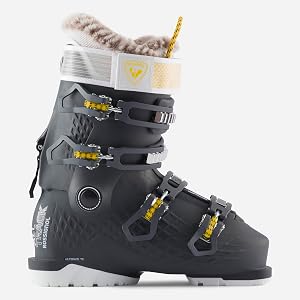
- Last: 102mm women’s regular fit
- Cuff: Shorter, tulip-shaped
- Technology: Generative Design Grid and Dual Core
- Walk mode: 50-degree range of motion
The Rossignol Alltrack 70 is a women’s boot that blends recreational comfort with some touring versatility. Its 102mm regular fit last is designed for all-day comfort, and the shorter, tulip-shaped cuff eliminates pressure around the shin and calf muscle. Full custom liners are 100% customizable, offering added comfort, precision and performance as you shape the fit to your foot.
The Generative Design Grid minimizes boot wall thickness, using material only where it is needed to cut weight and improve power transfer. Dual Core technology adds targeted power transmission and shell wrapping, giving the boot livelier rebound, response and control. The standout is the hike mode, where the lower shell provides a 50-degree range of motion for efficient walking and touring, then locks back into ski mode for maximum power. It is a lightweight, flexible choice for skiers who want to venture beyond the lift.
Pros:
- Women-specific cuff relieves pressure
- Wide 50-degree hike mode
- Lightweight with strong power transfer
Cons:
- 70 flex may feel soft to aggressive skiers
- Hike mode adds complexity for resort-only use
7. K2 BFC 90

- Last: 103mm for high volume feet
- Flex: 90, medium for beginner to intermediate skiers
- Liner: CushFit Plus
- Sole: GripWalk ISO 23223 outsoles
The K2 BFC 90 steps up from the softer BFC 80 and suits skiers moving from beginner to intermediate level. The medium 90 flex offers more support and response, while the 103mm last still keeps things comfortable for wider, higher volume feet. The CushFit Plus liner adds a plush, supportive feel that helps the boot feel good right out of the box.
Like its siblings, the BFC 90 features hands-free entry thanks to its dual material overlap, which makes getting in and out simple. The TPU shell and polypropylene cuff are both fully heat moldable, so a bootfitter can adapt the boot to your foot for a truly custom fit. Four adjustable light alloy buckles and a one-piece Velcro power strap lock everything down, and the removable GripWalk outsoles provide better grip and comfort when walking, standing and hiking. It is a versatile, comfortable boot for progressing skiers.
Pros:
- Heat moldable shell and cuff
- Hands-free entry and exit
- GripWalk soles included for easy walking
Cons:
- Wider last may not suit narrow feet
- Medium flex may be too stiff for true beginners
8. K2 BFC 100

- Last: 103mm for high volume feet
- Flex: 100, medium for intermediate to advanced intermediate skiers
- Liner: CushFit Plus
- Sole: GripWalk ISO 23223 outsoles
The K2 BFC 100 is the stiffest boot in the BFC line here, designed for intermediate and advanced intermediate skiers. The 100 flex delivers stronger support and sharper response for confident carving, yet the 103mm last remains accommodating for wider, higher volume feet. The CushFit Plus liner keeps the foot comfortable and secure, helping the boot feel good from the first run.
Hands-free entry comes from the dual material overlap, which makes the boot easy to put on and remove despite the firmer flex. Both the TPU shell and polypropylene cuff are fully heat moldable, allowing a bootfitter to create a custom fit for different foot shapes. Four adjustable light alloy buckles and a one-piece Velcro power strap provide a secure hold. Removable GripWalk outsoles improve grip and comfort when walking, standing and hiking, making this a well-rounded option for skiers ready for more performance.
Pros:
- Firmer flex for stronger control
- Heat moldable shell and cuff
- Hands-free entry with GripWalk soles
Cons:
- Too stiff for beginners
- Wide last may not fit narrow feet
9. Nordica Sportmachine 3 80

- Last: 102mm medium wide
- Flex: 80, softer for new or lighter skiers
- Liner: 3D Cork Fit Primaloft
- Cuff: Adjustable Cuff Profile (ACP)
The Nordica Sportmachine 3 80 is a feature-rich boot for skiers who want a highly personalized fit. The 102mm last suits wider than average feet, and Tri-Fit technology allows the liner and shell to be customized in just the areas that need it, using Infrared Fit technology and an oven. The Adjustable Cuff Profile lets you change cuff volume in seconds to suit larger or smaller calves.
The premium 3D Cork Fit Primaloft liner is a one-piece, hands-free design with a larger throat opening than a traditional boot, adding comfort and warmth. Easy entry instep flaps simplify getting in and out, while the Tri-Force construction pairs a rigid spine and chassis with a softer foot wrap for better wrapping without losing rigidity. Four micro-adjust aluminum alloy buckles and a 35mm Velcro strap secure the fit, and the soft 80 flex suits new or lighter skiers who want premium comfort.
Pros:
- Extensive fit customization
- Premium cork liner with easy entry
- Adjustable cuff for different calf sizes
Cons:
- Full customization needs a bootfitter and oven
- Soft flex limits more aggressive skiing
10. Tecnica Mach Sport HV 65 – Women’s

- Last: 103mm wide for all-day comfort
- Flex: 65, soft for lighter and new skiers
- Shell: C.A.S. anatomical shell, polypropylene
- Sole: GripWalk ISO 23223
The Tecnica Mach Sport HV 65 is a women’s boot made for lighter skiers and those just starting out. Its 103mm last offers all-day comfort, especially for wider feet, while the C.A.S. shell has an anatomical shape that matches the foot for a better out-of-the-box fit. Dimples on the shell reduce surface tension, which helps a bootfitter heat mold and adjust the shell when needed.
Tecnica researched the ideal women’s stance, resulting in a women-specific cuff and a 3mm higher back spine for natural balance, less fatigue and better performance. The double cuff alignment and 12 degree forward lean support a comfortable, centered position. The Double Quick Instep uses a large, softer plastic area so the shell opens easily for entry and exit. Four aluminum micro-adjustable buckles, an easy adjust top cuff ratchet and a 35mm Velcro power strap provide secure closure, and GripWalk soles make walking easier.
Pros:
- Women-specific stance and cuff
- Easy entry with Double Quick Instep
- GripWalk soles for comfortable walking
Cons:
- Soft flex not for aggressive skiers
- Wide last may feel loose on narrow feet
How to Choose Ski Boots for Beginners
Choosing your first pair of ski boots is one of the most important gear decisions you will make. Unlike rental boots that are designed to fit a wide range of feet adequately, your own boots need to fit precisely enough to give you control without causing pain. A boot that is too big will leave you fighting the ski, while a boot that is too stiff will make it nearly impossible to learn proper technique. The good news is that beginners have a clear set of priorities: comfort, a forgiving flex, and a fit that is snug but not punishing. This guide walks through the essential factors—sizing, flex, width, and key features—so you can walk into a shop informed and leave with boots that help you progress.
Start with the Right Size: Mondopoint, Not Shoe Size
The single most common mistake beginners make is buying ski boots based on their everyday shoe size. Ski boots use a completely different system called Mondopoint, which is simply the length of your foot in centimeters. A foot that measures 26.5 centimeters corresponds to a Mondopoint size of 26.5. This system exists because ski boots need to fit far more precisely than street shoes; a boot that is even half a size too large will allow your foot to slide, making it difficult to steer the skis and often leading to cramped toes from over-buckling.
To measure your foot at home, wear a thin pair of ski socks and stand with your heel against a wall. Place a sheet of paper under your foot and mark the tip of your longest toe. Measure the distance from the wall to that mark in centimeters. Repeat for both feet and use the longer measurement. Many ski shops will also measure you with a device called a Brannock tool, which is more accurate than a tape measure alone.
One crucial point for beginners: do not size up for “comfort.” Rental boots feel roomy because they are designed for many different feet, but that roominess is exactly what prevents you from controlling your skis. A beginner boot should feel snug around the heel and ankle from the first try-on, with your toes just lightly brushing the front of the liner when you stand in a skiing stance. The liner will compress slightly over the first few days of skiing, so a boot that feels almost too tight in the shop often ends up feeling just right on the hill.
Ski Boot Size Conversion (Mondopoint to US)
| Mondopoint (cm) | US Men’s | US Women’s |
|---|---|---|
| 24.5 | 7.5 | 8 |
| 25.0 | 8 | 8.5 |
| 25.5 | 8.5 | 9 |
| 26.0 | 9 | 9.5 |
| 26.5 | 9.5 | 10 |
| 27.0 | 10 | 10.5 |
| 27.5 | 10.5 | 11 |
Note: This chart is a rough guide only. Always prioritize your measured Mondopoint size over shoe size conversions.
Understand Flex: Why Softer Is Better for Learning
Flex index is a number that indicates how stiff the boot is when you lean forward into it. The scale typically runs from about 60 (very soft) to 130 or higher (very stiff). For beginners, a softer flex is essential because it allows you to bend your ankles and stay centered over the skis without fighting the boot. If the boot is too stiff, every forward movement becomes a struggle, and you will likely end up leaning back—the classic “backseat” position that makes turning nearly impossible.
For adult men, a beginner flex typically falls in the 60 to 80 range. For adult women, the range is generally 50 to 70. These numbers are not standardized across brands, so a 70 from one manufacturer might feel softer or stiffer than a 70 from another. The practical takeaway is to start on the softer end of the spectrum. A boot that is slightly too soft will still allow you to ski and learn; a boot that is too stiff will actively hinder your progress and may cause you to develop bad habits that take seasons to correct.
Your body weight also plays a role. A lighter skier will have an easier time flexing a soft boot, while a heavier skier may need slightly more support even as a beginner. However, ability level should be the primary guide, and beginners should err on the side of softness.
Beginner Flex Ranges by Gender
| Skier Type | Men’s Flex Range | Women’s Flex Range |
|---|---|---|
| First-time / Beginner | 60–80 | 50–70 |
| Intermediate | 80–100 | 70–85 |
| Advanced | 100–120 | 85–105 |
Flex ratings vary by brand and are not standardized. Treat these ranges as starting points, not absolute rules.
Match the Width (Last) to Your Foot Shape
Length is only half of the fit equation. The internal width of the boot at the widest part of your forefoot is called the “last.” A boot that is the correct length but too narrow will compress your foot and cause pain and numbness; a boot that is too wide will allow your foot to move side to side, reducing control. Most adult ski boots fall into three categories:
- Narrow (low volume): 97–100mm. Best for skiers with narrow feet or those prioritizing precision. Beginners with narrow feet can use this width, but should look for a softer flex within that category.
- Average (medium volume): 100–102mm. The most common width and a good starting point for most beginners.
- Wide (high volume): 102mm and above. Suitable for skiers with broader feet or those who prioritize comfort over ultimate precision.
If you have a very wide foot or a high instep, a wider last will reduce the risk of cramping and pressure points. Conversely, if your foot is narrow, choosing a wide boot to get “comfort” will leave you with a sloppy fit that makes it hard to edge the ski. A professional boot fitter can measure your foot width and recommend the appropriate last.
Consider Boot Type: Alpine Is Usually Best for Beginners
Ski boots are generally divided into three categories: alpine (downhill), freeride, and touring (backcountry). For a beginner skiing at a resort on groomed runs, an alpine boot is almost always the right choice. Alpine boots prioritize downhill performance with a solid shell, a fixed sole, and multiple buckles for fine adjustment. They are designed to work with standard alpine bindings and provide the most direct connection between your leg and the ski.
Freeride boots add a walk mode and a grippier sole for short hikes or sidecountry excursions, but they often sacrifice some downhill stiffness and add complexity. Touring boots are designed for moving uphill under your own power and are much lighter and more flexible in walk mode, but they are generally less supportive for learning on groomed terrain. Unless you have a specific reason to choose otherwise, start with an alpine boot.
Features That Matter for Beginners
Not every feature on a ski boot is relevant to a new skier. Focus on the elements that affect comfort, ease of use, and learning.
Buckles and Closure
Most beginner boots have two to four buckles. Four-buckle designs offer more fine-tuning, but three-buckle boots can be perfectly adequate and are often slightly lighter and easier to operate. Some entry-level models use a rear-entry design with a single main buckle, which is very easy to put on and take off, though these sacrifice some adjustability and performance. Micro-adjustable buckles are a worthwhile feature: they let you fine-tune the tension without unbuckling entirely, which helps dial in comfort throughout the day.
Liners
The liner is the soft inner boot that cushions your foot and provides warmth. Most beginner boots come with stock liners that are adequate but will compress over time. Many stock liners can be heat-molded by a shop, which improves the fit around the ankle and heel. If you have the budget, a heat-moldable liner can make a significant difference in comfort, but it is not essential for your first pair. Avoid boots with heavily padded liners that feel plush in the shop—they will pack out quickly and leave you with a loose fit.
Women’s-Specific Boots
Women’s ski boots are not simply men’s boots in smaller sizes. They typically have a lower cuff to accommodate a lower calf muscle position, a flared shape at the top of the cuff, and warmer liners. If you are a woman, try women’s-specific models first; the difference in calf fit can be substantial.
The Shell Fit Test: A Crucial Check
Before you commit to a boot, perform a shell fit. Remove the liner from the shell and slide your bare foot (or a thin-socked foot) into the empty plastic shell. Push your toes gently to the front. You should be able to fit one to two fingers behind your heel. If you can only fit one finger, the boot is likely too short. If you can fit three or more, the boot is too long and you will struggle to control the ski. This test checks the shell length independent of the liner’s padding, giving you a truer picture of the boot’s actual fit.
Get a Professional Fitting If Possible
While it is possible to buy ski boots online, beginners benefit enormously from an in-person fitting at a specialized ski shop. A boot fitter can assess your foot shape, arch height, instep, and calf shape—details that are nearly impossible to judge from a size chart. They can also heat-mold the liner, stretch the shell in specific spots if needed, and recommend a custom footbed if your arches require support. Many shops offer a fitting guarantee, allowing you to return for adjustments after skiing in the boots a few times.
If you do buy online, choose a retailer with a generous return policy and be prepared to try on several models. Wear thin, technical ski socks for every try-on, and spend at least fifteen minutes in each boot, flexing forward and standing in a skiing stance, before making a decision.
Summary: Your Beginner Boot Checklist
- Measure your Mondopoint size with thin ski socks and use the longer foot measurement.
- Choose a soft flex (roughly 60–80 for men, 50–70 for women) that you can bend easily with moderate forward pressure.
- Match the last width to your foot shape (narrow, average, or wide).
- Select an alpine boot unless you have a specific need for freeride or touring features.
- Do a shell fit to confirm one to two fingers fit behind your heel.
- Prioritize a snug heel and ankle over instant plush comfort; the liner will adapt.
- Consider a professional fitting for the best possible start.
Your first pair of ski boots does not need to be expensive or feature-packed. It needs to fit your foot shape, match your beginner ability with a forgiving flex, and hold your heel securely enough that you can feel the ski respond when you tilt your ankle. Get those fundamentals right, and you will spend your first season learning to ski rather than learning to tolerate your boots.