Best Ski Waxes of 2026
Keeping your skis fast and smooth on the slopes starts with using the right ski wax. Whether you’re racing down icy runs or cruising through fresh powder, ski wax helps your skis glide better, turn easier, and last longer. The right wax can make a big difference in performance and fun. In this guide, we’ve rounded up the best ski waxes for all snow conditions and skill levels, so you can enjoy smoother rides and get the most out of every trip to the mountains.
1. Demon Hyper Wax

- Weight: 1.06 lb big block
- Origin: Made in Southern California, USA
- Formula: Premium proprietary blend with scent
- Compatibility: All seasons and snow conditions
Demon Hyper Wax offers an exceptional formula designed to give snow sports enthusiasts maximum velocity. Handcrafted in Southern California, this wax relies on a proprietary blend that excels across all seasonal mountain conditions without performance drops.
Beyond speed enhancement, this wax features a pleasant premium scent that improves application. It melts smoothly and bonds effectively to ski and snowboard bases, providing durable protection against harsh snow friction for demanding riders.
Pros:
- Large block offers great value
- Versatile performance in all temperatures
Cons:
- Bulky size can feel cumbersome
2. Hertel Super HotSauce

- Weight: 340 grams package
- Temperature Range: 6F to 52F
- Application: Hot iron or rub-on
- Formula: Sustainable and non-hazardous
Hertel Super HotSauce delivers outstanding, long-lasting performance designed to keep skiers and snowboarders riding smoothly for up to three full days per application. Formulated to interact directly with snow structure, it provides excellent glide across changing slopes.
The generous package ensures ample wax for an entire season of mountain trips. Its unique formula avoids harmful additives, prioritizing rider health and environmental safety without sacrificing high-speed durability or smooth control in varied weather.
Pros:
- Broad operating temperature range
- Delivers three full days of glide
Cons:
- Requires thorough scraping for best results
3. Swix Universal

- Weight: Available in 60g or 180g bar
- Composition: Non-fluoro chemical formula
- Temperature Range: All temperature snow conditions
- Primary Use: Daily training and base protection
Swix Universal is a staple choice for riders seeking reliable daily maintenance and consistent gliding characteristics on the mountain. Formulated for all snow temperatures, this hydrocarbon wax serves as an ideal baseline treatment to protect your equipment.
Because it uses a non-fluoro composition, it offers an environmentally conscious option that maintains solid performance across diverse snowpack setups. The smooth melting properties make it easy to iron onto bases, ensuring quick preparation for practice sessions.
Pros:
- Non-fluoro composition provides eco-friendly care
- Provides reliable base abrasion protection
Cons:
- Requires frequent reapplication in wet snow
4. IGOSKI Snowboard Wax

- Type: High quality universal ski wax
- Formula: Non-fluoro environmental profile
- Temperature Range: All temperature ranges
- Application: Standard wax iron setup
IGOSKI Snowboard Wax is designed as a dependable go-to solution when snow conditions are unpredictable or varied throughout the day. Built to accommodate all temperature ranges, this universal formula provides consistent speed and maneuverability across standard equipment.
Featuring a non-fluoro formulation, it ensures safer handling and minimizes environmental impact while delivering solid friction reduction on slopes. It melts evenly during iron application, penetrating deep into base structures to deliver durable glide and reliable protection.
Pros:
- Great choice for uncertain weather conditions
- Smooth melting point makes application simple
Cons:
- Lacks speed advantages of temp-specific waxes
5. Dakine Nitrous

- Weight: 5.6 oz (160 grams)
- Base Material: 100% petroleum paraffin
- Additives: Perfluorocarbon (PFC) free
- Application: Hot wax or rub-on
Dakine Nitrous provides dependable speed and base protection through its high-grade paraffin formulation. Crafted to handle diverse winter elements, this PFC-free wax offers reliable friction reduction across varying snow densities without introducing harmful fluorocarbons into nature.
Available in cold, warm, and all-temp blends, it gives riders flexibility depending on specific seasonal needs. While hot ironing yields maximum longevity, the formula can also be quickly rubbed on for convenient field adjustments before riding down.
Pros:
- PFC-free formulation ensures eco-friendly performance
- Can be hot ironed or rubbed on
Cons:
- Specific temperatures require separate block purchases
6. Hertel Wax Rub N Go

- Weight: 70 grams solid block
- Form: Compact solid application stick
- Application: Fast rub-on, no corking needed
- Use: Exterior ski and snowboard bases
Hertel Wax Rub N Go offers high-speed convenience for snowboarders and skiers who prefer fast, hassle-free application on the slope. Eliminating the need for heating irons, corking, or tedious buffing, this solid wax stick allows rapid touch-ups.
Despite its quick application style, the durable coat holds up remarkably well across extended riding sessions. It fits easily inside jacket pockets, providing a practical backup solution when snow conditions change suddenly and immediate glide enhancement is required.
Pros:
- No iron or cork required for application
- Compact size fits easily into pockets
Cons:
- Does not penetrate bases as deeply as hot wax
7. mountainFLOW Snowboard Wax

- Weight: 130g per bar
- Ingredients: 100% plant-based formulation
- Petroleum Content: 0% petroleum ingredients
- Safety: Biodegradable and non-toxic formula
mountainFLOW Snowboard Wax sets a high bar for eco-friendly winter sports gear by utilizing a completely plant-based formulation. Unlike traditional petroleum products that leave chemical residues on snowpacks, this innovative wax breaks down naturally without shedding toxic substances.
Performance testing demonstrates that this sustainable option glides just as fast as conventional petroleum waxes. The bar melts smoothly under an iron, penetrating equipment bases efficiently to supply durable speed, smooth turning control, and reliable environmental safety.
Pros:
- Zero petroleum and completely biodegradable composition
- Delivers competitive speed matching petroleum alternatives
Cons:
- Higher price point compared to petroleum waxes
See the mountainFLOW Snowboard Wax
8. Purl – Ski & Snowboard Wax

- Iron Temperature: 265F (130C)
- Formula: Microcrystalline petroleum blend
- Eco Profile: Biodegradable formula
- Origin: Made in USA
Purl Universal Wax delivers durable base protection and versatile glide characteristics across wide-ranging snow conditions. Made in the United States, this biodegradable formula uses microcrystalline petroleum components designed to deeply saturate porous base materials, resisting wear caused by friction.
It works seamlessly across alpine skis, snowboards, and cross-country gear from frigid powder to slushy spring conditions. Melting smoothly at standard iron settings, it provides long-lasting durability for recreational riders and tuning technicians seeking dependable everyday performance.
Pros:
- Deep base saturation provides extended friction durability
- Made in USA using eco-conscious ingredients
Cons:
- Requires precise temperature monitoring during ironing
See the Purl – Ski & Snowboard Wax
9. Hertel Racing FC739

- Duration: Up to 7 days per ounce
- Temperature Range: 6F to 52F
- Formula: Fluoro-free racing composition
- Origin: Made in USA
Hertel Racing FC739 represents a top-tier racing wax formulated to provide extreme durability and effortless glide across all temperature ranges. Capable of lasting up to seven days on a single ounce, this advanced universal wax significantly reduces maintenance.
The fluoro-free composition prioritizes rider safety and environmental responsibility without sacrificing high-speed competition standards. By altering the micro-interaction between snow structure and base material, it enhances control, stability, and responsiveness, allowing riders to navigate terrain confidently.
Pros:
- Extremely long-lasting protection up to seven days
- Fluoro-free racing formula delivers high speed
Cons:
- Higher upfront cost than general recreational waxes
10. ZUMWax Rub-On

- Weight: 70g push-up container
- Chemical Profile: PTFE-free formula
- Included Tool: Attached cork on container
- Origin: Hand-poured in Washington, USA
ZUMWax Rub-On delivers effortless mountain maintenance through its clever push-up container equipped with an integrated cork buffer. Softened specifically for easier base penetration without an iron, this versatile wax allows quick application directly on slopes whenever speed is required.
Hand-poured in Washington State, it utilizes a PTFE-free chemical blend that keeps environmental safety at the forefront while offering impressive durability. The package provides enough formula for dozens of riding days, making it an essential companion for fast boosts.
Pros:
- Integrated cork buffer makes field application simple
- PTFE-free formula is hand-poured in USA
Cons:
- Manual cork buffing requires energetic physical effort
How to Choose Ski Waxes: The Ultimate Guide to Snow, Temperature, and Application
Skiing and snowboarding are sports defined by dynamic movement, precision, and interaction with the natural environment. While equipment design, edge sharpening, and skier technique play major roles in on-snow performance, the hidden foundation of speed, control, and base protection lies in ski wax. Choosing the right ski wax is often viewed as an obscure science reserved for Olympic race technicians, but understanding the core principles allows any skier or rider to dramatically improve their day on the mountain.
Wax serves two primary purposes: enhancing glide and protecting the polyethylene base of your skis or snowboard from friction, dirt, and mechanical abrasion. When a ski slides over snow, friction generates microscopic heat, melting the snow crystals into a paper-thin film of water. If your base has too much friction, it grabs the snow, making turning sluggish and tiring. If your base experiences too much suction from excess surface moisture, it drags. The correct ski wax manages this delicate microscopic water layer while defending the base material from dry ice crystals.
Understanding the Fundamentals of Ski Friction
To choose the right wax, it helps to understand the physical forces acting beneath your feet. Friction on snow falls into two distinct categories, depending on temperature and snow structure:
- Dry Friction: Occurs in extremely cold conditions. Sharp, intact snow crystals act like microscopic sandpaper, digging into the soft polyethylene base of the ski. In these conditions, you need a hard, durable wax that resists penetration and mechanical wear.
- Wet Friction (Capillary Attraction): Occurs in warm, high-moisture conditions. As snow melts under the heat of friction and ambient temperature, a liquid water layer builds up beneath the ski. Without proper wax, capillary suction pulls on the base, dragging the ski down. Warm-weather waxes are designed to be hydrophobic, aggressively repelling water to break suction.
Deciphering Snow Temperature and Moisture Content
The single most important factor when selecting a ski wax is temperature. Most wax manufacturers formulate their products around specific temperature ranges, usually categorized by snow temperature rather than air temperature.
Air Temperature vs. Snow Temperature
Air temperature and snow temperature are related, but they are rarely identical. Air temperature changes rapidly with wind and sunlight, whereas snow temperature changes much more slowly due to its density and thermal mass. Additionally, radiant heat from direct sun can warm the snow surface above the surrounding air temperature, while clear night skies can cool the snow base well below ambient air levels. When selecting wax, always measure or estimate the temperature of the snow itself, or account for recent weather trends.
Snow Crystal Types and Abrasiveness
Not all snow at a given temperature behaves the same way. The age and structure of snow crystals significantly alter how a wax performs:
- Fresh, New Snow: Features sharp, complex star-shaped crystals. These sharp edges create higher friction and require slightly harder wax than transformed snow at the same temperature.
- Old, Transformed Snow: Snow that has undergone melt-freeze cycles or mechanical grooming loses its sharp edges, transforming into rounded ice grains. This snow is less abrasive, allowing for slightly softer, faster waxes.
- Man-Made / Artificial Snow: Created by spraying water into freezing air, artificial snow consists of dense, highly abrasive spherical ice pellets. It shears wax off bases quickly, demanding hard, durable formulations regardless of moderate temperatures.
The Standard Color-Coding System
To make selection easier, the ski industry uses a universally recognized color-coding system for temperature-specific waxes. While exact temperature ranges vary slightly by manufacturer, the general guidelines remain consistent across brands.
| Wax Color | Snow Temperature Range | Typical Snow Conditions | Wax Characteristics |
|---|---|---|---|
| Yellow | 0°C to +10°C (32°F to 50°F) | Wet, slushy, spring snow; high water content | Soft, highly water-repellent, breaks suction |
| Red / Pink | -4°C to 0°C (25°F to 32°F) | Moist to fresh snow; near-freezing conditions | Medium-soft, versatile, good all-around performance |
| Blue | -12°C to -4°C (10°F to 25°F) | Cold, packed powder; standard mid-winter snow | Medium-hard, durable, low friction on cold crystals |
| Green / Black | -30°C to -12°C (-22°F to 10°F) | Extreme cold, dry powder, aggressive ice crystals | Very hard, highly wear-resistant, anti-static |
Types of Wax Formulations: Chemical Properties and Performance
Wax chemistry has evolved significantly over recent decades. Choosing a wax requires balancing performance demands, application time, budget, and environmental responsibility.
Hydrocarbon Waxes
Hydrocarbon waxes are the bedrock of ski maintenance. Made from refined paraffin petroleums, these waxes contain no added fluorocarbons or synthetic additives. They are available in temperature-specific blocks or universal formulations.
- Pros: Affordable, safe for the environment, easy to apply, highly effective for general recreational skiing.
- Cons: Lower hydrophobic properties in wet, saturated snow compared to advanced additives.
- Best For: Every day resort skiing, training, tuning shops, base preparation, and off-season storage.
Fluorinated Waxes and the Modern Eco-Friendly Shift
Historically, high-performance racing relied heavily on fluorinated waxes (LF, HF, and pure fluoro powders). Per- and polyfluoroalkyl substances (PFAS) provided extreme water repellency and dirt resistance. However, due to severe environmental persistence and health risks, fluorinated waxes have been banned by international skiing federations (FIS) and environmental regulatory agencies worldwide.
Today, modern manufacturers have developed eco-friendly, fluoro-free alternatives. These innovative formulations use advanced additives such as liquid paraffin, ceramic micro-particles, zinc derivatives, organo-modified silicones, and plant-based biopolymers to match or exceed historic fluoro performance without environmental harm.
Universal Waxes
Universal (or all-temperature) waxes are formulated to provide acceptable glide across a wide temperature spectrum, usually spanning from -10°C to +2°C (14°F to 36°F).
- Pros: Convenient, requires no weather forecasting, eliminates the need for multiple wax bars.
- Cons: Master of none; underperforms compared to temperature-specific wax in extreme cold or deep slush.
- Best For: Casual recreational skiers, vacationers, rental fleets, and unpredictable mid-winter days.
Glide Wax vs. Grip Wax: Choosing for Your Skiing Style
It is vital to distinguish between glide wax and grip (kick) wax, as applying the wrong type can ruin your day on the snow.
Glide Wax for Alpine, Snowboard, and Nordic
Glide wax is designed exclusively to minimize friction and help the ski slide forward. It is applied across the entire base of downhill skis, snowboards, and skate skis. It is also applied to the tip and tail zones of classic cross-country skis.
Kick Wax and Klister for Classic Cross-Country
Classic Nordic cross-country skiing requires friction under the foot to push off and propel the skier forward. Grip products are applied only to the designated kick zone (under the binding) of classic skis:
- Hard Kick Wax: Packaged in small aluminum tins, hard wax is rubbed onto the kick zone for cold, dry, or fresh snow conditions. Hardness scales track snow temperature similarly to glide wax.
- Klister: A sticky, viscous paste packaged in tubes, klister is used when snow has transformed into coarse ice or wet, coarse spring slush where standard kick wax fails to grip.
Application Methods: Hot Wax, Liquid, Paste, and Rub-On
Once you select the appropriate chemical formula and temperature range, you must choose an application method that fits your schedule, workspace, and gear setup.
Hot Iron Application
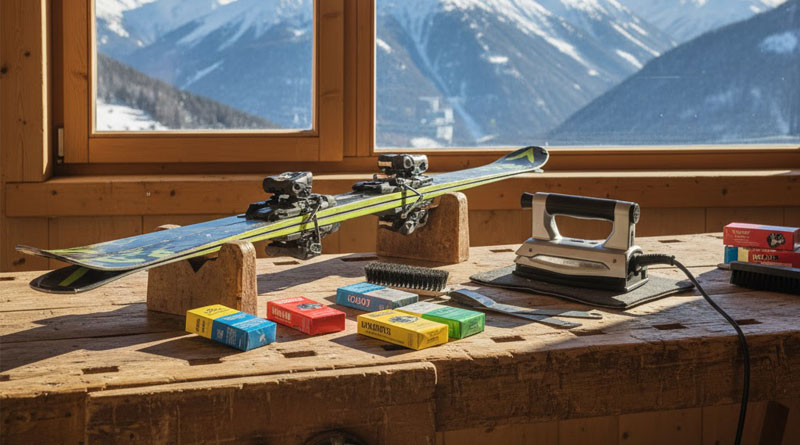
Hot waxing is the traditional, gold-standard method for long-term base care. A dedicated waxing iron melts a solid wax bar onto the base. The heat opens the microscopic pores of the sintered polyethylene base, allowing the liquid wax to penetrate deeply into the structure.
- Process: Melt wax onto base, iron smooth, cool completely (20–30 minutes), scrape excess with a plastic scraper, and brush out structure with nylon/brass brushes.
- Durability: Excellent (3 to 7 full days of skiing).
- Base Protection: Maximum protection against drying out and thermal damage.
Liquid Spray-On Waxes
Modern fluoro-free liquid waxes have revolutionized ski preparation. These waxes use alcohol or fast-evaporating solvents to carry micronized wax particles into the upper layer of the base without requiring an iron.
- Process: Spray or rub liquid onto a clean base, allow to dry for 10–15 minutes, then buff lightly with a fleece or soft polished brush.
- Durability: Moderate to high (1 to 3 days of skiing).
- Convenience: High; ideal for hotel rooms, quick morning adjustments, or traveling without heavy tools.
Paste and Rub-On Waxes
Rub-on blocks and paste waxes offer instantaneous application directly on the trail or in the parking lot.
- Process: Rub directly onto the base from the container, then buff firmly into the base using an attached cork pad.
- Durability: Low (lasts a few runs up to half a day).
- Convenience: Maximum pocket portability for mid-day weather changes.
| Application Method | Durability | Performance Level | Required Equipment | Time Needed |
|---|---|---|---|---|
| Hot Iron Wax | High (3–7 Days) | Maximum | Iron, Scraper, Brushes, Vices | 30–45 Minutes |
| Liquid Spray | Moderate (1–3 Days) | High | Liquid Bottle, Buffing Pad/Brush | 10–15 Minutes |
| Paste / Rub-On | Low (0.5 Day) | Moderate | Wax Applicator Pad / Cork | 2–5 Minutes |
Matching Wax to Your Ski Base Type
Not all ski bases absorb wax equally. The manufacturing process of your base influences how often and what type of wax you should apply.
Extruded Bases
Extruded bases are manufactured by melting polyethylene pellets and forcing them through a die sheet. This produces a smooth, low-cost, durable base with low porosity.
- Wax Absorption: Minimal; liquid and rub-on waxes or universal hot waxes work fine.
- Maintenance Need: Low. While extruded bases still benefit from wax, they will not dry out or suffer damage as quickly as higher-end materials.
Sintered Bases
Sintered bases are created by compressing high-density polyethylene powder under extreme pressure and heat. This process leaves microscopic voids and pores throughout the base matrix.
- Wax Absorption: Very High; sintered bases act like a rigid sponge, soaking up hot wax deeply into the base material.
- Maintenance Need: High. Sintered bases must be hot waxed regularly. If neglected, friction will oxidize the surface, turning the base grey, chalky, and sluggish.
How to Choose the Right Ski Wax: A Step-by-Step Decision Checklist
When standing in a ski shop or preparing your workshop bench, follow this step-by-step checklist to lock in the perfect wax choice for your outing:
- Identify Your Ski Type and Base: Determine if you need glide wax (Alpine, Snowboard, Skate) or grip wax (Classic Nordic). Check if your base is sintered (requires frequent hot waxing) or extruded.
- Check the Forecast: Look up expected snow temperatures and air temperatures for the specific elevation where you will be skiing. Pay attention to ambient humidity and sun exposure.
- Assess Snow Age and Origin: Is it fresh powder, firm groomed corduroy, artificial snow, or late-season wet slush? Select hard waxes for sharp or artificial crystals, and softer, hydrophobic waxes for old, wet snow.
- Pick the Color Category: Select Green for severe cold (< -12°C), Blue for cold mid-winter (-12°C to -4°C), Red for general conditions (-4°C to 0°C), and Yellow for warm spring slush (> 0°C). If temperatures fluctuate wildly, choose a Universal formulation.
- Select the Application Method: Use hot waxing at home for deep base conditioning and long durability. Use liquid sprays for quick mid-trip maintenance, or rub-on pastes for emergency pocket adjustments on the mountain.
Conclusion and Final Maintenance Tips
Choosing the correct ski wax does not require an advanced degree in chemistry. By paying attention to snow temperature, crystal abrasive qualities, and your base material, you can select a wax setup that delivers effortless glide and smooth turns. For general recreational skiing, maintaining a bar of universal hot wax or medium-range blue/red hydrocarbon wax, supplemented by a convenient liquid spray, will keep your gear performing smoothly across 90 percent of winter conditions.
Remember that even the best wax cannot perform on a dirty base. Always clean your ski bases with a soft brush or base cleaner prior to waxing, scrape and brush thoroughly after hot waxing, and store your equipment in a dry environment with a protective coat of storage wax during the summer off-season.