Best Snowboard Waxes of 2026
Keeping your snowboard fast and smooth on the slopes starts with the right wax. The best snowboard wax helps reduce friction, improves glide, and protects your base from damage caused by snow and ice. Whether you ride in powder, park, or icy conditions, using a good wax can make a big difference in performance and control. In this guide, we’ll look at some of the best snowboard waxes available today to help you find the perfect one for your riding style and conditions.
1. Demon Hyper

- Weight: 1.06 lb big block
- Origin: Made in Southern California, USA
- Formula: Proprietary premium blend
- Use: All seasons and snow conditions
Demon Hyper Wax is designed for riders who want a versatile hot wax that can perform across changing mountain conditions. Its proprietary blend is developed and manufactured in Southern California, giving the product a distinct identity and a formulation focused on speed. The 1.06-pound big block provides a substantial amount of wax, making it practical for repeated maintenance throughout the season. Its all-season positioning also makes it convenient for snowboarders and skiers who regularly encounter different temperatures and snow surfaces.
The wax emphasizes glide performance and includes a premium scent intended to make the waxing process more enjoyable. Because it is formulated for broad conditions, it can be a practical choice when you do not want to maintain several specialized waxes. The combination of a large block, USA manufacturing, and versatile application makes Demon Hyper an appealing option for frequent riders. However, riders seeking a temperature-specific racing wax may prefer a more specialized formulation tailored to particular snow conditions.
Pros:
- Large 1.06 lb block
- Designed for all seasons
- Made in the USA
- Premium blend and scent
Cons:
- Not temperature-specific
- May be more wax than occasional riders need
2. Hertel Super HotSauce

- Weight: 340 grams
- Temperature Range: 6°F to 52°F
- Application: Rub-on or iron-on
- Wax Type: All-temperature formulation
Hertel Super HotSauce is an all-temperature ski and snowboard wax designed to deliver consistent glide across a broad range of snow conditions. Its stated operating range of 6°F to 52°F makes it useful when temperatures vary throughout a season or during a single trip. The 340-gram package provides enough wax for multiple applications, while the formulation can be applied either by rubbing it directly onto the base or by using an iron for a more traditional hot-wax routine. Hertel also promotes the wax as a long-lasting option, with approximately three full days of riding possible from one ounce.
The wax is designed to interact with snow structure to provide smooth movement and control while helping reduce rider fatigue. Its broad temperature range makes it convenient for skiers and snowboarders who want one versatile product rather than several temperature-specific waxes. Hertel has been developing ski and snowboard wax since 1972 and describes Super HotSauce as part of that long-standing product history. Riders focused on highly specialized conditions may still prefer dedicated cold or warm waxes, but this formulation offers practical flexibility for general mountain use.
Pros:
- Wide 6°F to 52°F range
- 340-gram package
- Rub-on or iron-on application
- Suitable for skis and snowboards
Cons:
- Less specialized than temperature-specific wax
- Large package may not suit occasional users
3. Swix Universal

- Available Sizes: 60g or 180g bar
- Temperature: Universal, all temperatures
- Compatibility: Skis and snowboards
- Composition: Non-fluoro wax
Swix Universal is an everyday training wax developed for riders who need dependable glide and base protection across a variety of conditions. Its universal formulation is intended for all temperatures, making it a straightforward option for routine ski and snowboard maintenance. The wax is available in 60-gram and 180-gram bars, allowing users to select a size based on how frequently they wax and how much equipment they maintain. Its broad compatibility also means the same product can be used on both skis and snowboards.
The formulation emphasizes practical performance rather than highly specialized temperature targeting. Swix describes it as providing excellent gliding properties while helping protect the base, which makes it suitable for regular training and general mountain use. The non-fluoro composition is another notable specification for riders looking for a wax without fluorinated ingredients. While universal waxes can be convenient when conditions change, riders seeking maximum optimization for a very specific snow temperature may want a dedicated temperature-range product instead. Overall, Swix Universal is positioned as a simple maintenance wax for frequent use.
Pros:
- All-temperature formulation
- Available in two sizes
- Works on skis and snowboards
- Provides base protection
Cons:
- Less specialized for specific temperatures
- Training-oriented rather than highly specialized
4. IGOSKI Snowboard Wax

- Type: Universal ski and snowboard wax
- Temperature: All-temperature formulation
- Composition: Non-fluoro
- Application: Wax iron compatible
IGOSKI Snowboard Wax is a universal formulation designed for skiers and snowboarders who want a practical option for changing mountain conditions. Its all-temperature positioning makes it particularly useful when you are unsure which specialized wax is appropriate for the day’s snow. The wax is intended to provide good glide across most snow conditions and temperature ranges, making it suitable for routine preparation before heading to the mountain. Its compatibility with both skis and snowboards also gives it flexibility for households or riders maintaining different types of equipment.
The non-fluoro formulation is an important specification for users who prefer wax without fluorinated compounds. IGOSKI also identifies an appropriate wax-iron temperature, supporting conventional hot-wax application and helping riders integrate it into a standard waxing routine. As a universal product, it prioritizes convenience over highly targeted temperature performance. Riders who frequently encounter one specific snow condition and want maximum specialization may prefer a dedicated cold- or warm-weather formula. For general maintenance, however, the broad application range and straightforward formulation make IGOSKI a useful everyday option for snowboard and ski bases.
Pros:
- Universal temperature range
- Suitable for skis and snowboards
- Non-fluoro formulation
- Useful for changing conditions
Cons:
- Not specialized for exact temperatures
- Requires appropriate iron temperature for hot waxing
5. Dakine Nitrous

- Weight: 5.6 oz (160g)
- Base: 100% petroleum-based paraffin
- Application: Hot waxing or rub-on
- Options: Cold, Warm, or All Temp
Dakine Nitrous is a paraffin-based ski and snowboard wax designed for riders who want flexible application and condition-specific choices. The formula is made from 100% petroleum-based paraffin and is available in Cold, Warm, and All Temp versions. The Cold option is intended for temperatures below 20°F, while the Warm option is designed for temperatures above 26°F. The All Temp version provides a broader solution for changing snow conditions. At 5.6 ounces, or 160 grams, the package provides a useful quantity for repeated waxing without being excessively large.
Hot waxing is recommended for the best application, although the wax can also be rubbed on when convenience is more important. Dakine describes the blended formula as providing long-lasting speed across a variety of conditions. The PFC-free formulation is another notable feature for riders looking to avoid perfluorocarbons in their wax selection. The availability of different temperature formulations gives users more control over matching wax to conditions than a single universal product. However, riders must select the appropriate version for their expected temperatures, and maintaining multiple versions may be less convenient than using one all-temperature wax.
Pros:
- Available in cold, warm, and all-temp versions
- Hot or rub-on application
- 160g package
- PFC-free formulation
Cons:
- Temperature-specific versions require selection
- Petroleum-based formulation
6. Hertel Wax Rub N Go

- Form: Solid
- Weight: 70 g
- Application: Rub-on
- Use: Exterior ski and snowboard surfaces
Hertel Wax Rub N Go is designed for riders who want a fast and convenient waxing solution without the equipment and preparation associated with traditional hot waxing. The solid wax is made for direct application, making it particularly practical when you need to refresh your base during a day on the mountain. Hertel emphasizes durability, with the formula designed to leave a lasting coat that can remain effective through extended use. Its 70 g size also makes it compact enough to carry in a tuning kit or riding bag.
The biggest advantage of Rub N Go is its simplified application process. Hertel states that no corking or buffing is required, reducing the number of steps between applying the wax and getting back onto the slopes. This makes it useful for riders who prioritize convenience and fewer touch-ups during extended sessions. While a traditional hot wax may remain preferable for riders performing detailed workshop maintenance, Rub N Go is focused on quick field application. Its solid format, portable size, and durable coating make it a practical option for on-the-go ski and snowboard maintenance.
Pros:
- Quick and simple rub-on application
- No corking or buffing required
- Designed for lasting durability
- Portable 70 g size
Cons:
- Not intended as a traditional hot-wax routine
- 70 g provides less material than larger workshop blocks
7. mountainFLOW Snowboard Wax

- Ingredients: 100% plant-based
- Petroleum: 0%
- Size: 130 g bar
- Formula: Biodegradable and non-toxic
mountainFLOW Snowboard Wax is designed as an alternative to conventional petroleum-based ski and snowboard wax. The manufacturer states that the formulation uses 100% plant-based ingredients and contains zero petroleum. This construction is intended to reduce reliance on petroleum-derived materials while providing a functional waxing option for riders. The 130 g bar offers a practical amount for repeated applications and regular base maintenance throughout a riding season. Its biodegradable and non-toxic positioning also makes environmental considerations a central part of the product design.
Performance remains an important part of the formulation, with mountainFLOW stating that the wax performs as well as conventional petroleum-based ski wax based on controlled performance testing. The company also describes the product as wicked fast, emphasizing glide performance alongside its alternative composition. For riders interested in plant-based wax, this combination of performance claims and environmental characteristics provides a distinctive option. As with any manufacturer performance claim, actual results can vary according to snow conditions, base preparation, application technique, and equipment. Overall, the wax combines a 130 g format with plant-based, petroleum-free, biodegradable, and non-toxic characteristics.
Pros:
- 100% plant-based ingredients
- Contains no petroleum
- Biodegradable and non-toxic
- 130 g bar provides multiple applications
Cons:
- Performance claims are based on manufacturer testing
- May appeal primarily to riders seeking plant-based wax
See the mountainFLOW Snowboard Wax
8. Purl – Ski & Snowboard Wax

- Type: Purple Universal wax
- Application: Hot wax
- Iron Temperature: 265°F (130°C)
- Composition: Biodegradable microcrystalline petroleum
PURL Purple Universal Wax is an all-temperature ski and snowboard wax designed to provide consistent glide across a broad range of snow conditions. It is suitable for alpine skis, snowboards, touring skis, and cross-country skis, giving riders a versatile product for different equipment types. The formulation is made from biodegradable microcrystalline petroleum products and is designed to penetrate the base for durable coverage. PURL also states that the wax is designed to resist premature wear caused by friction, heat, and static while maintaining consistent glide during a day on the mountain.
Application is straightforward when using a ski or snowboard wax iron, with a recommended temperature of 265°F (130°C). The wax can be used independently for everyday maintenance or combined with PURL warm and cold waxes when changing conditions require more precise tuning. It is manufactured in the United States and is positioned as a biodegradable option that maintains durability and speed. Its broad compatibility makes it suitable for recreational riders, racers, technicians, and other users who want one universal formulation. Riders seeking specialized temperature performance can supplement it with dedicated warm or cold waxes.
Pros:
- All-temperature formulation
- Biodegradable composition
- Made in the USA
- Suitable for multiple ski and snowboard types
Cons:
- Requires an iron for hot-wax application
- Specialized conditions may require additional temperature-specific wax
See the Purl – Ski & Snowboard Wax
9. Hertel Racing FC739

- Temperature Range: 6°F to 52°F
- Application: Hot wax
- Formula: Fluoro-free
- Origin: Made in the USA
Hertel Racing FC739 is an all-temperature ski and snowboard wax designed for riders who want extended performance between waxing sessions. Hertel states that riders can get up to seven full days on the slopes using only one ounce, making durability a central feature of the product. The universal formulation covers a temperature range of 6°F to 52°F, allowing it to accommodate a broad variety of snow and weather conditions. It is designed for both skis and snowboards, making it suitable for riders maintaining different types of equipment.
The formulation is fluoro-free and is promoted as a sustainable option without sacrificing performance. Hertel describes the wax as providing smooth glide and control by interacting with snow structure, while its broad temperature range helps riders adapt to changing conditions. The brand has developed ski and snowboard wax products since 1972 and identifies FC739 as part of that history. The claimed seven-day longevity is manufacturer-provided, so actual durability can depend on snow conditions, riding frequency, base condition, and application technique. Overall, FC739 combines broad temperature coverage, a fluoro-free formula, and a focus on long-lasting use.
Pros:
- Wide 6°F to 52°F operating range
- Fluoro-free formulation
- Designed for extended use
- Suitable for skis and snowboards
Cons:
- Less specialized than dedicated temperature waxes
- Seven-day durability is a manufacturer claim
10. ZUMWax Rub-On

- Size: 70 g
- Application: Rub-on with attached cork
- Coverage: Universal, all conditions
- Formula: PTFE-free
ZUMWax Rub-On is designed for convenient waxing when riders need a quick solution without using an iron. The application involves rubbing the wax onto the base and then buffing it with the attached cork. Its push-up container is designed for easy on-hill application, allowing riders to carry it in a pocket or tuning kit and make quick adjustments during a day of skiing or snowboarding. The 70 g format is intended to last for many days of riding, providing a compact maintenance option.
The universal formula is designed for all conditions and is intended to enhance glide and overall ride feel. ZUMWax states that the product contains no PTFE and is hand-poured in Washington State. The rub-on formulation is based on the brand’s Iron-On Universal Wax but has been softened to make base penetration easier without an iron. This makes it particularly useful for riders prioritizing portability and convenience. Because it is a rub-on product, riders seeking a conventional deep hot-wax treatment may still prefer an iron-on formulation for workshop maintenance.
Pros:
- Easy on-hill application
- Includes attached cork
- PTFE-free formulation
- 70 g size is portable
Cons:
- Requires buffing with the included cork
- Not a replacement for traditional hot waxing in every situation
The Ultimate Guide to Choosing the Right Snowboard Wax
Snowboarding is an exhilarating winter sport, but your board’s performance on the mountain relies heavily on a element that is often overlooked: snowboard wax. Whether you are carving through fresh powder, gliding across groomed runs, or navigating slushy spring snow, the correct wax makes the difference between an effortless ride and a frustrating stick-and-jerk experience. Waxing your board reduces friction, improves control, protects the base from damage, and ensures maximum speed across all types of terrain.
Choosing the right snowboard wax requires an understanding of snow temperatures, snow crystal structures, base materials, and application methods. With dozens of formulations on the market—ranging from liquid quick waxes to temperature-specific hot waxes and eco-friendly alternatives—selecting the ideal product can seem overwhelming. This comprehensive guide breaks down everything you need to know about snowboard wax so you can make informed decisions and keep your ride smooth and fast all season long.
1. Introduction to Snowboard Waxing
To understand why choosing the right wax is critical, it helps to examine the friction dynamics between your snowboard base and the snow. Contrary to popular belief, a snowboard does not slide directly on ice or solid snow crystals. Instead, the friction generated by your moving board creates microscopic heat, melting the top layer of snow into a thin film of liquid water. Your snowboard actually glides on this microscopic water layer.
Friction and Water Film Management
The thickness of this microscopic water layer varies significantly based on snow temperature and humidity:
- Cold, Dry Snow: Generates very little meltwater. High friction occurs because dry snow crystals act like microscopic sandpaper, biting into the base of the board.
- Warm, Wet Snow: Creates too much water. High friction occurs due to suction—the excess water creates a vacuum effect between the board base and the snow surface.
Wax acts as a hydrophobic (water-repelling) barrier that regulates this interaction. A hard wax resists aggressive cold snow crystals, while a soft, water-repellent wax prevents suction in warm, wet conditions.
Base Protection and Longevity
In addition to speed and glide, wax serves as a primary protective shield for your snowboard’s base material. Snow crystals are abrasive. Riding an unwaxed board causes friction burn, manifested as dry, white, fibrous patches along the edges of the base (often referred to as base oxidation). Regular waxing hydrates the base material, prevents drying out, protects against physical abrasion from dirt and debris, and drastically extends the overall lifespan of your board.
2. Understanding Snowboard Base Types
Before selecting a wax formulation, you must understand your board’s base construction. Snowboard bases are primarily made from Polyethylene (PE), commonly known as Ultra-High-Molecular-Weight Polyethylene (UHMWPE) or by brand names like P-Tex. The two main manufacturing methods yield distinctly different base characteristics that directly impact wax absorption.
Extruded Bases
Extruded bases are created by melting polyethylene pellets and pushing (extruding) them through a die into a single sheet. This process results in a lower-density material with very few microscopic pores.
- Wax Absorption: Very low. Extruded bases do not absorb hot wax deep into the material matrix.
- Maintenance Requirements: Minimal. While they benefit from periodic waxing, they can run reasonably well without frequent treatment.
- Best Wax Options: All-temperature hot waxes or quick-apply liquid and paste waxes work well for extruded bases. Spending money on high-end specialty waxes for an extruded base yields diminishing returns.
Sintered Bases
Sintered bases are manufactured by compressing polyethylene powder under extreme heat and pressure without melting it completely. This creates a dense, highly durable base packed with microscopic pores and voids.
- Wax Absorption: High. Sintered bases act like a rigid sponge, holding significant amounts of wax within their porous structure.
- Maintenance Requirements: High. Sintered bases require regular hot waxing to perform correctly. If allowed to dry out, they lose speed dramatically and become vulnerable to damage.
- Best Wax Options: Temperature-specific hot waxes, graphite additives, and high-performance paraffin formulations maximize the potential of sintered bases.
3. Types of Snowboard Wax by Application Method
Snowboard waxes fall into two primary application categories: hot wax and quick-apply (rub-on or liquid) wax. Each serves a distinct purpose depending on your time constraints, equipment availability, and performance expectations.
Hot Wax (Iron-On Wax)
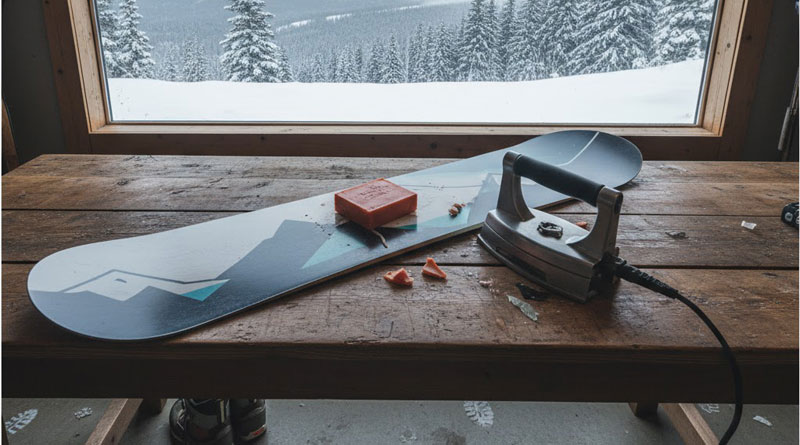
Hot waxing is the gold standard for snowboard maintenance. It involves melting solid wax blocks with a dedicated tuning iron, dripping the molten wax onto the base, spreading it evenly, letting it cool completely, and then scraping and brushing away the excess.
- Pros: Deep penetration into base pores (especially sintered bases), exceptional durability (lasts 3 to 6 riding days), optimal speed and hydration.
- Cons: Requires specific tools (iron, plastic scraper, horsehair/nylon brushes, tuning vise) and takes 20–30 minutes per board.
Quick Wax (Rub-On, Paste, and Spray/Liquid)
Quick waxes are designed for fast, on-the-go application without heat. They come as hard blocks rubbed directly onto the base, soft pastes applied with a foam applicator, or liquid sprays that dry in minutes.
- Pros: No heat or tools required, fast application (under 5 minutes), portable enough to carry in a jacket pocket for mid-day adjustments.
- Cons: Sits only on the surface of the base without penetrating pores; wears off quickly (usually within a few runs or half a day of riding).
4. Snowboard Wax Types by Temperature Rating
Snowboard wax formulations are categorized primarily by the ambient air and snow temperature ranges they are designed to handle. Using the correct temperature wax ensures optimal hardness and hydrophobic properties for the specific snow conditions of the day.
Cold / Hard Wax
Cold temperature waxes are formulated for ambient air temperatures dropping below 14°F (-10°C). Cold snow consists of sharp, un-melted, abrasive crystals that drag against soft base materials.
- Characteristics: Very dense and hard block consistency. High melting point during iron application.
- Function: Provides an ultra-hard protective barrier that resists the cutting action of sharp ice crystals while offering moderate water repellency.
All-Temperature / Universal Wax
All-temperature waxes are engineered to perform across a broad spectrum of temperatures, typically ranging from 12°F to 32°F (-11°C to 0°C). They represent the vast majority of consumer wax sales.
- Characteristics: Medium hardness formulation combining elements of cold and warm waxes.
- Function: Offers a dependable balance between hardness (crystal resistance) and water repellency. Ideal for recreational riders who travel to varied climates or do not want to change wax frequently.
Warm / Soft Wax
Warm temperature waxes are designed for conditions at or above freezing (32°F / 0°C and higher), frequently encountered during late spring riding or damp mid-winter days.
- Characteristics: Soft, pliable consistency with a lower melting point. Often contains high concentrations of water-repelling agents.
- Function: Breaks up suction created by excess free water on top of the snowpack, allowing the board to glide smoothly through wet slush.
5. Chemical Composition & Eco-Friendly Alternatives
Historically, snowboard waxes relied on paraffin wax derived from petroleum, supplemented by fluorocarbon additives to achieve maximum hydrophobic performance. However, recent environmental awareness and regulatory bans have fundamentally shifted the chemical landscape of snowsports tuning products.
Hydrocarbon Waxes
Standard hydrocarbon waxes are made from refined petroleum paraffin, microcrystalline waxes, and synthetic waxes. They contain no additives and serve as the baseline for non-fluoro tuning products.
- Performance: Excellent baseline glide in low-to-moderate humidity conditions. Very affordable and safe for home application.
- Best Use: Daily training, recreational riding, base cleaning, and storage wax.
The Fluorocarbon Ban and PFC-Free Alternatives
Per- and polyfluoroalkyl substances (PFAS / PFCs) were once the standard for high-performance racing waxes due to their unmatched water and oil dirt repellency. However, fluorocarbons do not break down in the environment, bioaccumulate in water systems, and pose serious health risks to humans and wildlife. As a result, major global organizations (including FIS) and regulatory bodies (such as the US EPA and European Chemicals Agency) have banned fluorinated waxes.
Modern performance waxes now utilize non-fluorinated (PFC-free) additives such as:
- Silicones: Enhance water repellency in wet snow without toxic bioaccumulation.
- Ceramic Nanoparticles: Increase surface durability and reduce friction against hard-packed ice.
- Zinc and Metal Oxides: Reduce static charge buildup in cold, dry powder conditions.
Plant-Based and Biodegradable Waxes
As sustainability becomes a priority for winter sports enthusiasts, bio-based waxes made from renewable resources like soy, seed oils, pine resin, and beeswax have proven that environmental responsibility does not require sacrificing performance.
- Environmental Impact: 100% biodegradable, petroleum-free, non-toxic runoff into mountain watersheds when snow melts in spring.
- Performance: Highly competitive with standard hydrocarbon waxes for recreational and all-mountain riding.
6. Comparative Summary of Snowboard Waxes
The following table provides a quick-reference overview comparing temperature ranges, snow conditions, wax characteristics, and recommended application scenarios:
| Wax Category | Air Temp Range | Snow Conditions | Wax Hardness | Primary Performance Goal |
|---|---|---|---|---|
| Cold / Sub-Zero | Below 14°F (< -10°C) | Dry powder, squeaky cold snow, sharp ice crystals | Very Hard | Resist sharp snow abrasions and prevent dry crystal friction |
| Mid-Temperature | 14°F to 28°F (-10°C to -2°C) | Standard packed powder, groomed runs, fresh snow | Medium-Hard | Optimal balance between glide, durability, and hydrophobic resistance |
| Warm / Slush | 28°F to 40°F+ (-2°C to 4°C+) | Wet snow, spring slush, melting mountain conditions | Soft | Repel high water volume and eliminate suction friction |
| All-Temperature | 10°F to 35°F (-12°C to 2°C) | Variable, changing, or unpredictable resort conditions | Medium | Provide versatile performance across diverse snow profiles |
| Graphite / Additive | Variable (Any Temp) | Dirty snow, spring melt runoff, high-static dry cold | Varies | Discharge static electricity and repel environmental dirt/oils |
7. Specialty Waxes and Additives
In specific snow conditions, standard hydrocarbon or all-temperature waxes may fall short. Specialty waxes incorporate additives to handle tough environmental factors like dirt pollution, static friction, and extreme humidity.
Graphite Wax
Graphite wax contains fine graphite powder blended into a hydrocarbon base. Graphite is electrically conductive, making it exceptionally effective at discharging static electricity generated when a board glides over snow at high speeds.
- When to Use: In extremely cold, dry snow (where static electricity builds rapidly) or in late-season spring snow where lift grease, pine needles, pollen, and dirt accumulate on the snow surface.
- Application Tip: Graphite wax can be applied purely, but it is often blended with a temperature-specific wax (e.g., 50% cold wax + 50% graphite wax) on sintered bases.
Base Cleaner Waxes (Soft Cleaning Waxes)
While chemical base cleaners (solvents) work well, frequent use can strip moisture from sintered bases. Cleaning waxes are very soft, low-melting-point paraffin blocks designed to flush out dirt through heat.
- Method: Iron the soft wax into the base, scrape it off immediately while it is still warm and liquid, and watch as it pulls trapped dirt out from the pores.
8. Step-by-Step Guide on Selecting the Right Wax for Your Conditions
Follow this systematic decision tree to select the perfect wax before heading up the mountain:
Step 1: Determine Your Base Type
Check whether your snowboard has an extruded or sintered base. Sintered bases warrant high-quality temperature-specific hot waxes, whereas extruded bases work sufficiently with all-temperature or rub-on options.
Step 2: Check the Weather Forecast
Look at the predicted air temperature, humidity level, and overall weather patterns for the resort elevation where you will be riding (not the valley floor temperature).
Step 3: Evaluate the Snow Pack Age and Structure
- Fresh Powder: Microscopic sharp edges require a slightly harder wax than the air temperature alone might suggest.
- Old, Transformed, or Groomed Snow: Rounded crystals cause less abrasion; focus more on temperature and moisture levels.
- Late Season Slush: Demands soft, water-repellent warm wax or graphite additives to prevent suction and dirt adhesion.
Step 4: Match to the Wax Matrix
- If temperatures are fluctuating wildly throughout the day: Choose an All-Temperature / Universal Wax.
- If conditions are consistently frigid (below 15°F): Choose a Cold / Hard Wax.
- If conditions are wet and slushy (above 30°F): Choose a Warm / Soft Wax.
9. Maintenance Schedule & Indicators for Re-Waxing
Knowing when to wax is just as important as choosing the right wax. Riding on a dry base degrades performance and accelerates permanent material wear.
Signs Your Snowboard Needs Waxing
- White Chalky Edges: Base material near the steel edges looks faded, dry, or fibrous.
- Loss of Glide: You find yourself flat-basing on cat tracks or light flats where you used to slide effortlessly.
- Suction Feeling: The board feels like it is sticking to the snow surface in warmer temperatures.
- Water Sheeting Instead of Beading: When you drop water onto your dry board base, it smears out flat rather than forming rounded droplets.
Recommended Waxing Schedule
- Hot Waxing Frequency: Every 3 to 5 days of active riding for sintered bases; every 6 to 8 days for extruded bases.
- Quick Wax Application: As needed between hot waxing sessions (e.g., during mid-day slush or multi-day trips without tuning equipment).
- End-of-Season Storage Wax: Before putting your board away for summer, apply a thick layer of soft hot wax over the base and steel edges, but do not scrape it off. This seals out moisture, prevents edge corrosion, and stops the base from drying out in storage.
10. Conclusion and Final Advice
Choosing the correct snowboard wax is a straightforward blend of understanding atmospheric conditions and base materials. For the vast majority of recreational riders, high-quality, PFC-free all-temperature wax or eco-friendly biodegradable options provide excellent speed, protection, and peace of mind across general mountain conditions.
However, if you ride in specialized climates—such as sub-zero midwinter powder or wet spring slush—investing in temperature-specific hot waxes and graphite additives will transform your board’s responsiveness, keep you gliding past flat spots, and protect your gear for years to come. Take the time to evaluate the snow, care for your base material, and enjoy a faster, smoother ride on the mountain.