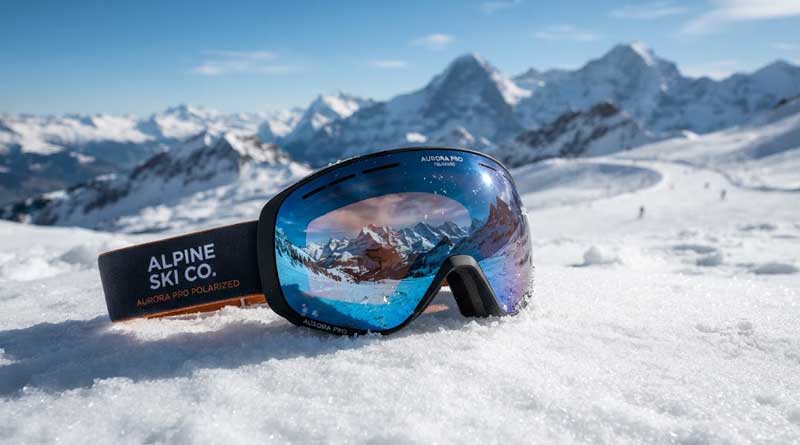
Best Polarized Ski Goggles of 2026
If you love skiing, you know how important it is to see clearly on the slopes. Bright sun and glare can make it hard to enjoy your run. That is where polarized ski goggles help. They cut down harsh light and protect your eyes. In this article, we will look at the best polarized ski goggles. We will share simple details to help you pick the right pair for your next ski trip.
1. Opolis Glacier View

- UV Protection: 100 percent
- Light Transmission: 17.8 percent / 60.2 percent
- Lens Shape: Cylindrical
- Polarized: Yes
From backcountry adventures to bluebird days, these Opolis snow goggles are built to perform reliably on any terrain. Their sleek profile is specifically engineered to fit smaller and medium faces extremely well without feeling bulky or obstructive. Designed for ultimate versatility, they make shifting between different weather conditions seamless.
Each pair comes equipped with two distinct lenses that are effortless to swap out when light conditions shift. With complete UV protection and a polarized cylindrical design, you get exceptional clarity and crisp vision all day long.
Pros:
- Includes extra lens
- Polarized protection
Cons:
- Not photochromic
- Best for smaller faces
2. COPOZZ Polarized Ski Goggles

- Lens Type: Spherical Double-Layer
- Coating: Italian Real Revo Mirror
- Compatibility: OTG and Helmet Compatible
- Ventilation: Two-Way Airflow System
Featuring a high-performance double-layer lens imported directly from Italy, these goggles deliver an unobstructed view across the slopes. The cool Revo mirror reflective coating offers full UV protection while shielding eyes from intense glare. A large frameless design ensures maximum peripheral vision during active snowboarding or skiing sessions.
Comfort is prioritized through multi-layer high-density foam that traps warmth while keeping harsh winds out. An extra-long elastic strap with non-slip silicone backing guarantees a secure fit over helmets for both adults and youth skiers.
Pros:
- Over-the-glasses design
- Frameless wide view
Cons:
- Replacement lenses sold separately
- Large frame profile
See the COPOZZ Polarized Ski Goggles
3. GoLight Anti-Glare OTG Goggles

- Lens Profile: Cylindrical Design
- Feature: OTG Compatible
- Coating: Multi-Layer Mirrored
- Visibility: Expanded Field of View
Designed with a refined cylindrical lens profile, these goggles focus on offering natural depth perception alongside extended side-to-side visibility. The wider field of view allows riders to scan mountain environments fluidly without distortion. It is an ideal companion for navigating variable snow conditions and treacherous mountain lines.
A multi-layer mirrored optical coating boosts contrast in shifting light conditions, allowing you to spot subtle changes in slope texture easily. The over-the-glasses build guarantees a comfortable fit for everyday winter sports enthusiasts who wear prescription eyewear.
Pros:
- Natural depth perception
- Enhanced terrain contrast
Cons:
- Single lens included
- Basic feature set
See the GoLight Anti-Glare OTG Goggles
4. JQF Gear Magnetic Ski Goggles
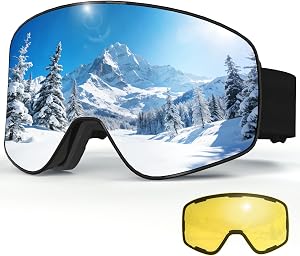
- Lens System: Magnetic Interchangeable
- Protection: UV400 Full REVO
- Frame Material: Flexible TPU
- Face Foam: Three-Layer Soft Sponge
These magnetic ski goggles make swapping lenses faster and easier than ever thanks to a powerful multi-point magnetic attachment system. The dual-layer full REVO lenses block harmful UV rays while integrated two-way ventilation prevents internal fogging during high-intensity runs. Flexible TPU frames maintain structural integrity even in extreme cold.
An integrated OTG cutout comfortably accommodates prescription glasses underneath. Furthermore, the adjustable non-slip strap features triple wavy silicone strips that grip helmet surfaces securely to prevent unwanted movement while riding aggressive terrain.
Pros:
- Rapid magnetic lens swap
- Durable flexible frame
Cons:
- Slightly heavier magnetic frame
- Bulky on smaller faces
See the JQF Gear Magnetic Ski Goggles
5. Opolis Alpin

- UV Protection: 100 percent
- Light Transmission: 10 percent / 26 percent
- Lens Shape: Cylindrical
- Polarized: Yes
Built for mountain endurance, the Opolis Alpin snow goggles deliver rugged functionality whether you are riding backcountry trails or taking the first morning chairlift. Their precise frame architecture integrates seamlessly with standard snow helmets to eliminate gaps and optimize airflow during fast descents down the slopes.
Featuring a cylindrical lens that provides a exceptionally broad field of view, these goggles keep your vision clear and unobstructed. They include an extra lens and feature polarized optical protection to guard against blinding alpine glare in all conditions.
Pros:
- Wide field of view
- Includes backup lens
Cons:
- Not photochromic
- Standard bridge fit only
6. Opolis Summit

- UV Protection: 100 percent
- Light Transmission: 7.5 percent / 21.5 percent
- Lens Shape: Cylindrical
- Polarized: Yes
The Opolis Summit snow goggles combine long-lasting durability with a comfortable, secure fit suited for long days on the slopes. Designed with an expansive cylindrical lens, they provide an extra-wide panoramic field of view so you can react quickly to downhill terrain and obstacles.
Equipped with 100 percent UV protection and a polarized finish, these goggles effectively eliminate glare in bright high-altitude environments. Every package includes two easily interchangeable lenses, making quick optical adjustments simple when low light or cloud cover rolls in.
Pros:
- Excellent low-light lens option
- Includes two lenses
Cons:
- Fixed cylindrical shape
- Medium size frame only
How to Choose Polarized Ski Goggles
Heading out onto snow-covered slopes demands optimal visual performance, clarity, and eye protection. White snow reflects up to eighty percent of incoming sunlight, making high-altitude solar glare one of the most blinding and hazardous obstacles alpine skiers and snowboarders encounter. While standard tinted lenses reduce overall brightness across the spectrum, polarized ski goggles are specifically engineered to cut through harsh reflected light, sharpen terrain contrast, and shield your eyes against damaging ultraviolet rays.
Selecting the ideal pair of polarized ski goggles involves navigating a variety of technical specifications, ranging from Visible Light Transmission percentages and physical lens geometry to frame architecture, ventilation systems, and helmet compatibility. This guide breaks down every factor you need to evaluate so you can make an informed decision for your winter sports needs.
Understanding Polarization and Slope Optics
To appreciate why polarized goggles are valuable for alpine athletes, it helps to understand the optical physics of reflected sunlight. Direct sunlight travels in electromagnetic waves vibrating across multiple planes. When horizontal light waves strike a flat, reflective surface such as wet snow, ice, or dense snowpacks, they bounce back aligned in a horizontal plane. This concentrated horizontal wave produces intense, blinding glare that degrades color contrast, causes severe eye fatigue, and temporarily impairs spatial perception.
Polarized lenses feature a microscopic vertical filter embedded within the lens material. This filter functions like a micro-grating, blocking horizontally polarized light waves while permitting vertical light rays to pass through. Consequently, harsh reflected glare is eliminated, resulting in superior visual clarity, richer depth perception, and decreased optical strain during long days on the mountain.
Advantages of Polarization on the Mountain
- Elimination of blinding surface glare reflected off bright snow fields and wet snowpacks.
- Significant reduction in eye strain, squinting, and fatigue during sunlit days.
- Enhanced color saturation and terrain contrast in high-luminosity environments.
- Comprehensive protection against ultraviolet A and ultraviolet B radiation.
Considerations and Trade-offs
- Polarized filters can make slick patches of blue ice harder to spot because ice relies on specular glare reflection to signal its presence to a moving skier.
- Digital screens, mobile phone displays, and electronic resort gate scanners may appear dark or show rainbow distortion when viewed through polarized filters.
Comparative Lens Technology Matrix
When shopping for winter eyewear, you will encounter multiple lens technologies. The table below compares polarized lenses against other common ski goggle lens options to clarify their relative strengths and ideal environments.
| Lens Technology | Primary Mechanism | Optimal Usage Scenario | Primary Limitation |
|---|---|---|---|
| Polarized | Blocks horizontal light waves to eliminate surface glare | Bright sunshine, high altitude, bluebird conditions | Slightly reduces contrast on icy patches |
| Standard Tinted | Reduces general light entry uniformly across the spectrum | Variable or mild overcast lighting conditions | Does not actively filter out horizontal reflected glare |
| Photochromic | Darkens or lightens automatically based on UV exposure | Rapidly changing weather throughout the day | Transition rate slows down in extreme cold weather |
| Contrast-Enhancing | Filters specific color wavelengths to boost terrain definition | Flat light, overcast skies, shadowed tree runs | May not eliminate intense glare without a polarized layer |
Visible Light Transmission and Lens Tints
Visible Light Transmission, abbreviated as VLT, is the measurement of how much ambient light passes through a goggle lens to reach your eyes. VLT is expressed as a percentage, ranging from under ten percent for intense alpine sun to over eighty percent for nighttime or heavy storm conditions. Choosing the right VLT rating ensures your eyes adapt comfortably to surrounding light levels.
Matching VLT Ranges to Atmospheric Conditions
| Category Standard | VLT Percentage Range | Recommended Lens Tints | Target Weather Environment |
|---|---|---|---|
| Category 4 | 3% to 8% VLT | Dark Gray, Black Mirror, Dark Bronze | High altitude, glacier skiing, intense unclouded sun |
| Category 3 | 9% to 18% VLT | Dark Copper, Gold Mirror, Deep Rose | Bright sunny days with minimal cloud cover |
| Category 2 | 19% to 43% VLT | Amber, Medium Rose, Violet Mirror | Partly cloudy skies, shifting light conditions |
| Category 1 | 44% to 80% VLT | Light Yellow, Light Rose, Light Blue | Heavy overcast, fog, flat light, snowfall |
| Category 0 | 81% to 100% VLT | Clear, Very Light Yellow | Night skiing, heavy dusk, artificial lighting |
If you ski in regions with changing weather patterns, consider goggle frames equipped with quick-change magnetic or mechanical retention systems. These allow you to swap between a low-VLT polarized lens for sunny mornings and a high-VLT tint when storm clouds roll in during the afternoon.
Lens Construction and Structural Geometry
The physical geometry of a goggle lens shapes your field of view, visual accuracy, optical distortion, and resistance to fogging. Ski goggle lenses are manufactured in three distinct structural shapes.
Cylindrical Lenses
Cylindrical lenses curve horizontally across your face from left to right while remaining vertically flat. This design offers a low-profile aesthetic and is generally more economical to produce. While functional, cylindrical lenses can create minor optical distortion near the upper and lower edges of your field of view, and their flatter profile offers slightly less interior volume for air circulation.
Spherical Lenses
Spherical lenses curve along both horizontal and vertical axes, mimicking the natural curvature of the human eye. This three-dimensional shape offers several optical advantages, including reduced optical distortion, an expanded peripheral field of vision, and less glare due to surface dispersal. Additionally, the increased volume inside the goggle cavity creates a larger air buffer that helps prevent condensation buildup.
Toric Lenses
Toric lenses combine elements of both cylindrical and spherical shapes. They curve along both axes, but with a tighter curve vertically than horizontally. This geometry delivers exceptional optical clarity and wide peripheral vision with less overall bulk than traditional spherical frames, balancing performance with a streamlined facial fit.
Frame Selection, Facial Ergonomics, and Fit
Even the most advanced polarized lens will fail to perform if the frame does not seal properly against your face. A proper seal prevents cold wind leaks, keeps snow out, and maintains internal air temperature.
Frame Sizing Categories
- Small Frame Fit: Tailored for youth, adolescents, or adults with narrower facial structures.
- Medium Frame Fit: The universal baseline size accommodating the majority of adult facial dimensions.
- Large or Oversized Frame Fit: Designed for wider facial profiles, offering an expansive peripheral view.
- Low Bridge or Asian Fit: Feature additional foam padding around the nose bridge to prevent air gaps for individuals with flatter nose bridges or higher cheekbones.
- Over The Glasses or OTG Fit: Features side notches in the frame and extra depth in the lens cavity to comfortably fit over prescription spectacles.
Multi-Layer Face Foam
Quality ski goggles incorporate multi-layer face foam, often consisting of dual or triple densities. The dense outer foam layer attaches securely to the frame, the soft middle layer cushions impact and adapts to contours, and the hypoallergenic fleece layer sits directly against your skin to wick away perspiration. Ensure the foam creates continuous contact around your cheeks, temple, and forehead without pinching your nose airways.
Anti-Fog Mechanisms and Airflow Engineering
Goggle fogging occurs when warm, moist air inside the goggle meets the cold outer lens surface, causing water vapor to condense into microscopic droplets. Advanced polarized goggles combat fogging through several integrated technologies.
- Dual-Pane Thermal Barriers: Modern goggles feature two separate lens panes bonded together with a sealed air gap between them. This construction acts as insulation, reducing the temperature differential between interior and exterior surfaces.
- Hydrophilic Coating Treatments: Chemical treatments applied to the interior lens surface help break surface tension, preventing micro-droplets from forming into opaque fog layers.
- Perimeter Frame Venting: Directional vents at the top, sides, and bottom of the frame allow warm, moist air to escape while drawing cooler dry air through breathable foam filters.
Helmet Integration and Maintenance Protocols
Your goggles and helmet must function as a single protective unit. Inspect the interface carefully to ensure seamless integration.
Evaluating Helmet Compatibility
- Eliminate Forehead Gaps: Verify there is no open gap between the top rim of the goggle frame and the brim of your helmet to prevent cold wind exposure.
- Verify Pressure Balance: Ensure the helmet rim does not push the goggle frame down hard onto your nose bridge, restricting nasal breathing.
- Siliconized Strap Backing: Look for goggle straps featuring inner silicone wave beads that grip the helmet shell securely without slipping during movement.
- Articulating Outriggers: Frames with hinged strap outriggers allow the goggle frame to sit flush on your face even when wrapped around a wide helmet shell.
Care and Storage Guidelines
- Air dry wet goggles completely at room temperature; avoid placing them near direct heat sources such as radiators or stove vents.
- Never wipe the inner lens surface when wet, as wet anti-fog coatings are soft and easily damaged. Dab moisture gently with a clean microfiber pouch.
- Clean the outer lens using only purpose-made optical microfiber cloths to prevent scratching anti-reflective or mirror coatings.
- Store your goggles in a rigid protective case or breathable cloth bag when traveling to prevent frame deformation and lens scratching.
Step-by-Step Selection Process
Follow this practical decision sequence when purchasing your polarized ski goggles:
- Identify Primary Conditions: Assess whether you predominantly ski in bright, unclouded alpine environments where polarized Category 2 or 3 lenses excel.
- Determine Required Frame Size: Choose small, medium, large, Low Bridge, or OTG frame options based on your physical features or prescription requirements.
- Test with Helmet: Try on prospective goggles while wearing your personal ski helmet to ensure proper fit, comfort, and airflow alignment.
- Select Lens Geometry: Pick cylindrical lenses for value and classic styling, or spherical/toric lenses for maximum peripheral vision and distortion resistance.
- Evaluate Interchangeability: Decide if a quick-swap lens retention system fits your budget and skiing habits for multi-weather versatility.
Investing time in choosing the right polarized ski goggles guarantees better vision, improved comfort, and increased safety across every descent. By matching lens VLT, physical geometry, frame fit, and helmet integration to your individual riding style, you ensure crisp, glare-free vision throughout the winter season.