Best Rear-Entry Ski Boots of 2026
If you have a hard time bending over to buckle your ski boots, rear-entry boots can make life much easier. Instead of leaning forward, you simply step in and close the back. These boots are comfortable, warm, and quick to put on, making them great for beginners and older skiers. In this article, we’ll show you the best rear-entry ski boots and help you find the right pair for your feet and skiing style.
1. Nordica HF 100

- Last: 102 mm high volume
- Closure: HF Back Buckle monolock
- Shell: Easy Entry opens 40 degrees
- Fit: I.V.C. adjusts boot board +/- 4 mm
The Nordica HF 100 is built for skiers who value comfort without giving up on-hill performance. Its high volume rear entry design makes stepping in and out incredibly intuitive, almost like sliding into a favorite pair of slippers. The hands-free closure system and Primaloft insulated liner keep things warm and hassle-free, while the 102 mm last provides generous room for wider feet or those who prefer a relaxed fit.
On snow, the Double Axis Pivot delivers impressive lateral support and quick response, making turns easier and more stable. The Instep Volume Control lets you fine-tune the fit by adjusting the boot board height, which is a rare and useful feature in this category. It is an excellent choice for intermediate to advanced skiers seeking convenience and all-day comfort.
- Pros: Effortless entry and exit, warm liner, adjustable instep volume, strong lateral support
- Cons: High volume may be too roomy for narrow feet, rear entry has limited performance ceiling
2. Nordica HF 75 – Women’s

- Last: 102 mm medium-wide
- Closure: Hands-free Back Buckle
- Liner: 3D Performance Fit Primaloft
- Shell: PU Cuff and Shell with 5355 PU soles
The Nordica HF 75 W is designed to make skiing effortless for women who want comfort and convenience. The hands-free Back Buckle Closure lets you slide in and out without bending down or fiddling with traditional buckles, making every session start and end smoothly. The customizable liner and shell adapt to your foot shape, delivering a personal fit that boosts control and stability throughout the day.
With a women’s specific 3D Performance Fit Primaloft liner, this boot provides warmth, comfort, and lasting support. The medium-wide 102 mm last offers ample space without sacrificing responsiveness, making it ideal for all-day skiing. Durable PU construction and extra-grip soles add traction and reliability on any terrain, ensuring season after season of confident performance.
- Pros: Very easy on and off, warm Primaloft liner, women’s specific fit, durable soles
- Cons: Softer 75 flex limits aggressive skiing, medium-wide fit may not suit narrow feet
See the Nordica HF 75 – Women’s
3. Nordica HF 120

- Last: 102 mm high volume
- Closure: HF Back Buckle monolock
- Liner: 3D Custom Cork
- Power: Power Driver strap
The Nordica HF 120 is the highest performance model in the HF rear entry lineup, aimed at advanced skiers who still want hands-free convenience. The high volume 102 mm last and Easy Entry Shell that opens 40 degrees make stepping in remarkably simple, while the Primaloft insulated liner keeps feet warm. The HF Back Buckle Closure system is intuitive and can be opened with a ski pole, so you never have to bend over.
What sets the HF 120 apart is its 3D Custom Cork Liner, which uses natural cork at the heel for excellent lateral transmission, thermal insulation, and customizable fit. The Power Driver strap wraps the upper leg to ensure powerful energy transfer and distribution. The result is a rear entry boot that delivers near-overlap performance with unmatched convenience for strong intermediate to expert skiers.
- Pros: Powerful 120 flex, cork liner enhances fit and warmth, strong power transmission, easy entry
- Cons: High volume fit is not for narrow feet, heavier than some overlap boots
4. Nordica HF 110

- Last: 102 mm high volume
- Closure: HF Back Buckle monolock
- Liner: 3D Custom Cork
- Pivot: Double Axis Pivot
The Nordica HF 110 strikes a balance between the comfort-focused HF 100 and the more powerful HF 120. It shares the same high volume 102 mm last, Easy Entry Shell that opens 40 degrees, and hands-free HF Back Buckle Closure, so getting in and out is incredibly easy. The Primaloft insulated liner adds warmth, while the 3D Custom Cork Liner provides lateral transmission and thermal insulation with a customizable fit.
The Double Axis Pivot aligns the cuff and shell for excellent lateral support and immediate ski response, giving you easier turns, more stability, and confident control. With a 110 flex, this boot suits intermediate to advanced skiers who want a versatile, comfortable ride. It is a smart choice for those who prioritize convenience but still demand solid on-hill performance.
- Pros: Balanced 110 flex, cork liner for fit and warmth, excellent lateral support, easy entry
- Cons: High volume may overwhelm narrow feet, not as powerful as the HF 120
5. Atomic Nexus 120

- Last: 101 mm medium width / HV
- Closure: BOA H+i1 Single Pull
- Liner: Mimic heat-moldable
- Construction: NexStep easy-entry cuff
The Atomic Nexus 120 combines overlap boot performance with easy entry convenience. Its NexStep Construction pairs a performance overlap design with an easy-entry cuff, so stepping in and out is effortless. The BOA H+i1 Single Pull system offers improved shell wrapping with bi-directional micro adjustments, letting you dial in a precise fit quickly and easily.
The Mimic liner uses special heat-moldable plastics in the heel and ankle areas to mimic your anatomy, while Memory Fit technology reshapes the plastic cuff and shell to your leg and foot shape. With a 101 mm last that blends medium width and higher volume, the Nexus 120 maximizes ease of entry and exit without sacrificing a 120 flex performance. It is a great option for advanced skiers wanting convenience and a customizable fit.
- Pros: BOA closure is fast and precise, Memory Fit and Mimic liner customize well, easy entry, strong 120 flex
- Cons: Not a true rear entry, heat molding requires a shop visit, medium width may not fit very wide feet
6. Roxa Rezon 100

- Last: 102 mm high volume
- Flex: 100 medium
- Closure: Radial Closure with Autodrive
- Liner: EZ Fit U75 heat moldable Ultralon EVA
The Roxa Rezon 100 is part of Roxa’s revolutionary Rezon Series, featuring AUTODRIVE architecture for versatile, hassle-free, and comfortable all-day skiing. The EZ Access Cuff makes entry and exit effortless, while the 102 mm high volume last provides generous room. A 100 flex targets intermediate to advanced all mountain skiers who want a balance of comfort and control.
The EZ Fit U75 heat moldable Ultralon EVA based liner can be customized for a precise fit, and the moldable shell further enhances comfort. GripWalk soles improve walking traction, and the Radial Closure with Autodrive secures the foot efficiently. Quick Entry and easy exit make this boot a joy for skiers who value convenience, while the medium flex delivers reliable performance across varied terrain. It is a strong value for those seeking a modern rear entry design.
- Pros: Quick entry and exit, heat moldable liner and shell, GripWalk soles, comfortable high volume fit
- Cons: 100 flex may be soft for aggressive experts, brand support and availability are more limited
7. Nordica HF 85 – Women’s
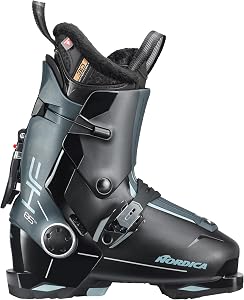
- Last: 102 mm high volume
- Closure: HF Back Buckle monolock
- Liner: 3D Custom Cork
- Pivot: Double Axis Pivot
The Nordica HF 85 W brings the convenience of the HF rear entry line to women skiers who want a slightly firmer flex than the HF 75. The high volume 102 mm last and Easy Entry Shell that opens 40 degrees make stepping in and out effortless, while the hands-free Back Buckle Closure can be operated with a ski pole so you never have to bend over.
The 3D Custom Cork Liner uses natural cork at the heel for lateral transmission, thermal insulation, and easy customization. The Double Axis Pivot provides excellent lateral support and immediate ski response, delivering easier turns, more stability, and better control. With an 85 flex, this boot suits intermediate women skiers seeking comfort, warmth, and reliable performance in a convenient package.
- Pros: Hands-free entry, warm cork liner, good lateral support, women’s specific design
- Cons: 85 flex limits expert-level skiing, high volume fit may be too roomy for narrow feet
See the Nordica HF 85 – Women’s
8. Nordica HF Pro 95 – Women’s

- Last: 100 mm mid volume
- Closure: HF Pro wired cable buckle
- Cuff: Adjustable Cuff Profile up to 8 mm
- Liner: Anatomical Primaloft
The Nordica HF Pro 95 W is a premium women’s rear entry boot that blends control, confidence, and convenience. Its mid volume 100 mm last and Tri Force shell technology provide a more precise fit than the standard HF line, while the anatomical Primaloft liner keeps feet warm. The HF Pro Closure System is incredibly easy to operate, boosting stability and control with every step in.
The wired cable buckle allows micro adjustments that are retained each time you step into the boots, and the HF Pro Adjustable Cable Length fits a variety of foot and lower leg shapes. Skiers with high volume calves will appreciate the Adjustable Cuff Profile, which increases upper cuff circumference by up to 8 mm. With a 95 flex, this boot suits intermediate to advanced women seeking a refined, customizable rear entry option.
- Pros: Mid volume fit is more precise, adjustable cuff for larger calves, retained micro adjustments
- Cons: Higher price than standard HF models, 95 flex may be limiting for aggressive experts
See the Nordica HF Pro 95 – Women’s
How to Choose Rear-Entry Ski Boots
Rear-entry ski boots have made a significant comeback in recent years, offering skiers a compelling blend of convenience and comfort that traditional overlap boots struggle to match. Once dismissed as a compromise on performance, modern rear-entry designs from brands like Nordica and Roxa have redefined what this category can achieve. If you’re tired of wrestling with buckles in the cold or bending over to loosen your boots at the end of the day, a rear-entry boot might be exactly what you need. This guide will walk you through everything you should consider before making a purchase.
What Are Rear-Entry Ski Boots?
Rear-entry ski boots are designed with an opening at the back of the boot rather than the front. Instead of stepping into the shell and closing overlapping flaps with multiple buckles, you slide your foot in from behind, much like putting on a slipper. The rear flap or cuff then closes and secures your foot and lower leg. This design was pioneered by Salomon in the late 1970s and gained widespread popularity in the 1980s and 1990s before falling out of favor as overlap boots became the standard for performance.
Early rear-entry boots earned a reputation for poor stance and limited control, but the latest generation has largely overcome those issues. Modern rear-entry boots use advanced shell materials, customizable liners, and sophisticated closure systems to deliver a fit and performance that rivals traditional designs. Nordica’s HF series, for example, combines a hands-free back buckle closure with a 40-degree opening shell that makes entry effortless while still providing strong lateral support through features like the Double Axis Pivot.
Why Choose Rear-Entry Over Traditional Boots?
The primary appeal of rear-entry boots is convenience. If you have limited flexibility, struggle with cold hands, or simply value ease of use, a rear-entry design can transform your skiing experience. The hands-free closure systems found on many modern models allow you to step in and lock the boot by simply pressing down with your foot or using a ski pole, eliminating the need to bend over entirely.
Comfort is another major advantage. Rear-entry boots typically feature a high-volume fit with generous space across the forefoot and instep. For skiers with wider feet or high insteps, this can mean the difference between an enjoyable day on the mountain and one spent dealing with pressure points. The Nordica HF line uses a 102mm last across most models, placing them firmly in the high-volume category.
Finally, modern rear-entry boots have closed the performance gap considerably. Features like customizable cork liners, adjustable instep volume, and rigid rear covers that lock against the cuff have made these boots capable of driving wider skis with confidence. The goal of modern rear-entry design is to combine the sporting advantages of traditional shoes with the comfort advantages of rear entry shoes.
Key Factors to Consider
Last Width and Volume
The last is the internal width of the boot across the forefoot, measured in millimeters. Getting this right is arguably the single most important factor in boot selection. A boot that is too narrow will cause pain and numbness; one that is too wide will allow your foot to move, reducing control.
Most rear-entry boots are designed for medium to high-volume feet. Here is a general guide:
- Narrow feet: 97–100mm last
- Average width: 100–102mm last
- Wide feet: 102mm or wider
Nordica’s HF series uses a 102mm last on the HF 75, HF 85, HF 100, HF 110, and HF 120 models, while the HF Pro 95 uses a slightly narrower 100mm last. Roxa’s Rezon 100 also uses a 102mm last. If you have an exceptionally wide foot, you may need to look at boots with a 103mm or 104mm last, though these are less common in the rear-entry category.
It is important to note that width alone does not tell the whole story. Instep height—the space over the top of your foot—is a separate measurement that can affect fit just as much. Some boots, like the Nordica HF, offer Instep Volume Control (I.V.C.), which allows you to raise or lower the boot board by up to 4mm to accommodate different instep heights.
Flex Index
Flex refers to how stiff the boot is when you lean forward. Higher numbers mean a stiffer boot with more direct energy transfer, while lower numbers indicate a softer, more forgiving feel. Flex ratings typically range from around 60 for beginner boots to 130 or more for expert racing models.
Choosing the right flex depends on your ability level, weight, and skiing style:
- Soft flex (70–90): Best for beginners, lighter skiers, and those who prioritize comfort over high-speed control
- Medium flex (100–110): A balanced blend of support and play, ideal for progressing intermediates and most all-mountain skiers
- Stiff flex (120+): Powerful and precise, suited to heavier, stronger, or expert skiers who ski fast and charge hard
In the rear-entry category, you will find options across the spectrum. The Nordica HF 75 W is a soft-flexing women’s model at 75, while the HF 120 offers a stiff 120 flex for advanced skiers. Roxa’s Rezon 100 sits in the middle with a medium 100 flex. Keep in mind that flex ratings are not standardized across brands, so a 100 from one manufacturer may feel different from a 100 from another.
Closure Systems
Rear-entry boots use a variety of closure mechanisms, and understanding the differences can help you choose the right one for your needs.
Traditional rear buckle: Many rear-entry boots use a single lever or buckle at the back of the boot. Nordica’s HF Back Buckle Closure is a monolock design that you simply push down with your foot to close. To open it, you can use your ski pole without bending over. This is the simplest and most intuitive system.
Cable systems: Some models, like the Nordica HF Pro, use a wired cable buckle that allows for micro adjustments. These adjustments are retained each time you step into the boots, so you can dial in your fit once and forget it. The HF Pro also features adjustable cable length to accommodate different foot and lower leg shapes.
BOA dial: While BOA is more commonly found on traditional overlap boots, some hybrid designs like the Atomic Nexus 120 use BOA for shell closure combined with an easy-entry cuff. BOA offers even pressure distribution and quick micro-adjustability, though it cannot replicate the independent zone adjustment of traditional buckles.
| Closure Type | Ease of Use | Adjustability | Best For |
|---|---|---|---|
| Rear Buckle (monolock) | Excellent – hands-free | Basic | Convenience-focused skiers |
| Cable System | Very Good | High – retains settings | Skiers wanting personalized fit |
| BOA Dial | Good | Precise but single-zone | Those prioritizing even pressure |
Liner Quality and Customization
The liner is the soft inner boot that provides warmth, cushioning, and fit. Many rear-entry boots come with heat-moldable liners that can be customized to your foot shape, either at home or by a boot fitter.
Nordica’s HF series uses a 3D Custom Cork Liner on several models. This liner incorporates natural cork at the heel surface, which provides excellent lateral transmission for ski control while also offering thermal insulation and easy customization. The HF 75 W uses a 3D Performance Fit Primaloft liner, which prioritizes warmth and comfort with a women’s specific design.
Roxa’s Rezon 100 features an EZ Fit U75 heat moldable Ultralon EVA based liner, which can be customized for a precise fit. The shell itself is also moldable, adding another layer of personalization.
If you have significant fit challenges—very wide feet, high insteps, or unusual foot shapes—look for boots with both a moldable shell and a moldable liner. This combination gives a boot fitter the most tools to work with.
Shell Design and Entry Mechanism
The way a rear-entry boot opens and closes has a significant impact on both convenience and performance. The best designs allow the rear flap to open widely for easy entry, then lock down firmly against the cuff for skiing.
Nordica’s HF Easy Entry Shell opens 40 degrees, which is enough to slide your foot in without resistance. The Double Axis Pivot on models like the HF 100, HF 110, HF 120, and HF 85 W ensures that the cuff and shell align properly when closed, providing unmatchable lateral support and immediate ski response.
The HF Pro 95 W takes a different approach with its Adjustable Cuff Profile, which allows skiers with high-volume calves to increase the upper cuff circumference by up to 8mm. This is a valuable feature for skiers who often find boot cuffs too tight around the calf.
Roxa’s Rezon series uses an AUTODRIVE architecture with a Radial Closure system. The EZ Access Cuff facilitates effortless entry and exit, while the closure system secures the foot efficiently for skiing.
Weight and Walking Ability
Rear-entry boots are not typically marketed for their lightweight properties, but weight can still be a consideration if you plan to walk in your boots or carry them. Most rear-entry models use PU (polyurethane) shells, which are durable and provide good performance but are not the lightest option available.
Many modern boots, including the Roxa Rezon 100 and Nordica HF models, come with GripWalk soles. These soles feature a rubberized tread that provides better traction on snow and ice when walking, and they are compatible with GripWalk-certified bindings. If you frequently walk from the parking lot or lodge to the lifts, this is a feature worth prioritizing.
Matching Rear-Entry Boots to Your Skiing
Your ability level should guide not just flex selection but also the overall features you prioritize.
Beginners and low-intermediate skiers will benefit most from softer flex boots like the Nordica HF 75 W (women’s) or a 90-flex model. These boots prioritize comfort, warmth, and ease of use above all else. The soft flex makes it easier to learn proper forward pressure without fighting the boot.
Intermediate skiers are well-served by medium-flex boots in the 100–110 range. The Nordica HF 100 and Roxa Rezon 100 both fit this category, offering a balance of comfort and control that supports skill development. Look for features like customizable liners and adjustable instep volume if you want to fine-tune the fit over time.
Advanced and expert skiers who still want rear-entry convenience should look at stiffer options like the Nordica HF 120 or HF 110. These boots feature more rigid shells, better power transmission through features like the Power Driver strap, and higher-quality liners with cork or other performance materials. The trade-off is that they are less forgiving and may require more technique to flex properly.
It is worth noting that even the stiffest rear-entry boots have some inherent limitations compared to top-tier overlap boots. The rear-entry design cannot match the precise, progressive flex of a well-fitted overlap boot, and aggressive skiers may notice a slight vagueness at high speeds. However, for the vast majority of recreational skiers, modern rear-entry boots provide more than enough performance.
The Importance of Professional Fitting
No matter how much research you do, the single most important step in choosing ski boots is getting professionally fitted. Ski boots are not like street shoes—they should fit snugly with your toes brushing the front when standing and pulling back slightly when you flex forward. Your heel should stay locked in place, and there should be no pressure points that cause pain or numbness.
A boot fitter can measure your foot length, width, and instep height, then recommend boots that match your measurements. They can also perform shell modifications, heat mold liners, and add custom footbeds to optimize the fit. Many shops offer a fit guarantee that includes unlimited adjustments for the life of the boot, which is valuable if you develop pressure points after a few days of skiing.
If you are considering rear-entry boots specifically, ask the fitter to let you try on several models with different closure systems. Pay attention to how easy it is to get in and out, how secure the heel feels when closed, and whether you can achieve a snug fit without excessive pressure. The best boot is the one that fits your foot and your skiing style, regardless of the category.
Final Thoughts
Rear-entry ski boots have evolved from a convenience-focused compromise into legitimate performance options for a wide range of skiers. With features like customizable cork liners, adjustable instep volume, and precision closure systems, today’s rear-entry boots offer comfort and control that would have seemed impossible in the 1980s.
When choosing your boots, prioritize fit above all else. Get professionally measured and fitted, and be honest with your boot fitter about your ability level, skiing goals, and any foot shape challenges you have. A well-fitted rear-entry boot will serve you better than an ill-fitting overlap boot every time.
For skiers who value convenience, warmth, and comfort—and who ski primarily on groomed runs and moderate terrain—a modern rear-entry boot is an excellent choice. The Nordica HF series and Roxa Rezon line offer strong options across a range of flex ratings and price points, and both brands have invested heavily in making rear-entry performance competitive with traditional designs.