Best Photochromic Ski Goggles of 2026
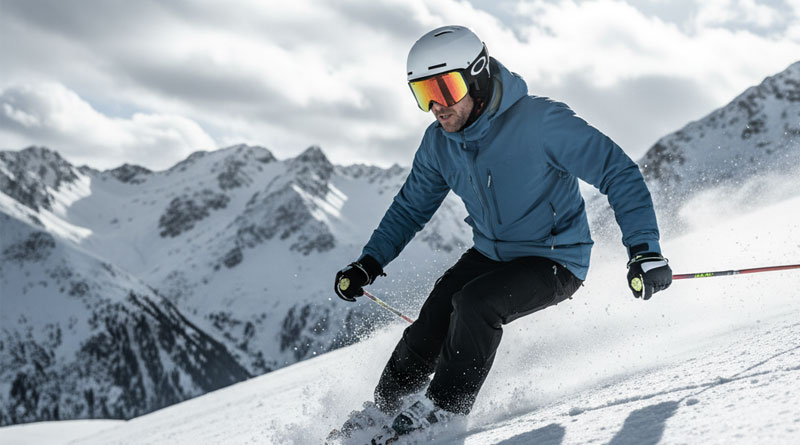
Skiing and snowboarding are exciting winter sports, but clear vision on the slopes is essential for both safety and fun. Changing weather and light conditions can make it difficult to see, which is why photochromic ski goggles are a smart choice. These goggles automatically adjust their tint depending on the light, giving you the right level of protection whether it’s sunny, cloudy, or snowy. In this guide, we review the best photochromic ski goggles to help you find the perfect pair for your winter adventures.
1. Smith I/O MAG XL ChromaPop Pro

- UV Protection: 100 percent
- Light Transmission: 16-55 percent / 55 percent
- Lens Shape: Spherical
- Frame Size: Medium/Large
The Smith I/O MAG XL ChromaPop Pro is built for skiers and riders who want maximum clarity across changing light. The photochromic ChromaPop lens shifts smoothly between overcast mornings and bright afternoons, keeping wind lips, landing zones and tree glades easy to read. The spherical shape mirrors natural eye curvature, reducing distortion and glare while widening peripheral vision, which is especially helpful on fast runs or in tight trees.
Fit is generous, made for medium to large faces, and the frame pairs well with most helmets thanks to a low-profile design. A bundled lens protector adds convenience for travel and storage. Interchangeable lenses mean you can swap for a second included lens for flat light or bluebird days, extending versatility beyond a single lens setup.
- Pros: Excellent clarity in variable light, wide peripheral vision from spherical lens
- Cons: Runs large, not ideal for smaller faces, premium price point
2. OutdoorMaster PRO
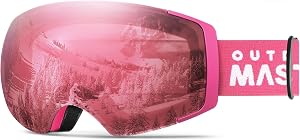
- UV Protection: 100% UV400
- Lens Design: Frameless spherical
- OTG Compatible: Yes
- Helmet Fit: Universal
The OutdoorMaster PRO ski goggles are built for riders who want solid performance without spending a premium price. The large frameless spherical lens delivers a wide, unobstructed view, helping you spot terrain changes and other riders with ease. All lenses feature anti-fog coating and full UV400 protection, making these goggles dependable for sunny days and reflective snow conditions. The interchangeable lens system allows you to adapt quickly to different weather, with over 20 lens options available separately.
Comfort and versatility are key strengths of the PRO model. The OTG design accommodates prescription glasses comfortably, making it a practical choice for many skiers and snowboarders. An extra-long elastic strap ensures secure helmet compatibility for adults and teens alike. The goggles feel lightweight on the face while still providing a stable seal during long sessions on the mountain. Included accessories such as a protective case and carrying pouch add value and make storage easy. Overall, the OutdoorMaster PRO offers impressive usability, wide compatibility, and dependable protection for recreational riders and frequent resort users.
- Pros: Affordable, wide field of view, OTG friendly
- Cons: Extra lenses sold separately, basic foam padding
3. Odoland Photochromic Ski Goggles
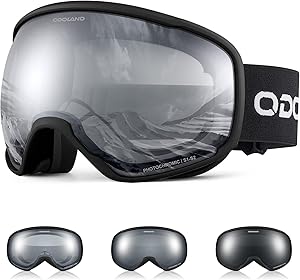
- UV Protection: 99.99% UVA/UVB
- Lens Type: Photochromic dual-layer
- OTG Compatible: Yes
- Foam Padding: Triple-density
The Odoland Photochromic Ski Goggles are designed for skiers and snowboarders who want simplicity and adaptability in changing light conditions. The photochromic lens automatically adjusts tint from sunny to cloudy environments, eliminating the need to swap lenses throughout the day. This makes them especially convenient for long sessions on the slopes. Dual-layer lens construction with an anti-fog coating and two-way ventilation helps maintain clear vision during intense activity.
Comfort is a strong focus of this model. The OTG design allows most standard glasses to fit comfortably underneath, while the adjustable silicone-backed strap ensures helmet compatibility and stability. Triple-density foam with a soft fleece liner cushions the face, blocks cold wind, and prevents pressure points during extended wear. The frameless design enhances peripheral vision and gives the goggles a modern look. Suitable for a wide range of winter sports, these goggles provide dependable eye protection, warmth, and clarity at an accessible price point.
- Pros: Photochromic convenience, comfortable fit, good UV protection
- Cons: Slower tint adjustment, average lens durability
4. LECAGE Ski Goggles

- UV Protection: 100% UV400
- Lens Response: Photochromic 5-second shift
- Lens Coating: F3 anti-fog
- Fit Type: Unisex helmet compatible
The LECAGE Ski Goggles are built for riders who want fast-reacting lens technology and a wide, confidence-inspiring view. The photochromic adaptive lens adjusts from clear to dark in about five seconds, ensuring optimal visibility from early morning runs to late afternoon descents. A frameless design delivers a panoramic field of view, reducing blind spots and improving awareness in crowded or technical terrain.
These goggles emphasize comfort and durability for long days on snow. Triple-layer face foam conforms smoothly to facial contours, minimizing pressure while maintaining a secure seal. The dual-layer lens with F3 anti-fog coating resists moisture buildup during high-output riding. Impact- and scratch-resistant construction improves longevity, while contrast-enhancing lens technology helps define snow texture and changing conditions. With a wide adjustable strap and included protective accessories, the LECAGE Ski Goggles are a practical and reliable option for skiing, snowboarding, and snowmobiling.
- Pros: Fast photochromic response, wide vision, comfortable foam
- Cons: Limited brand recognition, basic accessory set
5. Smith Moment

- UV Protection: 100 percent
- Light Transmission: 30-50 percent
- Lens Shape: Spherical
- Frame Size: Small
The Smith Moment is designed specifically for smaller faces, filling a gap many goggle lines leave unaddressed. Its sleek, low-volume frame sits close without feeling bulky, and the spherical ChromaPop lens delivers the same wide field of view and color clarity found in Smith’s larger models. The photochromic tint adapts automatically as clouds roll in or sun breaks through, so there’s less fumbling with lens swaps mid-run.
Peripheral vision stays strong thanks to the curved lens profile, and the frame remains helmet compatible despite its compact size. This makes the Moment a strong pick for younger riders, women with narrower faces, or anyone who has struggled with oversized goggles slipping or gapping. It’s a focused, well-executed goggle rather than a scaled-down afterthought.
- Pros: True small-face fit, Wide field of view for its size, reliable photochromic performance
- Cons: No stated additional lens included, limited to smaller frame sizes only
6. Atomic Savor L Photo

- UV Protection: 100 percent
- Light Transmission: Photochromic Red Photo: 53-13 percent
- Lens Shape: Cylindrical
- Frame Size: Large
Atomic’s Savor L Photo is an all-mountain goggle built around a refreshed frame design and a photochromic lens that reacts quickly to shifting light. The cylindrical lens shape keeps the profile lower than spherical alternatives while still offering solid coverage, and the automatic tint adjustment means fewer stops to change lenses when clouds move in or clear out over the course of a day.
The large frame is aimed squarely at broader faces, providing generous coverage without pressure points. It remains helmet compatible and eyewear compatible, so it works for riders who wear prescription glasses underneath. Interchangeable lenses add flexibility if conditions call for a different tint. Overall, it’s a practical, no-frills option for bigger-faced riders who want light-adaptive performance without the price tag of premium spherical goggles.
- Pros: Fast-reacting photochromic lens, great fit for larger faces
- Cons: Cylindrical lens gives less peripheral vision than spherical, not suited to smaller face shapes
7. Giro Article II

- UV Protection: 100 percent
- Light Transmission: Vivid Infrared Photo: 18-45 percent
- Lens Shape: Toric
- Frame Size: Medium
The Giro Article II stands out with its toric lens shape, a design that curves horizontally more than vertically, giving high-contrast, undistorted vision across a wide field of view. Paired with the Vivid Infrared photochromic lens, it darkens under strong sun and clears up quickly in flat or low light, making it a dependable choice from early season storms through spring corn snow.
Built for medium-sized faces, the frame stays comfortable over long days and remains compatible with both helmets and prescription eyewear. This versatility, combined with interchangeable lens capability, makes the Article II a solid all-season option for riders who spend time in variable mountain conditions and don’t want to carry multiple lenses for every possible weather scenario.
- Pros: Toric lens improves clarity and contrast, quick-reacting photochromic tech
- Cons: Medium fit only, no size range, Vivid Infrared tint may be too dark for very flat light
8. Rossignol Otava

- Light Transmission: Photochromic Blue: 10-80 percent
- Lens Shape: Cylindrical
- Frame Size: Medium
- Interchangeable Lenses: Yes
The Rossignol Otava leans on Hi-Trast technology to sharpen contrast and improve terrain visibility, a useful edge on flat-light days when snow definition disappears. Its photochromic blue lens covers an unusually wide transmission range, from 10 to 80 percent, letting it handle everything from bright bluebird skies to dim, snowy whiteouts without needing a lens swap partway through the day.
The antifog coating holds up well during high-output riding, and the medium-sized cylindrical frame fits a broad range of face shapes comfortably. It’s helmet and eyewear compatible, so it layers easily into existing gear setups. For riders who want one dependable lens that adjusts on its own across a full day on the mountain, the Otava is a versatile and budget-friendly contender.
- Pros: Very wide light transmission range, strong contrast-enhancing tech
- Cons: No stated UV protection figure, cylindrical shape limits peripheral view somewhat
9. KAPVOE Photochromic Ski Goggles

- UV Protection: 99.99 percent UV400
- Light Transmission: S1 to S4 adaptive range
- Lens System: 8-point magnetic, quick-swap
- Anti-Fog: Compound eye anti-fog technology
KAPVOE’s photochromic ski goggles combine an adaptive S1-S4 lens with a compound anti-fog system that uses microscopic surface texture alongside a moisture-absorbing inner layer, backed by honeycomb frame venting. The result is consistently clear vision whether you’re skiing indoors, at night, or under harsh midday sun, without the fogging issues that plague many budget goggles during high-exertion runs.
The X-VYSN coating boosts color and contrast, while an oleophobic layer resists smudging from gloves or snow spray. An 8-point magnetic lens system allows fast, glove-friendly lens changes, and the adjustable strap with anti-slip silicone keeps the goggles secure across most helmets. It’s a feature-dense option built for riders who want convenience alongside solid optical performance.
- Pros: Strong anti-fog engineering, fast magnetic lens swaps
- Cons: Lesser-known brand with less track record, lens shape and size specs not clearly listed
10. VOZAPOW Photochromic Goggles

- UV Protection: Blocks 99.9 percent UVA/UVB
- Lens: Double-layer PC, photochromic, one lens included
- Frame: Durable TPU with triple-layer foam
- Compatibility: OTG, fits glasses up to 5.5″ x 1.9″
The VOZAPOW Photochromic Goggles use a double-layer PC lens that automatically shifts from clear to dark based on UV intensity, backed by German-sourced lens technology for scratch and impact resistance. High-definition processing pushes image accuracy well above standard lenses, giving a notably crisp view of terrain even as light conditions change throughout a run.
Comfort comes from a TPU frame paired with three layers of skin-friendly foam that molds to different face shapes while promoting airflow to fight fogging. The ventilation system is designed to actively clear moisture during intense activity, and the OTG build accommodates most prescription glasses. An adjustable, non-slip strap keeps the fit secure across ski helmets, making this a comfortable all-day option for varied snow sports.
- Pros: Comfortable OTG-friendly design, high UVA/UVB protection
- Cons: Only one lens included, frame size and lens shape not specified
11. Julbo Lightyear
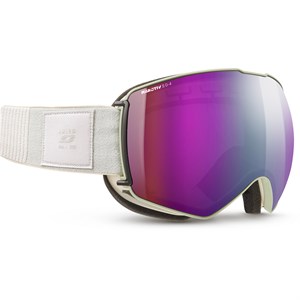
- Frame Size: Large
- Lens Type: REACTIV photochromic spherical
- Light Range: Cat. 1–4
- Ventilation: SuperFlow Pro
The Julbo Lightyear Goggles are built for big terrain and demanding conditions, delivering one of the widest fields of view in Julbo’s lineup. The large spherical REACTIV photochromic lens adapts automatically to changing light, covering everything from flat light to intense alpine sun without requiring a lens swap. Crafted from Trivex material, the lens offers near-glass optical quality with excellent impact resistance.
Fog management is a standout feature thanks to the SuperFlow Pro system, which allows the lens to hinge forward for instant ventilation even while wearing gloves. Integrated airflow channels further help manage moisture buildup during high-output riding. A frameless construction maximizes peripheral vision, while dual-density foam provides a comfortable seal against the face. Designed for riders who prioritize clarity and adaptability, the Lightyear excels in variable mountain conditions.
- Pros: Outstanding field of view, lifetime photochromic lens, premium optics
- Cons: Large fit only, higher weight than minimalist goggles
View at Backcountry View at Amazon
12. Julbo Razor Edge
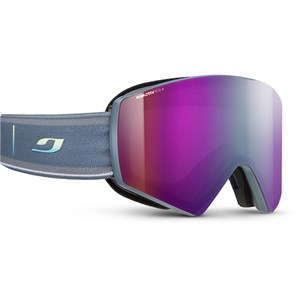
- Frame Size: Large
- Lens Type: REACTIV photochromic cylindrical
- Light Range: Cat. 0–4
- Helmet Compatible: Yes
The Julbo Razor Edge Goggles are built for riders who want zero interruptions on the mountain. The REACTIV photochromic cylindrical lens adapts instantly to changing light, eliminating the need to stop and swap lenses. Optical quality is exceptional thanks to Trivex construction, delivering clarity that rivals glass while maintaining strong impact resistance.
A frameless design maximizes field of view and gives the goggles a clean, modern look. Integrated ventilation and a durable anti-fog coating help maintain clear vision during active riding. Dual-density face foam ensures comfort throughout long sessions, while the extra-wide strap provides a secure fit with any helmet. The Razor Edge is a reliable choice for riders who value simplicity and all-conditions performance.
- Pros: No lens swapping needed, excellent clarity, wide field of view
- Cons: Cylindrical lens feel, limited style options
13. Atomic Four Pro L HD Photo
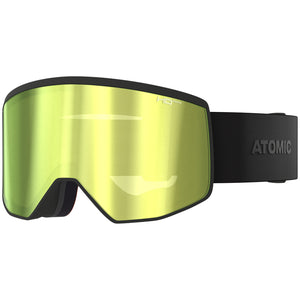
- Frame Size: Medium, OTG
- Lens Type: Cylindrical
- Helmet Compatible: Yes
- UV Protection: 100 percent
The Atomic Four Pro HD PHOTO Goggles blend eco-friendliness with elite performance. Featuring a photochromatic HD lens that changes automatically with variable light, these goggles ensure optimal vision throughout the day without requiring manual lens swaps. The wide view provided by the cylindrical double lens helps you conquer the slopes comfortably, regardless of changing weather patterns.
Designed to accommodate prescription glasses, the over-the-glasses construction provides a comfortable and pressure-free fit. Furthermore, the hydrophobic and anti-fog coatings guarantee that you will see clearly even in the midst of heavy powder mayhem. These goggles serve as a versatile all-in-one companion for your winter adventures.
- Pros: Automatic photochromic lens adjustment, over-the-glasses compatibility
- Cons: Cylindrical lens offers less peripheral distortion mitigation than spherical options
14. Zeal Lookout
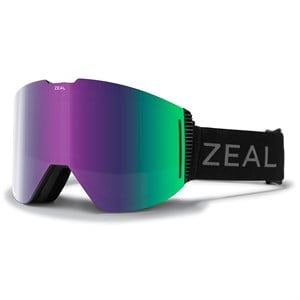
- Frame Size: Medium OTG
- Lens Type: Automatic+ polarized cylindrical
- Quick Lens Swap: Rail Lock System
- Helmet Compatible: Yes
The Zeal Lookout Goggles redefine peripheral awareness with Observation Deck Technology, increasing vertical field of view by 20 percent. The Automatic+ lens combines photochromic and polarized technologies, adjusting to light changes in real time while reducing glare and eye fatigue. Everclear anti-fog molecules are permanently infused into the lens, ensuring long-lasting fog resistance.
Designed with comfort and versatility in mind, the Lookout features triple-layer face foam and an OTG-friendly fit for riders who wear glasses. Upper and lower venting promotes airflow, while the Rail Lock System allows quick, secure lens changes when needed. With durable coatings and premium optics, the Lookout is a strong all-day option for riders seeking innovation and clarity.
- Pros: Excellent vertical visibility, polarized photochromic lens, OTG fit
- Cons: Heavier than minimalist designs, premium price point
View at Backcountry View at Amazon
How to Choose Photochromic Ski Goggles
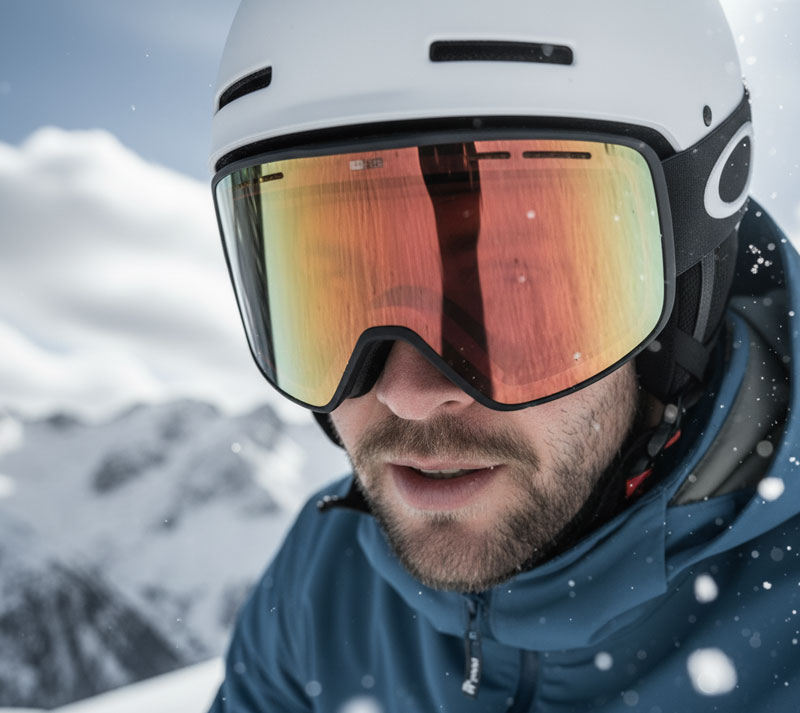
Choosing the right ski goggles is a crucial part of preparing for a day on the slopes. While there are many options available, photochromic ski goggles have become a popular choice for their ability to adapt to a wide range of light conditions. These “light-adaptive” lenses automatically darken in bright sunlight and lighten in overcast or low-light conditions, eliminating the need to carry and swap out multiple lenses. But with a variety of brands and features on the market, how do you choose the right pair? This comprehensive guide will walk you through the key factors to consider, ensuring you make an informed decision for your next ski adventure.
What Are Photochromic Goggles?
Before diving into the specifics of choosing a pair, it’s essential to understand the technology behind them. Photochromic lenses contain special molecules that react to ultraviolet (UV) light. When exposed to more intense UV rays, these molecules change shape and darken the lens. In the absence of UV light, such as on cloudy days or indoors, the molecules return to their original state, and the lens becomes lighter or clearer. This transition allows a single pair of goggles to perform well in both bright sun and low light, providing consistent eye protection and clarity.
The transition speed of these lenses varies between brands and models. Some high-end goggles can change tint in a matter of seconds, while others may take a minute or two. The effectiveness of the tint change is also tied to temperature; in colder weather, the lenses tend to get darker, while in extreme heat, they might not darken as much. This is a key consideration for skiers and snowboarders who often encounter a wide range of temperatures on the mountain.
Key Features to Consider
While the photochromic technology is the main draw, other features are just as important for comfort, safety, and performance. Here are the most critical factors to evaluate when shopping for your new goggles.
Lens Technology
Beyond the photochromic properties, the lens itself plays a significant role in your on-mountain experience. You’ll encounter a few different lens shapes and materials:
- Spherical vs. Cylindrical Lenses: Spherical lenses curve both horizontally and vertically, like a portion of a sphere. This shape provides a wider field of view, reduces glare, and minimizes optical distortion. Cylindrical lenses, on the other hand, curve horizontally but remain flat vertically. They are often more affordable but can have a slightly narrower field of view and may be more prone to glare.
- Optical Quality: High-quality lenses are made from materials like Trivex, which offers superior clarity and impact resistance compared to standard polycarbonate. Some brands also use proprietary technologies, like Smith’s ChromaPop or Atomic’s HD PHOTO, to enhance contrast and color. These technologies can make a big difference in your ability to see subtle details in the snow, like icy patches or moguls.
- Anti-Fog and Anti-Scratch Coatings: A good pair of goggles should have a durable anti-fog coating on the inner lens to prevent moisture buildup from your body heat. A scratch-resistant coating on the outer lens is also essential for longevity, protecting the lens from nicks and scrapes.
Frame and Fit
A well-fitting goggle is vital for comfort and performance. A poor fit can lead to cold spots, fogging, or pressure points that cause discomfort.
- Frame Size: Goggles come in different frame sizes, typically small, medium, and large. Choosing a size that matches your face shape is crucial. Larger frames offer a wider field of vision, but they might not fit smaller faces comfortably.
- Face Foam: The foam around the frame should be thick and comfortable, conforming to your face to create a seal that keeps out cold air and snow. Many high-end goggles use a triple-layer foam with a moisture-wicking fleece liner to provide a better fit and prevent sweating.
- Helmet Compatibility: Most modern goggles are designed to be helmet-compatible, but it’s always a good idea to check. The best goggles will have a design that integrates seamlessly with a helmet, creating a flush fit and ensuring proper ventilation to prevent the dreaded “gaper gap” and minimize fogging.
- OTG (Over The Glasses) Design: If you wear prescription glasses, look for goggles specifically designed with an OTG feature. These frames have extra grooves and space to accommodate your eyeglasses comfortably without putting pressure on your face.
Ventilation
Proper ventilation is the most important factor in preventing your goggles from fogging up. Skiing and snowboarding are high-energy activities, and your body heat can quickly cause condensation on the inside of the lens.
- Ventilation Systems: Look for goggles with strategic vents on the top and bottom of the frame. These vents are designed to allow a constant flow of air through the goggle, carrying away warm, moist air and replacing it with cooler, dry air.
- Integrated Systems: Brands like Smith and Julbo have developed ventilation systems that are designed to work in conjunction with their helmets. These integrated systems create a seamless pathway for air to flow from the goggles through the helmet’s vents, providing maximum fog prevention.
Strap and Adjustability
The goggle strap should be secure and comfortable, holding the goggles firmly in place without being too tight.
- Silicone-Backed Strap: A strap with a silicone strip on the inside is highly recommended. This strip provides a strong grip on your helmet, preventing the goggles from slipping out of place during active movement.
- Adjustment System: A good adjustment system, often with two-sided buckles, allows you to easily find the perfect fit. Some models also feature a quick-release or magnetic buckle for added convenience.
Brands and Models to Consider
The market for photochromic goggles is competitive, with many brands offering excellent options. Here are a few notable examples:
- Smith: Known for their innovative technology, Smith offers the 4D MAG ChromaPop goggles with a photochromic lens. The **BirdsEye Vision** feature provides an incredible field of view, and the **ChromaPop** technology delivers exceptional color and contrast.
- Julbo: A specialist in photochromic lenses, Julbo’s **REACTIV** technology is among the best on the market, known for its fast-acting transition and optical clarity. Models like the Julbo Razor Edge and Julbo Launcher are excellent examples of their high-performance offerings.
- Atomic: The Atomic Savor GT HD PHOTO goggles feature their unique **HD PHOTO** technology, which enhances clarity and contrast while adapting to light. The **Live Fit Frame** also provides an exceptionally comfortable and personalized fit.
Conclusion
Choosing the right photochromic ski goggles is about balancing advanced technology with practical features. By focusing on the lens quality, frame fit, and ventilation, you can find a pair that not only adapts to changing light conditions but also provides all-day comfort and crystal-clear vision. A good pair of photochromic goggles is a valuable investment that will enhance your safety and enjoyment on the mountain, allowing you to focus on the thrill of the ride, regardless of the weather.